
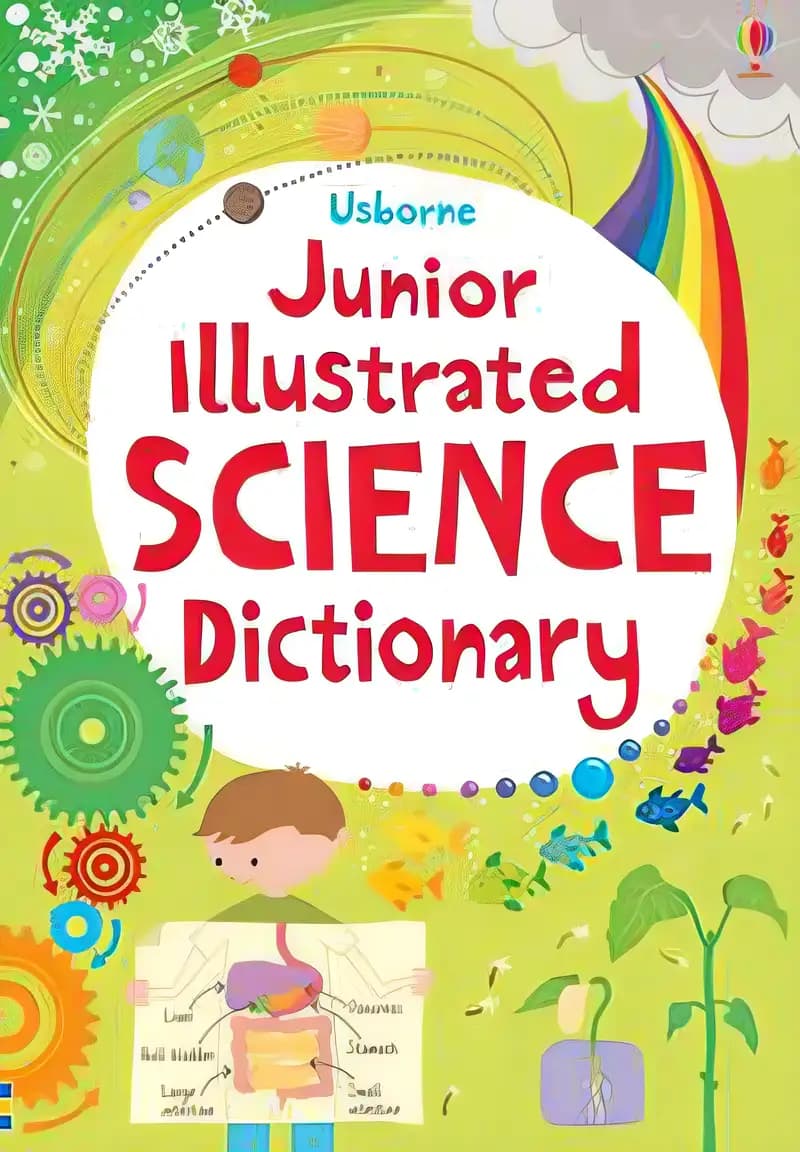
Junior Illustrated Science Dictionary
on Goodreads (31)
What’s inside...
Vibrant and straight-talking, this illustrated dictionary will help children develop firm foundations for confidence and success in science from UK Key Stage 2 onwards. Contains clear definitions of over 700 key terms and concepts, with hundreds of useful examples and illustrations. Readers can dip in for quick explanations or read through by subject to grasp the essentials. A perfect accompaniment to homework, and with links to recommended science websites for further information.
Why read this book
- Simplifies complex science terms for young minds.
- Colorful illustrations accompany clear, concise definitions.
- Encourages curiosity and exploration in science.
- Ideal for both home and classroom learning environments.
Age
7-12
Length
136 pages
Text complexity
Discussion points
What new scientific term did you learn today and what does it mean?
Can you think of an experiment we could do at home to demonstrate one of the concepts you read about?
How do you think science helps us in our daily lives?
Can you explain how one of the scientific gadgets illustrated works?
What’s the most surprising or exciting fact you’ve discovered in this dictionary?
Tip: Role play these questions
Encourage your child to articulate the definitions in their own words to reinforce understanding.
Relate scientific terms and concepts to everyday objects and occurrences to make the discussion more tangible and relatable.
Praise efforts to understand and explain, even if the answers aren't perfect, to foster a positive learning environment.
Use the book as a reference during practical activities like cooking, gardening, or simple experiments to bring the dictionary to life.
Ask follow-up questions that prompt deeper thinking and exploration beyond the content of the book.
Key lessons
Example Lesson: Curiosity and Exploration
Explanation: The 'Junior Illustrated Science Dictionary' introduces young readers to scientific concepts in an accessible and engaging way, stimulating their curiosity about the world around them.
Real-World Application: Children can apply this curiosity by exploring and asking questions about everyday phenomena, leading to a deeper understanding and appreciation of their environment.
Example Lesson: Critical Thinking
Explanation: This dictionary encourages children to think critically about scientific explanations and terminology, promoting a questioning mindset.
Real-World Application: Critical thinking skills can help children in problem solving and making informed decisions in various aspects of their lives, from school projects to social interactions.
Example Lesson: Vocabulary Expansion
Explanation: By presenting complex scientific terms with clear definitions and illustrations, the book aids in enhancing children’s vocabulary related to science.
Real-World Application: An expanded vocabulary can boost communication skills and confidence in academic settings, helping children articulate their thoughts more effectively.
Example Lesson: Appreciation for Science
Explanation: The dictionary format, coupled with illustrations, makes learning about science appealing and fun, fostering a positive attitude towards the subject.
Real-World Application: This appreciation can lead to greater interest in scientific subjects at school and potentially spark a lifelong interest in STEM fields.