
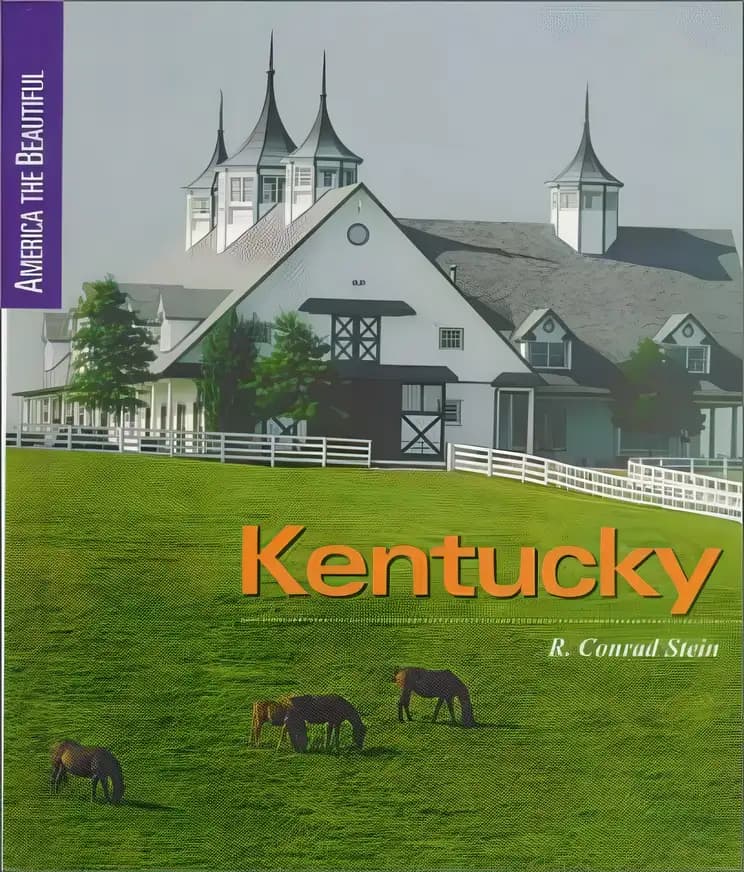
Kentucky
America the beautiful. Series
on Goodreads (5)
What’s inside...
Describes the geography, plants, animals, history, economy, language, religions, culture, sports, art, and people of the Bluegrass State.
Series reading
Non-Sequential
Age
10-12
Length
144 pages
Text complexity
Discussion points
What did you learn about the state of Kentucky from this book?
How does the history of Kentucky contribute to its unique culture today?
What parts of Kentucky's nature and wildlife are you most curious about?
How do the stories and events mentioned in the book make you feel about Kentucky?
If you could visit any place in Kentucky mentioned in the book, where would it be and why?
Tip: Role play these questions
Encourage your child to think critically by asking them what surprised them the most about Kentucky and why.
Connect the book to your child’s experiences by discussing any family memories or stories related to Kentucky or similar regions.
Use the book’s illustrations or descriptions to inspire imaginative thinking; ask your child to draw or describe their version of a perfect day in Kentucky.
Build empathy and understanding by discussing how different life might be in Kentucky compared to your own locality.
Foster curiosity by looking up more facts or images about Kentucky’s landmarks and wildlife mentioned in the book.
Key lessons
Example Lesson: Appreciating Diversity
Explanation: In 'Kentucky,' children are introduced to the diverse cultures and traditions of the state, from the Appalachian Mountains to the vibrant city life of Louisville.
Real-World Application: Children learn to appreciate and respect different cultures and backgrounds, which aids in developing empathy and social awareness in their daily interactions.
Example Lesson: Importance of History
Explanation: The book highlights historical landmarks and events in Kentucky, such as the creation of the Kentucky Derby and the significance of the Civil War battles fought on its soil.
Real-World Application: Understanding history helps children connect with their community and nation, fostering a sense of identity and continuity.
Example Lesson: Respect for Nature
Explanation: Kentucky's natural beauty, including the Cumberland Gap and Mammoth Cave, is vividly depicted, emphasizing the importance of conservation and environmental care.
Real-World Application: Children learn the value of preserving natural resources, which can lead to environmentally responsible behaviors like recycling and conserving water.
Example Lesson: Curiosity and Learning
Explanation: The book encourages exploration through its detailed descriptions of various Kentucky regions and their unique aspects.
Real-World Application: This lesson teaches children to be inquisitive and enthusiastic about learning, skills that are applicable in educational settings and personal growth.