
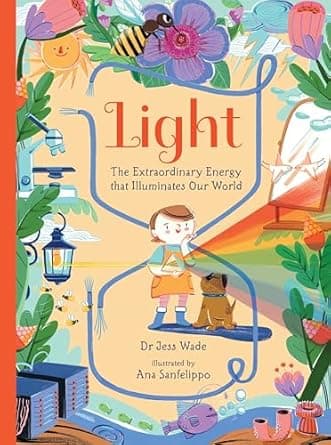
Light: The Extraordinary Energy That Illuminates Our World
Science Explorers (stand-alone titles) Series
illustrations by
What’s inside...
Physicist Jess Wade guides young readers on a dazzling tour of light, from the dawn of the universe to the screens in their pockets. Blending history, hands-on science, and real-world applications, the book explains how ancient thinkers puzzled over rainbows, how Newton and Maxwell changed our understanding of color and waves, and how today’s engineers use photons in everything from solar panels to fiber-optic cables. Engaging illustrations and clear experiments invite children to see, bend, and split light for themselves while discovering its role in art, medicine, and protecting the planet.
Series reading
Non-Sequential
Age
6-9
Length
32 pages
Text complexity
Discussion points
Why do rainbows always appear in the same color order?
How might life be different without artificial light?
Which light-based invention do you think changed the world most?
How can we use sunlight to help the planet?
Tip: Role play these questions
Compare household objects that emit light and classify them.
Recreate a mini-shadow play to explore opaque vs. translucent materials.
Key lessons
Example Lesson: Curiosity drives discovery
Explanation: Historical scientists asked bold questions about light.
Real-World Application: Kids learn to ask 'why' about everyday phenomena.
Example Lesson: Science is for everyone
Explanation: Book highlights diverse contributors to optics.
Real-World Application: Readers see themselves as future innovators.
Example Lesson: Safety and responsibility
Explanation: Sun-gazing warnings teach respectful experimentation.
Real-World Application: Children learn to take precautions during projects.
Example Lesson: Sustainable thinking
Explanation: Solar power section links light to green energy.
Real-World Application: Kids consider renewable choices at home and school.