
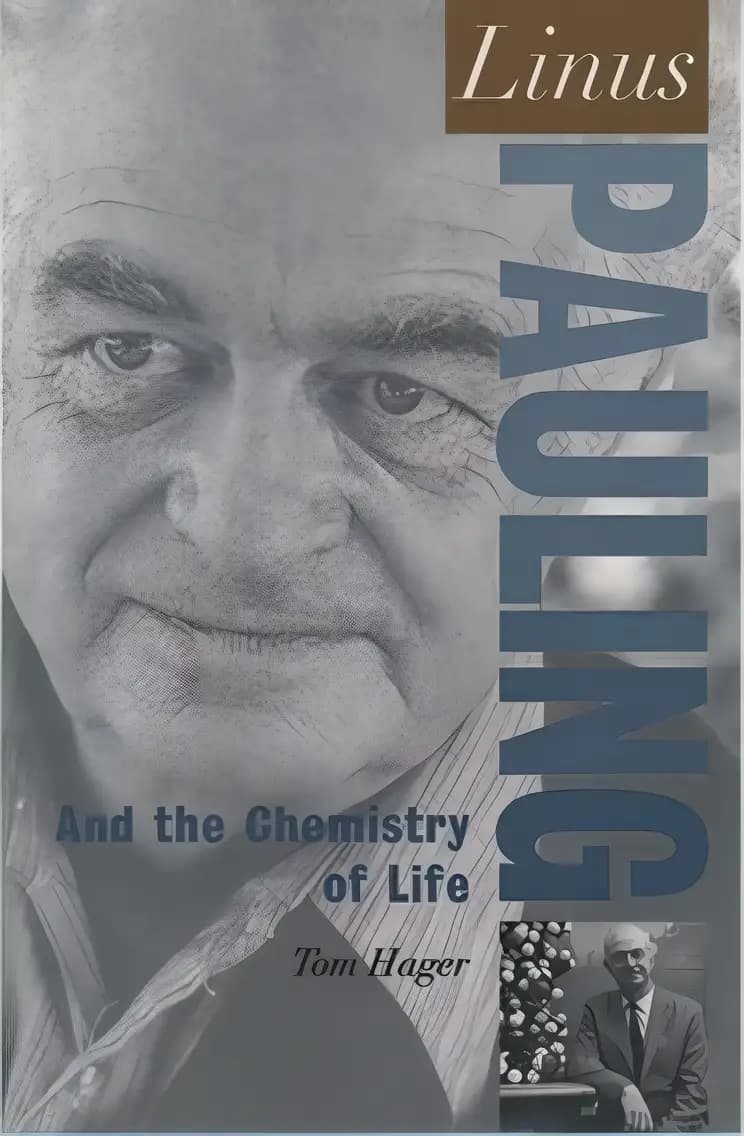
Linus Pauling: And the Chemistry of Life (Oxford Portraits in Science)
Oxford Portraits In Science Series
on Goodreads (37)
What’s inside...
Profiles the Nobel Prize-winning chemist who made important discoveries in the fields of quantum mechanics, immunology, and evolution, and used his scientific fame to help advance political causes. Linus Pauling was the most important chemist, and arguably the most important American scientist, of the 20th century. From his description of the chemical bond to his discovery of the cause of sickle-cell anemia and his groundbreaking work with vitamin C, his work leaped over the boundaries of disciplines, including chemistry, physics, biology, immunology, nuclear physics, and more. Now in this exciting new biography, acclaimed science writer Tom Hager brings Pauling's wide range of scientific accomplishments vividly to life while also shedding light on Pauling's activities outside the scientific realm. He shows how Pauling used his scientific fame to help advance political causes, particularly the battle against the spread of nuclear weapons during the 1950s. Despite the trouble his political activism caused him, he remained unmoved in his dedication to making the world a safer place. His perseverance was rewarded with a Nobel Peace Prize in 1963, making him the only person in history to win two unshared Nobels.
Series reading
Non-Sequential
Age
14-17
Length
144 pages
Text complexity
Character compass
Linus Pauling
Ava Helen Pauling
Discussion points
What do you think inspired Linus Pauling to become a scientist and explore chemistry?
How do you think Linus Pauling’s discoveries impact our daily lives?
What qualities do you believe are important for a scientist like Linus Pauling to possess?
If you could ask Linus Pauling one question about his work, what would it be?
What is one experiment or discovery mentioned in the book that you found particularly interesting or surprising?
Tip: Role play these questions
Prior to reading each chapter, ask your child what they know or think they know about chemistry and its importance.
While discussing the book, relate the scientific concepts to everyday life to make them more tangible for your child.
Encourage your child to think critically by asking them how they would approach different scientific challenges that Pauling faced.
Post-discussion, consider watching a documentary or conducting simple at-home experiments to further illustrate the book’s themes.
Celebrate your child’s curiosity by commending their questions and offering to explore the answers together beyond the book.
Key lessons
Example Lesson: Perseverance in pursuit of knowledge
Explanation: The book details Linus Pauling's relentless dedication to understanding the molecular world, showcasing his journey through challenges and breakthroughs.
Real-World Application: Children can learn the importance of staying curious and persistent in their studies or when exploring new hobbies, understanding that challenges are part of the learning process.
Example Lesson: The value of critical thinking
Explanation: Pauling's approach to scientific problems emphasizes the need to question established beliefs and think critically to find solutions.
Real-World Application: This can encourage children to question the world around them and not accept information at face value, promoting a more analytical approach to problem-solving.
Example Lesson: Cross-disciplinary learning
Explanation: Pauling's work spanned across multiple scientific disciplines, highlighting how integrating knowledge from various fields can lead to innovative outcomes.
Real-World Application: Students can be encouraged to see connections between different subjects they learn in school, such as how art can relate to science, fostering a more holistic understanding of the world.
Example Lesson: The impact of scientific research on society
Explanation: The book illustrates how Pauling's discoveries in chemistry had profound impacts on medicine and health, thereby demonstrating the societal benefits of scientific research.
Real-World Application: Children can be inspired to appreciate and possibly pursue science and research careers, understanding their potential to contribute positively to society.
Example Lesson: Ethical responsibility in science
Explanation: Pauling is also known for his advocacy for peace and his stance against nuclear weapons, showing his ethical commitment beyond the laboratory.
Real-World Application: This can teach children the importance of thinking ethically in any endeavor and using their own skills and knowledge for the greater good of society.