
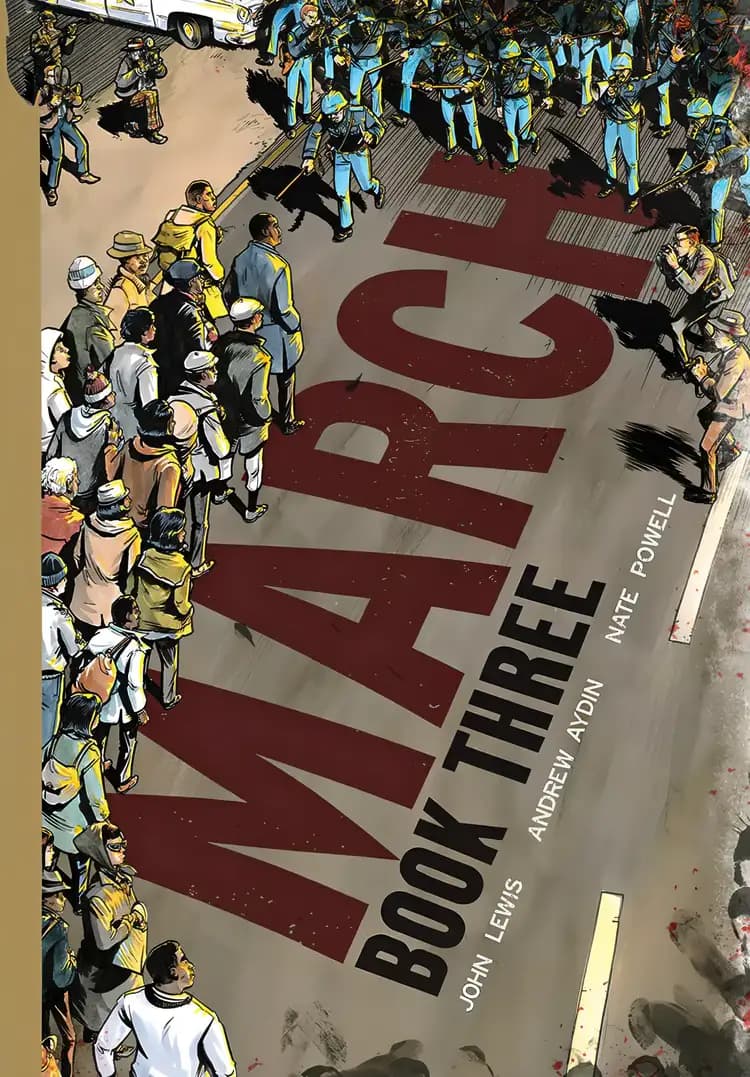
March: Book Three
#3 of 4 in March Series
What’s inside...
Welcome to the stunning conclusion of the award-winning and best-selling MARCH trilogy. Congressman John Lewis, an American icon and one of the key figures of the civil rights movement, joins co-writer Andrew Aydin and artist Nate Powell to bring the lessons of history to vivid life for a new generation, urgently relevant for today's world. By the fall of 1963, the Civil Rights Movement has penetrated deep into the American consciousness, and as chairman of the Student Nonviolent Coordinating Committee, John Lewis is guiding the tip of the spear. Through relentless direct action, SNCC continues to force the nation to confront its own blatant injustice, but for every step forward, the danger grows more intense: Jim Crow strikes back through legal tricks, intimidation, violence, and death. The only hope for lasting change is to give voice to the millions of Americans silenced by voter suppression: 'One Man, One Vote.' To carry out their nonviolent revolution, Lewis and an army of young activists launch a series of innovative campaigns, including the Freedom Vote, Mississippi Freedom Summer, and an all-out battle for the soul of the Democratic Party waged live on national television. With these new struggles come new allies, new opponents, and an unpredictable new president who might be both at once. But fractures within the movement are deepening... even as 25-year-old John Lewis prepares to risk everything in a historic showdown high above the Alabama river, in a town called Selma.
Character compass
John Lewis
Lyndon B. Johnson
Martin Luther King Jr.
Jim Clark
Hubert Humphrey
Julian Bond
Wilson Baker
Joseph L. Rauh Jr.
Hosea Williams
Frederick D. Reese
Barry Goldwater
Bob Moses
Robert F. "Bobby" Kennedy
John Robert Lewis
Malcolm X
Barack Obama
Annie Lee Cooper
Diane Nash
Fannie Lou Hamer
Rosa Parks
Discussion points
How does John Lewis’ journey in 'March: Book Three' inspire you personally?
What are some of the key challenges faced by the characters, and how do they overcome them?
Why is it important to stand up for what you believe in, according to the story?
How do the events in the book relate to current events today?
What did you learn about the civil rights movement through this book?
Tip: Role play these questions
Before starting the book, provide a brief overview of the civil rights movement to set the historical context for your child.
Encourage your child to express their feelings on the injustices described, reassuring them that it’s okay to feel upset about these events.
Discuss the importance of teamwork and community as shown through the activism in the book.
Connect the struggles in the book to everyday situations your child might encounter, emphasizing resilience and integrity.
After finishing the book, encourage your child to think about ways they can contribute positively to their own community.
Key lessons
Example Lesson: The importance of resilience
Explanation: In 'March: Book Three', John Lewis showcases his unwavering commitment to the Civil Rights Movement despite facing numerous challenges and adversities.
Real-World Application: Children can learn to persevere through their own challenges, whether in their academic lives or personal struggles, reinforcing the idea that steadfastness can lead to meaningful change.
Example Lesson: Understanding historical struggles for justice
Explanation: The book provides a vivid depiction of the political and social struggles during the Civil Rights Movement, allowing young readers to gain a historical perspective on the fight for equality.
Real-World Application: This lesson can encourage children to appreciate the sacrifices made for justice and promote a deeper understanding of current social issues.
Example Lesson: The power of nonviolent protest
Explanation: John Lewis's story demonstrates the effectiveness and moral high ground of nonviolent protest, which was a cornerstone of his philosophy during the Civil Rights Movement.
Real-World Application: Children learn the value of resolving conflicts without violence, fostering peaceful interactions and dialogue in their everyday interactions with others.
Example Lesson: The role of courage in leadership
Explanation: Throughout the book, John Lewis's actions exemplify courage in the face of immense danger, highlighting how essential bravery is in leaders who advocate for justice and equality.
Real-World Application: This encourages children to stand up for what is right and to be leaders in their own right, advocating for fairness in their communities.
Example Lesson: The impact of unity and collaboration
Explanation: The narrative illustrates how collaboration among diverse groups was crucial in advancing the goals of the Civil Rights Movement.
Real-World Application: Teaching children the importance of working together despite differences can help them build stronger, more inclusive communities.