
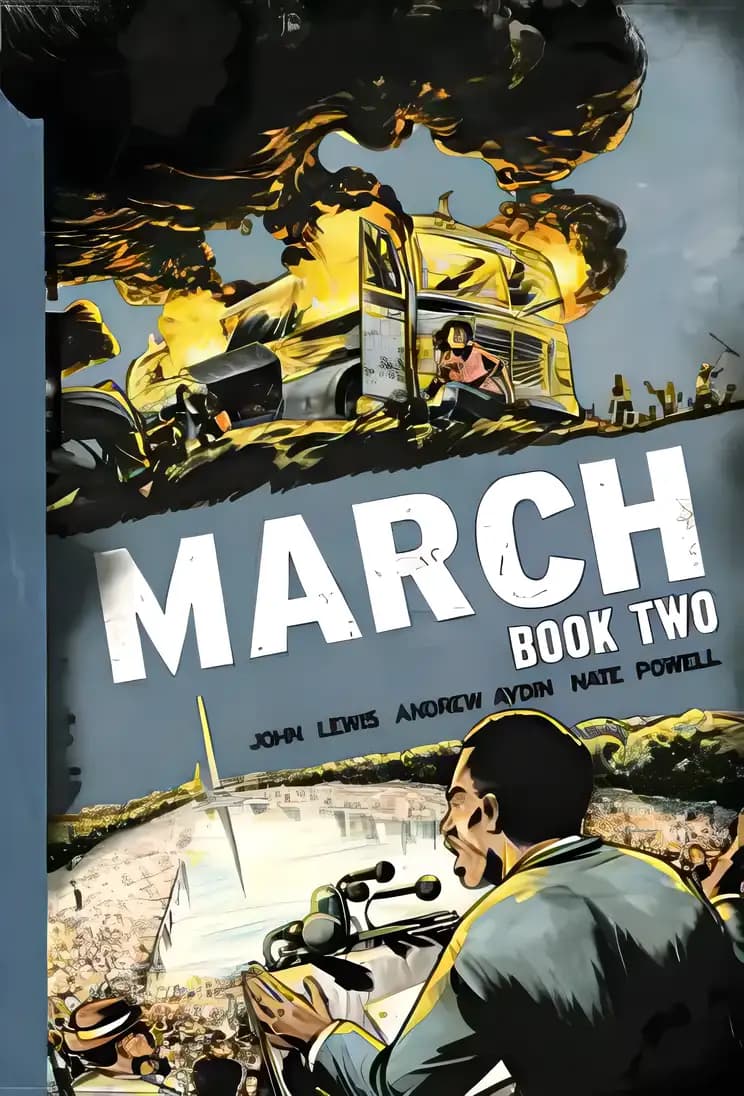
March: Book Two
#2 of 4 in March Series
What’s inside...
Congressman John Lewis continues his award-winning graphic novel trilogy with 'March: Book Two', taking readers through the heart of the civil rights movement. After the success of the Nashville sit-in campaign, Lewis and his fellow Freedom Riders face severe challenges while advocating for nonviolence in the deep south. They encounter beatings, police brutality, and even murder, drawing the attention of notable figures like Martin Luther King, Jr. and Robert F. Kennedy. As Lewis is elected chairman of the Student Nonviolent Coordinating Committee, he becomes a key leader in the civil rights movement and plays a significant role in the 1963 March on Washington for Jobs and Freedom.
Character compass
John Lewis
Diane Nash
Martin Luther King Jr.
Eugene 'Bull' Connor
Albert Bigelow
John Seigenthaler
Al Hibbler
Whitney Young
Robert F. "Bobby" Kennedy
John Robert Lewis
Roy Wilkins
A. Philip Randolph
Bayard Rustin
James Bevel
John F. Kennedy
Malcolm X
Barack Obama
Stokely Carmichael
George Wallace
Bull Connor
Bob Moses
James Farmer
Discussion points
How does John Lewis's journey in 'March: Book Two' inspire you to think about justice and equality?
What challenges did the characters face, and how did they handle them? What can we learn from their resilience?
Why do you think nonviolent protest was important during the civil rights movement? How does it compare to other forms of protest?
How does teamwork play a role in achieving the common goals seen in the book? Can you think of a time when you worked with others to accomplish something?
What emotions did you feel while reading about the historical events in 'March: Book Two'? Why do you think these events are important to remember and discuss?
Tip: Role play these questions
Start by sharing your own thoughts on the book’s themes, setting a tone of open dialogue and encouraging your child to express their opinions and feelings freely.
Connect the story to current events or personal family history to make the discussion more relevant and impactful.
Encourage your child to ask questions about anything they didn’t understand, and explore the answers together, possibly with additional research or related reading materials.
Use praise to reinforce your child’s insights and contributions to the discussion, boosting their confidence and engagement in future book talks.
Suggest drawing a scene or writing a short essay on a poignant moment in the book to deepen understanding and personal connection to the story.
Key lessons
Example Lesson: The importance of perseverance
Explanation: John Lewis' continued efforts in the civil rights movement, despite facing numerous setbacks, exemplify perseverance.
Real-World Application: Children can learn to persist in their goals, whether in school projects or personal ambitions, despite challenges.
Example Lesson: Understanding historical injustices
Explanation: The book covers significant events like the Freedom Rides and Martin Luther King Jr.'s role in the movement, educating about past inequalities.
Real-World Application: This knowledge helps children develop empathy and a deeper understanding of cultural and racial history which is crucial in today’s diverse society.
Example Lesson: The power of collective action
Explanation: John Lewis' participation in group protests and assemblies illustrates how collective action can effect change.
Real-World Application: Children can be encouraged to work collaboratively in their communities or schools to bring positive changes and achieve common goals.
Example Lesson: Importance of standing up for what is right
Explanation: John Lewis took courageous stands against racial injustice, showing moral fortitude.
Real-World Application: This can inspire children to uphold fairness and justice in their everyday interactions and stand against bullying or unfair treatment.