
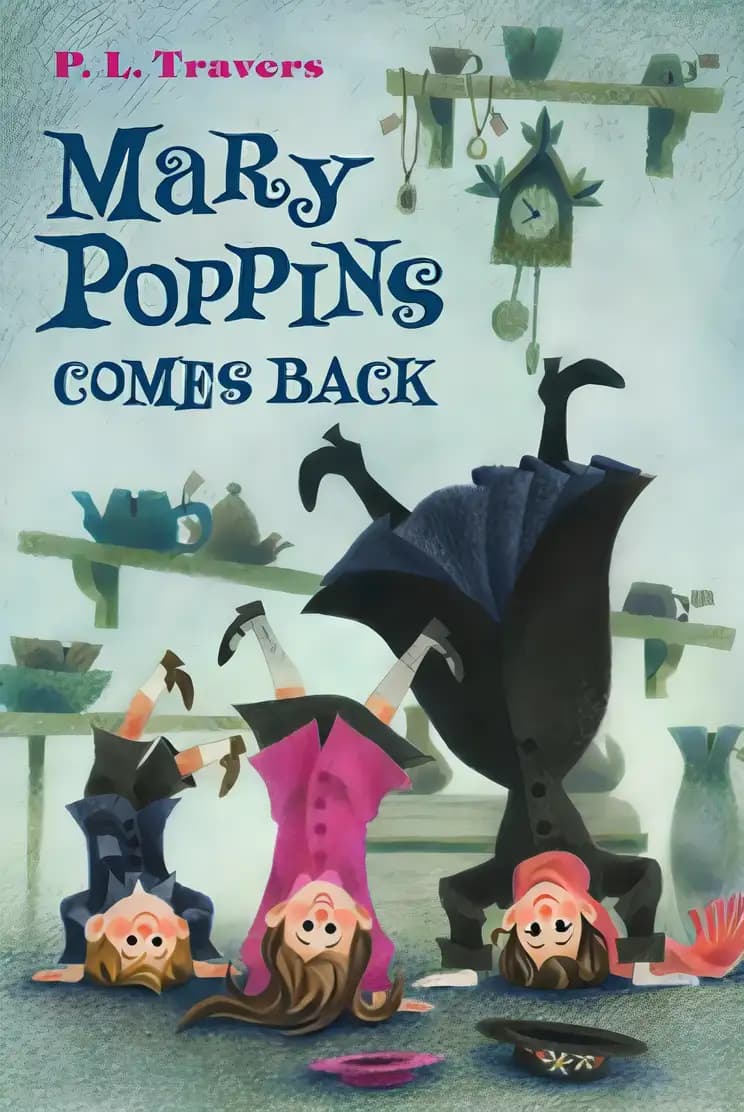
Mary Poppins Comes Back
#2 of 8 in Mary Poppins Series
What’s inside...
Pulled down from the clouds at the end of a kite string, Mary Poppins is back. In Mary's care, the Banks children meet the King of the Castle and the Dirty Rascal, visit the upside-down world of Mr. Turvy and his bride, Miss Topsy, and spend a breathless afternoon above the park, dangling from a clutch of balloons.
Character compass
Mary Poppins
Jane Banks
Michael Banks
Discussion points
How do you think Mary Poppins changed the lives of the Banks children when she returned?
What would you have asked Mary Poppins to do if you could spend one day with her?
Why is it important that Mary Poppins listens to the children's secrets and wishes?
How does the sense of adventure in the book inspire you in your everyday life?
Tip: Role play these questions
Encourage your child to imagine their own magical adventure. Ask them to describe what it would look like and what kind of magical powers they would want to have.
Discuss the theme of change and continuity shown through Mary Poppins' return. Talk about how some changes might be good and necessary.
Relate the characters’ experiences to real-life situations in your child’s life to make the themes of the story more relevant.
After reading the book, ask your child to draw their favorite scene. This can help them express their understanding and appreciation of the story creatively.
Key lessons
Example Lesson: Responsibility
Explanation: Mary Poppins teaches the Banks children to take care of their belongings and surroundings, emphasizing the importance of personal responsibility.
Real-World Application: Children can apply this lesson by managing their own spaces, such as cleaning their room or organizing their school supplies, fostering a sense of independence.
Example Lesson: Compassion
Explanation: Throughout the book, Mary Poppins and the children encounter various characters who are facing difficulties. The interactions encourage empathy and understanding towards others.
Real-World Application: Children learn to recognize when someone else is in need and can practice offering their help or understanding in school or with friends.
Example Lesson: Imagination
Explanation: Mary Poppins introduces the children to magical adventures, reinforcing the power of imagination and creative thinking.
Real-World Application: This encourages children to engage in creative activities like drawing, storytelling, or imaginative play, helping enhance their cognitive flexibility and problem-solving skills.
Example Lesson: Resilience
Explanation: The characters often face unusual and challenging situations but find ways to overcome them, demonstrating resilience.
Real-World Application: This lesson helps children understand that facing challenges is a part of life, and with creativity and persistence, they can manage and overcome difficulties.
Example Lesson: The value of rules
Explanation: Mary Poppins is strict about certain rules, teaching the children that structure and discipline are necessary for a functioning household and society.
Real-World Application: Children can learn to appreciate and follow rules at home, in school, and in other social settings, realizing that these guidelines are designed to ensure safety and fairness.