
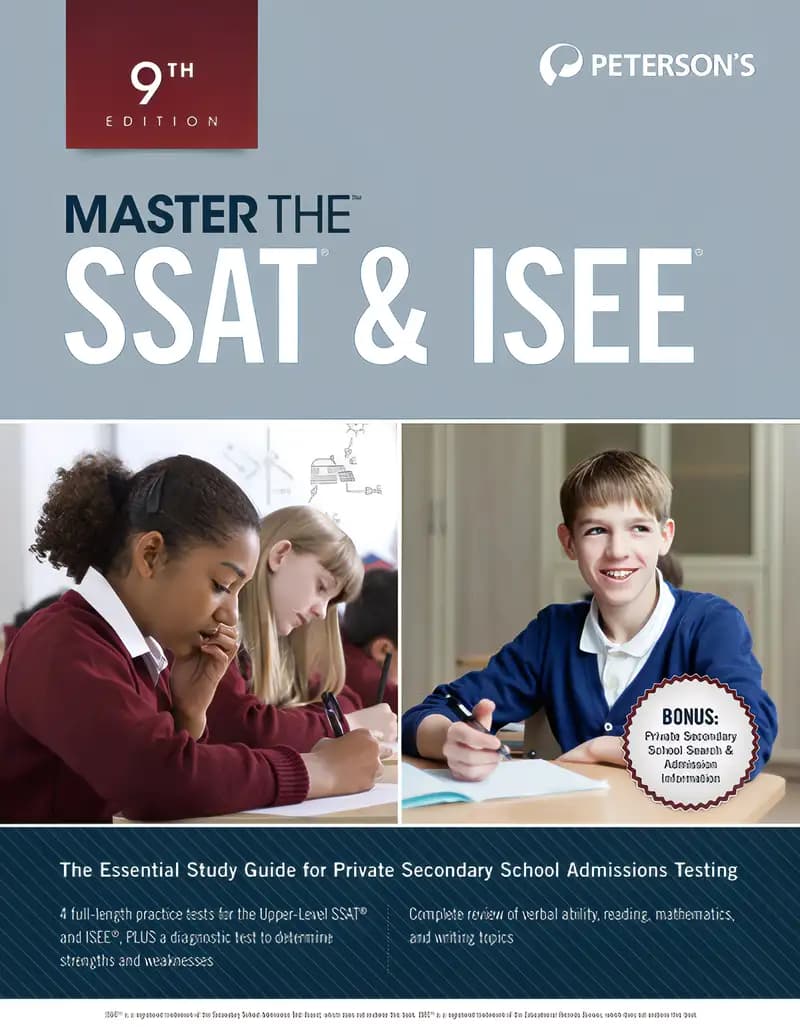
Master the SSAT & ISEE
on Goodreads (6)
What’s inside...
Peterson's Master the SSAT® & ISEE® is the guide to prepare students and their parents for success on the SSAT® and the ISEE®. Both tests include complete review of verbal ability, reading, mathematics and writing topics. Complete with the most up-to-date information on the upper-level exams, this 9th edition is important to students preparing for private secondary school admissions testing. In this guide, students have access to test-taking strategies for each of the question types, along with exam day specific advice. PLUS Four practice tests, AND A diagnostic test to give students a realistic idea of what to expect on test day. Additionally, students and parents will find: tips on all aspects of the private secondary school search process: how to identify schools that are a good fit, how to apply for financial aid, and all the challenges of finding the right private secondary school for YOUR child. Peterson's Master the SSAT® & ISEE® is the essential study guide for private secondary school admissions testing.
Why read this book
- Prepares students for SSAT and ISEE exams effectively.
- Boosts critical thinking and problem-solving skills.
- Detailed, easy-to-understand content, encourages independent learning.
- Instills confidence in test-taking abilities.
Age
11-18
Length
720 pages
Text complexity
Discussion points
What are some strategies from the book that you find most helpful for test preparation?
How does setting specific study goals influence your test-taking confidence?
Can you identify any areas or subjects you feel you need more practice in after reading this book?
What did you learn about time management for tests from this book?
How can we as a family support you in your preparation for these exams?
Tip: Role play these questions
Encourage your child to express any concerns or anxieties they have about the exams, providing a supportive space for dialogue.
Discuss each section of the test with your child to identify areas they feel confident in and areas they might need more help.
Help your child develop a realistic study plan, breaking down the book’s strategies into manageable steps.
Set aside regular check-ins to discuss progress and adjust strategies as needed, emphasizing that preparation is a journey and that improvement takes time.
Celebrate small successes along the way to keep motivation high.
Key lessons
Example Lesson: Importance of Preparation
Explanation: Master the SSAT & ISEE guides students through detailed preparations for these crucial exams, emphasizing the necessity of consistent study and practice.
Real-World Application: Children can apply this lesson by developing organized study habits and a disciplined approach to tackling tasks or challenges in school and other areas of life.
Example Lesson: Setting Goals
Explanation: The book helps students set realistic goals for each section of the exams, teaching the value of setting achievable targets.
Real-World Application: Kids learn to set and pursue their own goals, understanding the steps needed to achieve them whether it be in academics, sports, or personal hobbies.
Example Lesson: Overcoming Challenges
Explanation: Through practice tests and problem-solving strategies, the book equips students to handle and overcome obstacles they might face during the exams.
Real-World Application: This instills resilience in children, helping them face academic and personal challenges with confidence and strategic thinking.
Example Lesson: Time Management
Explanation: Master the SSAT & ISEE highlights the importance of managing time effectively both in preparation for and during the exams.
Real-World Application: Children can use these principles to improve time management skills in completing homework, participating in extracurricular activities, and managing daily tasks.
Example Lesson: Critical Thinking
Explanation: The book includes sections that challenge students to apply logic and reasoning, enhancing critical thinking skills.
Real-World Application: By sharpening their analytical skills, children can better navigate complex situations in school and other areas of life, making informed decisions.