
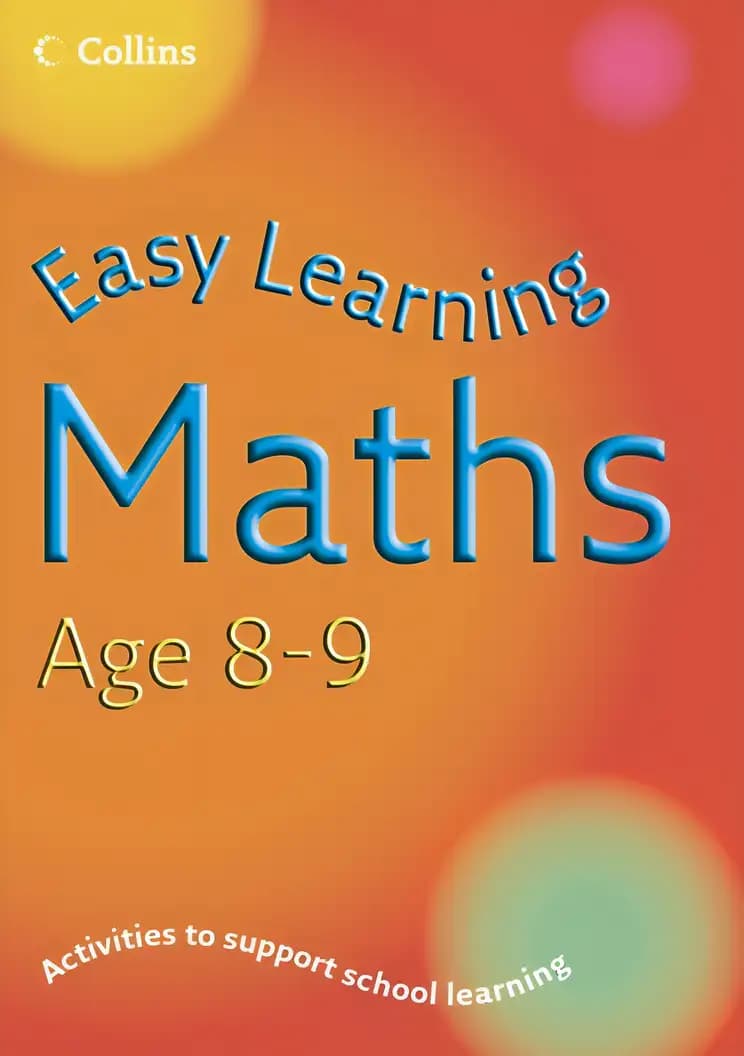
Maths Age 8-9
Easy Learning Series
What’s inside...
Easy Learning Maths Age 8-9 provides a user-friendly approach to learning math through engaging activities and clear step-by-step guidance for both parents and children. The book is designed to make learning at home enjoyable and to help children succeed in school by presenting information in small, memorable chunks and offering practice through maths activities.
Series reading
Non-Sequential
Age
8-9
Length
32 pages
Text complexity
Discussion points
What was your favorite math problem in the book and why did it stand out to you?
How do you think using math helps us in everyday life?
Can you think of a situation where you could use what you learned in this book?
What new math concept did you learn from this book, and how would you explain it to a friend?
If you could add a math problem to the book, what would it be and why?
Tip: Role play these questions
Discuss your own experiences with learning math and how it has been useful in various aspects of life. This helps children connect math skills to real-world scenarios.
Praise efforts rather than just correctness to encourage a growth mindset. Focus on the process of learning rather than just the final answer.
After discussing a problem from the book, relate it to daily activities that involve math, such as cooking or shopping, to demonstrate practical application.
Encourage your child to create their own math problems. This promotes creativity and deeper understanding of the material.
Use visuals if possible, like drawing out problems or using physical objects, to help clarify complex concepts.
Key lessons
Example Lesson: Problem Solving Skills
Explanation: The book introduces various mathematical challenges that require logical thinking and decision-making.
Real-World Application: Children can use these problem-solving skills to navigate tasks and challenges in their schoolwork and daily activities.
Example Lesson: Importance of Practice
Explanation: Through repetitive exercises and examples, the book emphasizes the significance of regular practice in mastering mathematical concepts.
Real-World Application: This lesson teaches children the value of consistent effort and practice in learning new skills, not just in math, but in any area of study or interest.
Example Lesson: Building Confidence with Numbers
Explanation: As children work through the exercises, they gain confidence in their numerical abilities, which is reinforced by positive feedback mechanisms in the book.
Real-World Application: This confidence can help diminish any math anxiety and encourage a more positive attitude towards math and problem-solving.
Example Lesson: Critical Thinking Enhancement
Explanation: The book challenges students to think critically by presenting them with math puzzles and problems that require more than straightforward calculations.
Real-World Application: Critical thinking skills developed here can extend to making informed decisions and solving real-life problems efficiently.
Example Lesson: Understanding Patterns and Relationships
Explanation: Maths Age 8-9 encourages recognition of patterns and understanding relationships between different mathematical elements.
Real-World Application: This ability helps in predicting outcomes and understanding complex systems in nature and technology, fostering scientific thinking and curiosity.