
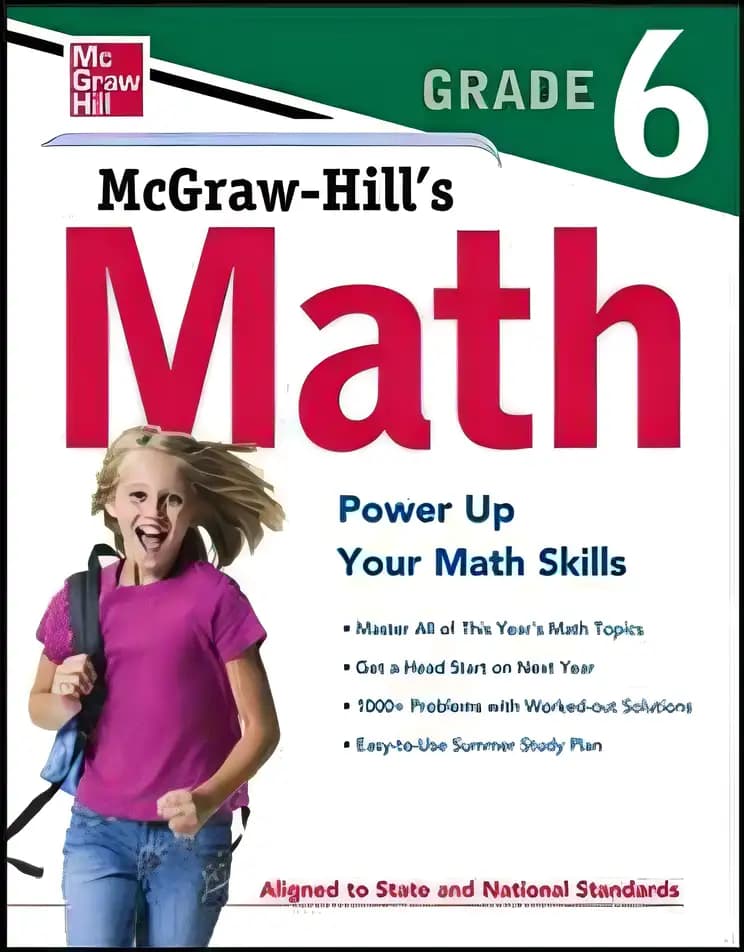
McGraw-Hill Education Math Grade 6
#6 in McGraw-Hill Social Studies Series
What’s inside...
McGraw-Hill's Math Grade 6 is designed to help middle-school students sharpen their math skills through engaging activities aligned with state and national standards. The book features a four-color page design for a student-friendly learning experience, with sections that focus on reinforcing mastered skills, linking skills to real-world applications, exploring other media, and promoting language acquisition. It includes a summer study plan, self-assessment in each lesson, and covers topics such as addition, subtraction, multiplication, division, fractions, geometry, and measurements. Now students can bring home the classroom expertise of McGraw-Hill to help them sharpen their math skills! McGraw-Hill's Math Grade 6 helps your middle-school student learn and practice basic math skills he or she will need in the classroom and on standardized NCLB tests. Its attractive four-color page design creates a student-friendly learning experience, and all pages are filled to the brim with activities for maximum educational value. All content aligned to state and national standards.
Discussion points
Can you think of a real-life situation where you could use the math concept you just learned?
Which math problem from the book did you find most challenging, and how did you solve it?
How do you think learning these math skills will help you in everyday life?
Can you explain a math concept from this book to me as if I’m learning it for the first time?
Tip: Role play these questions
Before starting a new chapter, ask your child what they already know about the topic to build on their existing knowledge.
After your child solves a problem, encourage them to explain their thought process. This promotes critical thinking.
Relate math problems to your child's interests (e.g., if they like cooking, tie it to recipes or measurements) to make learning more relevant and enjoyable.
Praise their efforts rather than just their correctness to boost their confidence and encourage a growth mindset.
Key lessons
Example Lesson: Problem-Solving Skills
Explanation: Through various mathematical challenges and exercises, the book trains children in essential problem-solving methodologies.
Real-World Application: These skills help children analyze and solve real-life problems efficiently, be it in academic scenarios or daily situations.
Example Lesson: Critical Thinking
Explanation: The book encourages children to think critically by presenting them with complex mathematical problems that require deeper analysis.
Real-World Application: Critical thinking skills are vital in helping children make informed decisions and understand the consequences of their actions in everyday life.
Example Lesson: The importance of Practice
Explanation: The exercises reinforce the concept that continuous practice can lead to mastery of the subject.
Real-World Application: This teaches children the value of perseverance and consistent effort in not only academics but also in learning new skills or hobbies.
Example Lesson: Logical Reasoning
Explanation: By engaging with the material, students develop logical reasoning abilities as they connect mathematical concepts and apply them to solve problems.
Real-World Application: Logical reasoning enhances a child’s ability to sequence, categorize, and make valid conclusions, thereby improving their decision-making process in real-life situations.