
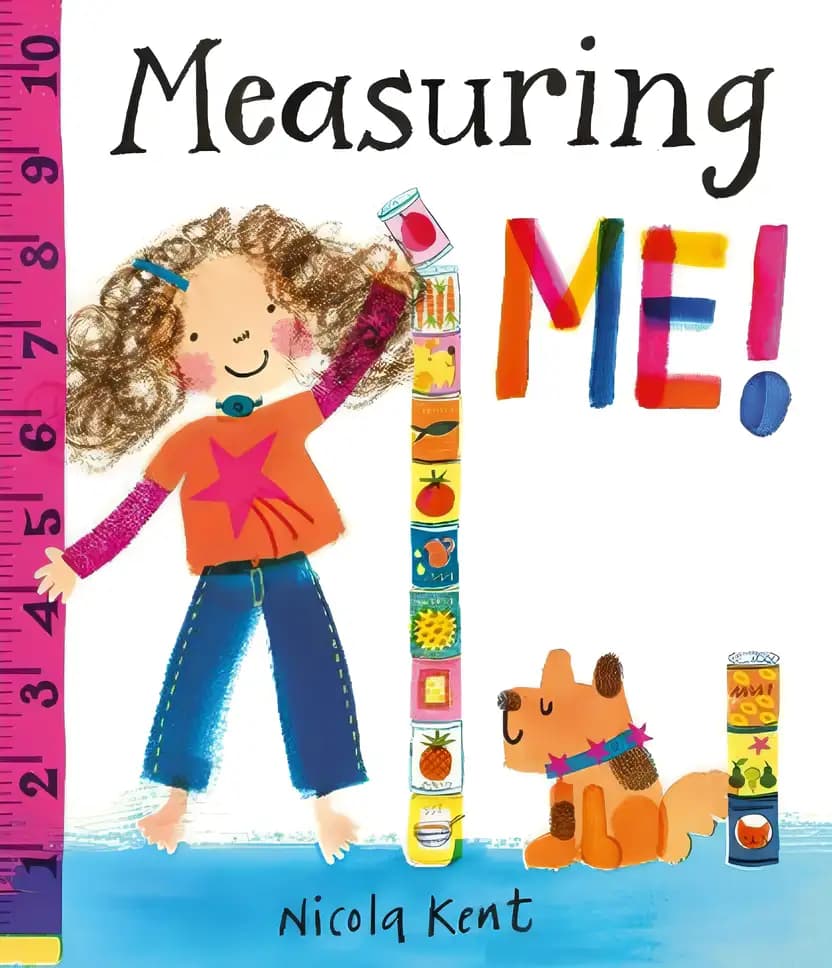
Measuring Me
illustrations by
What’s inside...
Measuring Me is a charming story that follows the journey of a young child who learns about the world through the act of measuring various things. From the length of a worm to the height of a tree, the protagonist uses different objects and units to explore and understand their environment.
Age
4-8
Length
32 pages
Text complexity
Discussion points
What are some ways you measured things in the book 'Measuring Me'? Can you think of other things you could measure around the house?
How do you think measuring things helps us in everyday life?
Why do you think it's important to know how tall or short things are?
What was your favorite part of the book and why?
If you could add a page to the book, what would you measure and how?
Tip: Role play these questions
Encourage your child to explore measurement by using objects around the house, like measuring the length of the table with a string and then comparing it to another object.
Discuss how measurements play a vital role in cooking, building, and sewing which are part of everyday life, enhancing their understanding of its practical uses.
Ask your child to guess the measurements before actually measuring items to make it interactive and fun.
Relate the measurements in the book to your child’s own experiences, like comparing their height to the height of a character in the book.
After reading, engage your child in a creative activity where they can draw and measure their own imaginary items, integrating art with measurement.
Key lessons
Example Lesson: Understanding growth and change
Explanation: In 'Measuring Me', the protagonist explores different ways to measure various aspects of their everyday life, including their own growth over time.
Real-World Application: Children can apply this concept by tracking their own growth in height or skills, fostering a sense of achievement and the understanding of personal development.
Example Lesson: Learning measurement units
Explanation: The book introduces basic measurement units like inches and centimeters, and teaches the children how to use them through engaging activities.
Real-World Application: Kids can use this knowledge to engage in activities that require measurements, like baking or crafting, hence improving their practical math skills.
Example Lesson: Developing comparison skills
Explanation: Through measuring various objects and themselves, children are taught how to compare different lengths and sizes.
Real-World Application: This skill helps children understand basic math concepts which can be used in everyday scenarios like comparing prices or quantities while shopping.
Example Lesson: Appreciating individual uniqueness
Explanation: The story highlights that every individual is unique in their size, ability, and pace of growth.
Real-World Application: This lesson can help children to appreciate personal differences and promote self-acceptance among their peers.
Example Lesson: Problem-solving and critical thinking
Explanation: While measuring, the protagonist encounters and solves various challenges, promoting problem-solving skills.
Real-World Application: Children learn to approach and resolve everyday problems by breaking them down and finding creative solutions, which is a critical life skill.