
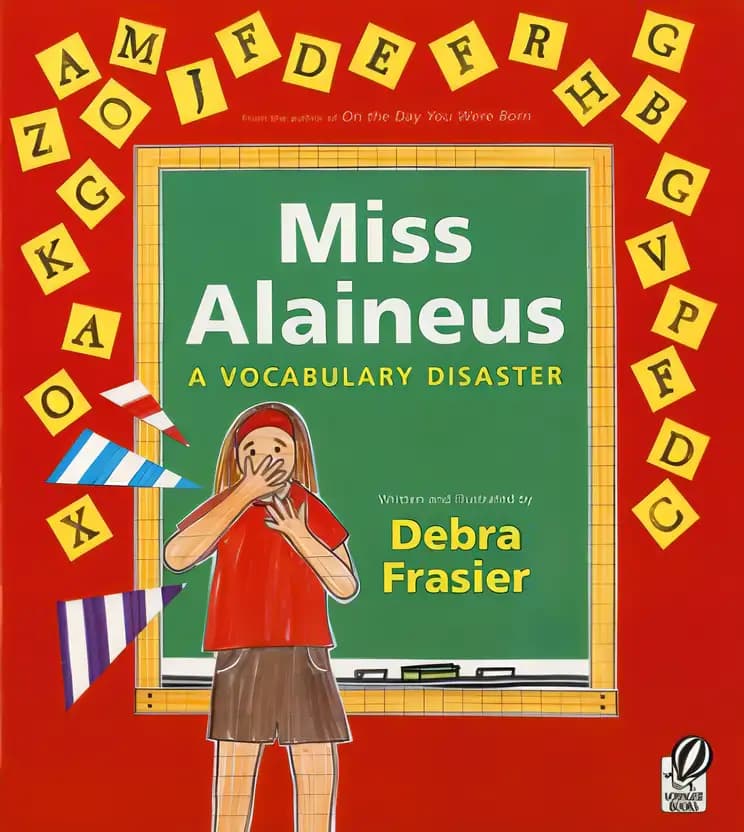
Miss Alaineus: A Vocabulary Disaster
on Goodreads (535)
What’s inside...
Sage has misheard and misunderstood one of Mrs. Page's weekly vocabulary words. Her error leads to a humbling catastrophe: a momentous tragedy, in front of the entire class. Can Sage turn her vocabulary disaster: an event bringing great misfortune, into a triumph: a true success? Anyone who has ever been daunted: discouraged or disheartened, by a mere word in the dictionary will cheer wildly: in a manner lacking all restraint, as Sage transforms embarrassment into victory in Debra Frasier's touching story of loving--and mistaking--our glorious language.
Age
4-7
Length
34 pages
Text complexity
Character compass
Sage
Sage'S Mother
Ms. Page
Discussion points
What do you think Sage felt when she made the mistake with the word 'miscellaneous'? How would you feel in her situation?
Why is it important to learn new words and understand their meanings?
How did Sage’s classmates respond to her vocabulary disaster? What does this tell us about handling mistakes?
How can mistakes sometimes lead to creative ideas or solutions? Can you think of a time when a mistake turned into something good for you?
What did you learn from Sage's experience in the book?
Tip: Role play these questions
Encourage open conversation by sharing a personal story about a time you made a misunderstanding or mistake, similar to Sage’s. This can make your child feel more comfortable to discuss and connect with the story.
Ask your child to think of new words they learned recently and discuss their meanings. It can help them connect personally with the theme of vocabulary building, just like Sage.
Celebrate mistakes as learning opportunities. Highlight how Sage’s mistake led to a new, creative way to learn vocabulary, showing that errors can be productive and enlightening.
After discussing Sage's experiences, encourage your child to create their own vocabulary list from the book. It's a fun activity and reinforces the learning aspect of the story.
Key lessons
Example Lesson: The power of resilience
Explanation: The protagonist, Sage, experiences embarrassment when she makes a mistake in front of her class. However, she uses her creativity to turn the situation around during the Vocabulary Parade.
Real-World Application: Children learn to face setbacks positively and understand that mistakes can lead to unique opportunities and solutions.
Example Lesson: The importance of vocabulary and communication
Explanation: Sage misunderstands a word which leads to a humorous mix-up. This highlights how vocabulary is crucial for effective communication.
Real-World Application: It encourages children to enhance their vocabulary and shows how communication is vital in understanding and being understood by others.
Example Lesson: Creativity as a problem-solving tool
Explanation: Sage creatively transforms her embarrassing moment into a triumphant one by creatively using it as her costume in the Vocabulary Parade.
Real-World Application: This teaches children that creative thinking can transform challenges into wins in everyday situations.
Example Lesson: Learning from mistakes
Explanation: After her initial misunderstanding, Sage works to understand her vocabulary words better, turning her mistake into a learning opportunity.
Real-World Application: This lesson can help children see the value in reviewing and learning from their errors to improve their understanding and skills.