
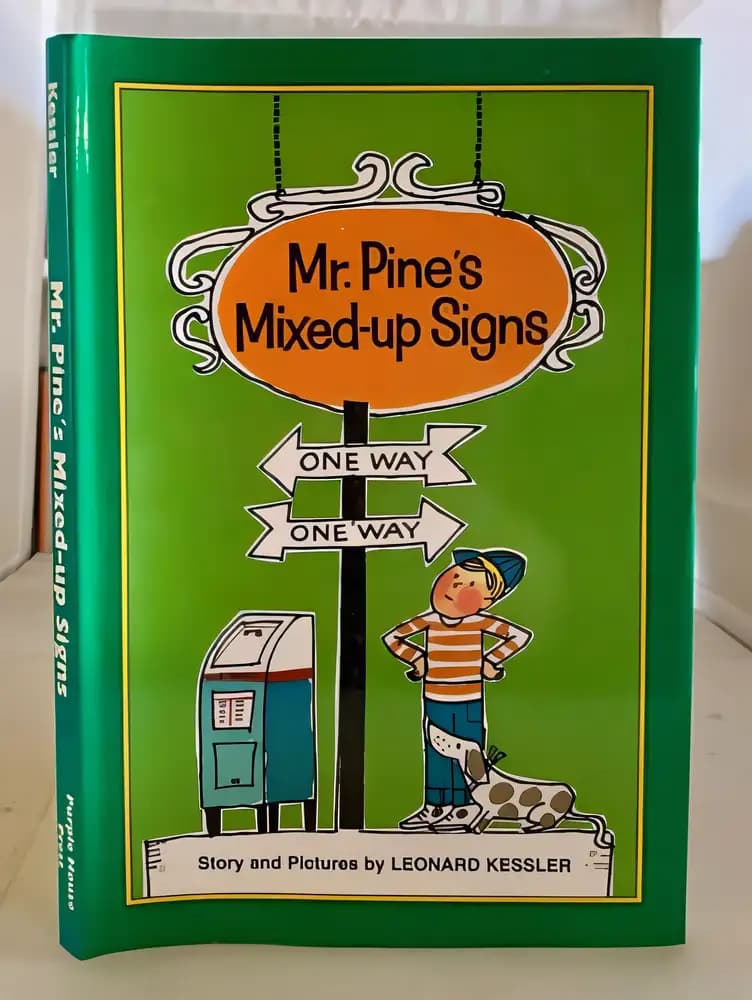
Mr. Pine's Mixed-Up Signs
#2 in Mr. Pine, Wonder Books Easy Reader Series
on Goodreads (136)
What’s inside...
The 40th Anniversary Edition of Mr. Pine's Mixed-up Signs celebrates the adventures of the beloved, intrepid sign painter Mr. Pine. Mr. Pine made all kinds of signs for Little Town, but when it was time to replace the old signs, he couldn't find his glasses and accidentally put up mixed-up signs all over town. The story follows Mr. Pine as he searches for his glasses and tries to solve the problem of the mixed-up signs.
Character compass
Mr. Pine
Discussion points
What do you think happened when Mr. Pine mixed up the signs in the town?
How do you think the people in the town felt when they saw the mixed-up signs?
Why is it important for signs to be in the right places?
What would you have done if you were Mr. Pine to fix the mistake?
Can you think of a time when you solved a problem like Mr. Pine?
Tip: Role play these questions
Encourage your child to imagine themselves in the story and think about how they would react to the mixed-up signs.
Ask your child to point out specific parts of the illustrations that help tell the story of the mixed-up signs.
Discuss the importance of problem-solving and how mistakes can be opportunities to learn and grow.
Relate the story to real-life situations by discussing times when following directions or signs is important.
Praise your child’s responses and insights to build their confidence in expressing their thoughts and ideas.
Key lessons
Example Lesson: Problem-solving
Explanation: Mr. Pine faces a challenge when his signs are mixed up and must find a solution to restore order in the town.
Real-World Application: Children learn the importance of addressing problems head-on and using creativity and logic to find solutions, which are applicable in school projects or interpersonal issues.
Example Lesson: Responsibility
Explanation: Mr. Pine takes responsibility for the mix-up, despite it not being his fault, showing integrity and accountability.
Real-World Application: This teaches children the value of taking responsibility for their actions and the situations they are involved in, fostering a sense of reliability.
Example Lesson: Community Involvement
Explanation: The community comes together to help Mr. Pine fix the signs, illustrating the power of teamwork and cooperation.
Real-World Application: Encourages children to participate in community activities and understand the benefits of working together towards a common goal.
Example Lesson: Attention to Detail
Explanation: Mr. Pine has to be meticulous to correct all the signs, showcasing the importance of attention to detail.
Real-World Application: This can be translated into a child’s academic life, teaching them the importance of careful observation and thoroughness in their work.