
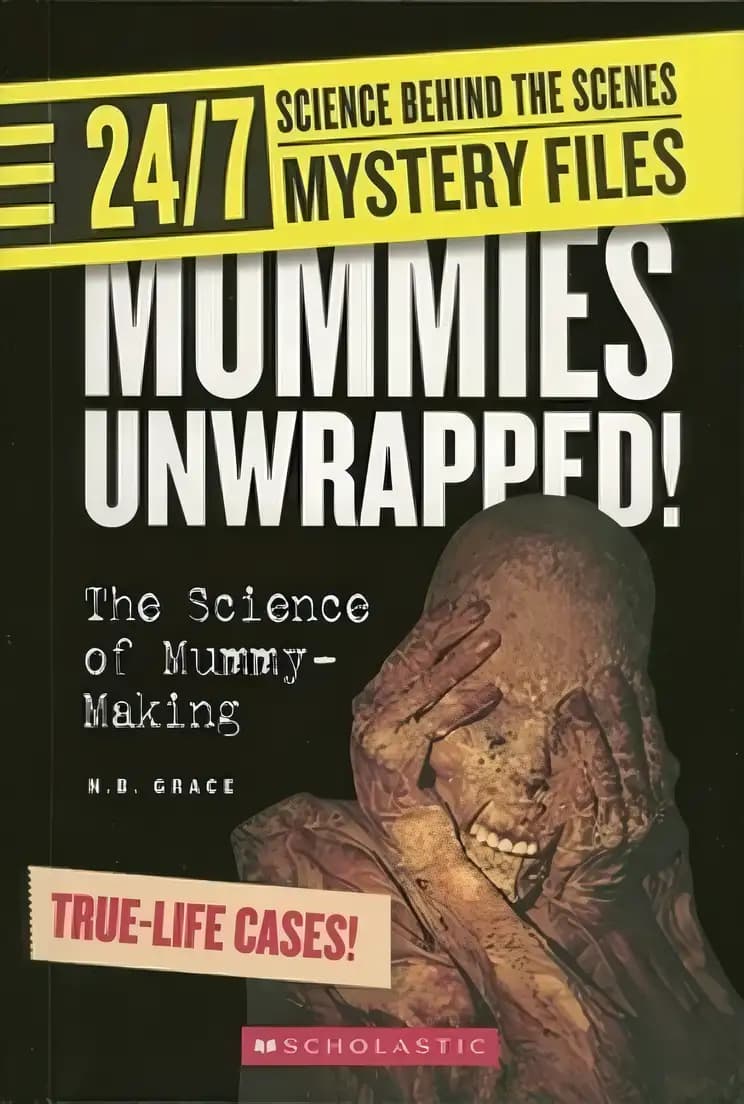
Mummies Unwrapped!: The Science of Mummy-Making (24/7: Science Behind the Scenes: Mystery Files)
24/7: Science Behind The Scenes: Mystery Files Series
on Goodreads (11)
What’s inside...
Discover mummies! Science as inquiry is the core of this dynamic, investigative, high-interest series which focuses on the science and technology used to solve real-life crimes and mysteries. It includes chapter summaries, reading cues, and sidebar interviews.
Series reading
Non-Sequential
Age
12-13
Length
64 pages
Text complexity
Discussion points
What do you think inspired ancient civilizations to create mummies?
How do you think scientists use the clues from mummies to learn about the past?
What surprised you the most about the mummy-making process?
If you could meet an ancient Egyptian, what would you ask them about their burial practices?
How do you think the discovery of mummies impacts our understanding of history and science today?
Tip: Role play these questions
Encourage your child to think about the connection between the science of mummies and other subjects they are learning about, like history and chemistry.
Discuss the ethical considerations of studying human remains, enhancing their critical thinking about respect and cultural heritage.
Ask your child to relate the technologies and methods described in the book to modern-day science, fostering real-world connections and sustained interest.
Invite them to imagine being an archaeologist or a scientist studying mummies, which can spark their curiosity further and make the reading experience more immersive.
Key lessons
Example Lesson: The importance of respecting different cultures and traditions
Explanation: The book explores the ancient practices of mummy-making across various cultures, highlighting the significance and sacredness of these traditions.
Real-World Application: Children can learn to appreciate and respect cultural diversity in their everyday interactions at school and in their community.
Example Lesson: Understanding scientific processes through history
Explanation: Through the lens of mummy-making, the book teaches various scientific methods such as preservation and the chemistry behind embalming. It connects these processes to their historical contexts.
Real-World Application: This encourages children to develop a curiosity about science and history, sparking inquiries into how things work and why things were done in certain ways historically.
Example Lesson: The value of interdisciplinary learning
Explanation: The book integrates science with history and archaeology, showing how these fields work together to solve mysteries from the past.
Real-World Application: This can inspire children to see the interconnectedness of different subjects and promote a more holistic approach to learning in their own educational journeys.
Example Lesson: Critical thinking and analysis
Explanation: As the book delves into the mysteries behind mummies, it encourages readers to think critically about the sources of historical knowledge and the methods used to obtain it.
Real-World Application: Children can apply these critical thinking skills to analyze information, question sources, and make informed decisions in daily life.