
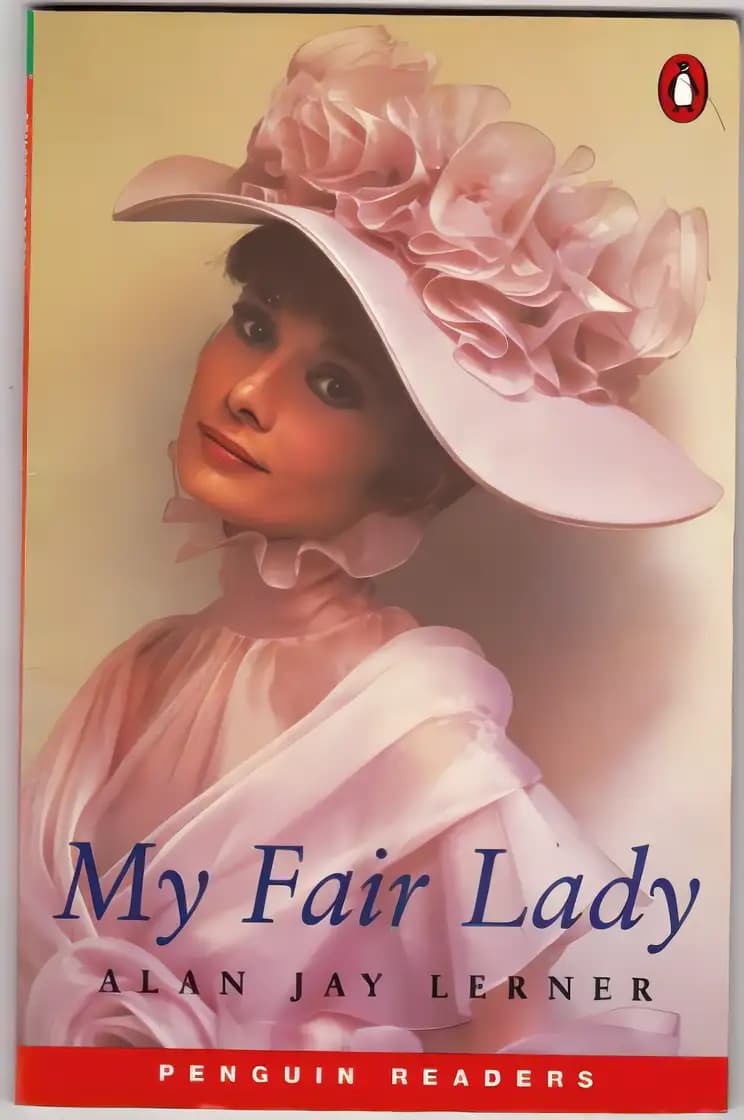
My Fair Lady
#3 of 109 in All Aboard Reading Series
on Goodreads (3,234)
What’s inside...
Eliza Doolittle, a poor flower-seller in Victorian London, becomes the subject of an experiment by Professor Higgins, who aims to teach her to speak like an upper-class lady. The 'Penguin Readers' series offers simplified novels and titles in English for various reading levels, introducing students to literature and aiding English language learning.
Character compass
Eliza Doolittle
Freddy Eynsford-Hill
Alfred Doolittle
Colonel Pickering
Mrs. Higgins
Henry Higgins
Discussion points
Why do you think Eliza wanted to speak more properly? What might she have hoped to achieve?
How do the different characters treat Eliza throughout the story? What does this tell us about how people view and treat each other?
What changes did you notice in Eliza's character from the beginning to the end of the book? How did these changes affect her life?
Professor Higgins and Eliza have a complex relationship. What do you think each character learned from the other?
Do you think the ending was fair to all characters involved? Why or why not?
Tip: Role play these questions
Use open-ended questions that encourage critical thinking rather than simple yes/no answers.
Encourage your child to compare the story’s events and characters' actions with real-life situations or their personal experiences.
Ask your child how they might feel in Eliza’s situation to foster empathy and understanding of the character’s decisions.
Discuss with your child the idea of personal growth and development as showcased by Eliza’s journey in the story.
Key lessons
Example Lesson: The importance of respect and kindness
Explanation: In 'My Fair Lady', Professor Higgins learns to appreciate and respect Eliza Doolittle, highlighting the significance of treating everyone with kindness regardless of their social status.
Real-World Application: Children can apply this lesson by treating their peers and adults with respect and kindness, fostering positive relationships and a supportive community.
Example Lesson: Value of education and self-improvement
Explanation: Eliza's transformation demonstrates how education can change a person's life, empowering them and broadening their opportunities.
Real-World Application: This lesson encourages children to embrace learning and self-improvement, using education as a tool to advance themselves and achieve their dreams.
Example Lesson: Social mobility and equality
Explanation: The story shows Eliza breaking out of the constraints of her lower-class background, advocating for social mobility and equality.
Real-World Application: Children can understand the value of equality and strive to treat everyone equally, regardless of their background or social standing.
Example Lesson: The power of perseverance
Explanation: Eliza’s determination to learn proper speech and manners, despite numerous challenges, emphasizes the power of perseverance in achieving one’s goals.
Real-World Application: This teaches children the importance of persisting through difficulties and continuing to work towards their goals, even when faced with obstacles.