
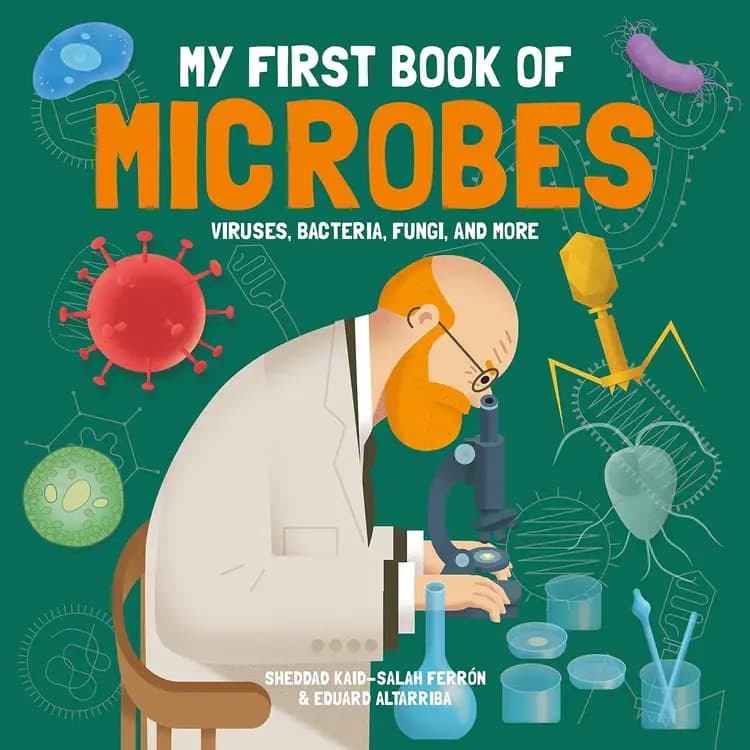
My First Book of Microbes
What’s inside...
My First Book of Microbes is the ideal STEM book for children – it uses fascinating bite-size facts, clear and simple explanations, and attractive and absorbing illustrations to demystify the hidden world of microbes. You’ll discover what they are, where they come from and what they do, as well as which ones are good and which can be harmful. Especially pertinent are the clear explanations about how viruses spread, the role of antibodies and the importance of vaccines – essential understanding for us all during this time of the COVID-19 pandemic; in fact, there’s a whole spread dedicated to COVID-19. Packed with clever analogies that make understanding a difficult topic easy, this STEM title is perfect for young budding scientists with an active and enquiring mind and for people of any age who are interested in learning about the natural world and the human body. Sales
Why read this book
- Introduces young readers to the world of microbes.
- Engaging illustrations complement easy-to-understand scientific concepts.
- Encourages curiosity and learning about biology and nature.
- Ideal for nurturing early scientific thinking and literacy.
Age
8-16
Length
64 pages
Text complexity
Discussion points
What do you think microbes are and where can they be found?
Can you describe how microbes might help us?
Why do you think it's important to learn about microbes, even though they are so tiny?
How do you feel knowing that there are microbes all around us?
Which microbe did you find most interesting and why?
Tip: Role play these questions
Use everyday examples to explain the concept of microbes, such as comparing them to tiny superheroes that help us digest food or keep us healthy.
Encourage your child to draw their favorite microbe from the book, discussing its features and role.
While discussing the book, integrate tactile learning by using a microscope or magnifying glass to explore everyday objects, emphasizing how microbes are everywhere, though unseen.
After reading, suggest watching age-appropriate documentaries or shows about microbes to reinforce the information and maintain interest.
Ask your child to explain what they have learned to another family member, fostering confidence and reinforcing their understanding.
Key lessons
Example Lesson: Understanding the complexity of the microbial world
Explanation: The book introduces young readers to various types of microbes, explaining their forms, functions, and environments.
Real-World Application: Children can apply this knowledge to understand the importance of hygiene and the unseen world that impacts their health.
Example Lesson: Appreciating the role of microbes in nature and human life
Explanation: Through colorful illustrations and simple explanations, children learn that microbes are not only germs but also essential elements in ecosystems.
Real-World Application: This can foster a sense of environmental awareness and responsibility as they learn how every aspect of nature, including microbes, contributes to the health of our planet.
Example Lesson: Promoting scientific curiosity
Explanation: The book poses questions and provides surprising facts that challenge children’s thinking about the microscopic world.
Real-World Application: Encourages children to ask questions and seek out answers, thereby nurturing a lifelong love for science and exploration.
Example Lesson: Highlighting the benefits of good microbes
Explanation: ‘My First Book of Microbes’ talks about how some microbes are beneficial, playing critical roles such as in digestion and production of some types of medicines.
Real-World Application: Children can understand the importance of maintaining a balanced diet to support the good microbes in their body and the role of medication in maintaining health.