
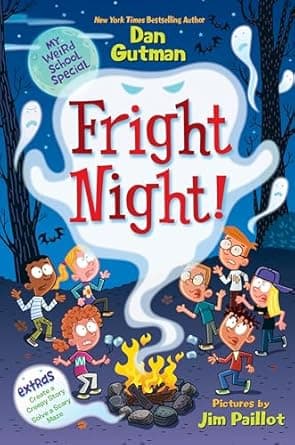
My Weird School Special: Fright Night!
#4 of 21 in My Weird School Series
illustrations by
What’s inside...
It is Halloween in Dan Gutman’s laugh-out-loud universe, and A.J., Andrea, and the rest of the Ella Mentry School gang cannot wait to trick-or-treat. But when a mysterious haunted house appears on 34th Street, the night turns into a series of spooky—and seriously funny—misadventures. From costume mix-ups and broccoli-giving neighbors to secret passageways and unexpected scares, the kids must stick together, overcome their fears, and figure out how to escape the creepiest house in town while still scoring the best candy haul ever.
Character compass
Arlo "A.J." Jervis
Neil
Michael
Ryan
Andrea Young
Discussion points
Which part of the haunted house would scare you most?
How did A.J.’s friends help him feel brave?
Why is it important to plan a route when trick-or-treating?
What could you do if a friend is frightened during a sleepover?
Tip: Role play these questions
Act out funny scenes to reinforce comprehension.
Compare safe vs. unsafe Halloween practices.
Let children design their own ‘haunted’ maze on paper.
Key lessons
Example Lesson: Teamwork makes challenges manageable.
Explanation: Kids escape the haunted house by sharing ideas and supporting each other.
Real-World Application: Students can partner on school projects to divide tasks and reduce stress.
Example Lesson: It is okay to admit you are scared.
Explanation: A.J. confesses his fear of the dark, prompting empathy from friends.
Real-World Application: Children learn to express worries to caregivers instead of hiding them.
Example Lesson: Creativity can solve unexpected problems.
Explanation: Improvised costumes and clues help the kids adapt.
Real-World Application: Kids might repurpose household items for crafts rather than buying new ones.
Example Lesson: Kindness trumps pranks.
Explanation: They choose not to prank the broccoli neighbor after understanding his motives.
Real-World Application: Kids can think before teasing peers, opting for supportive actions.