
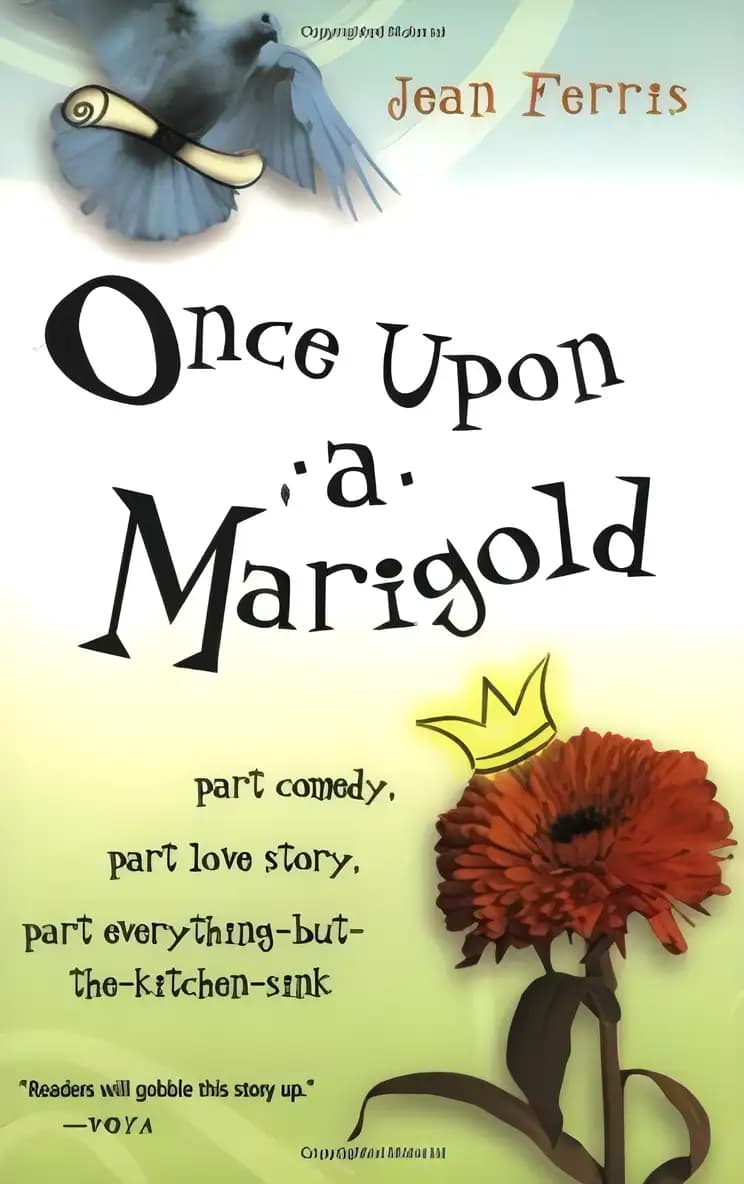
Once Upon a Marigold
#1 of 3 in Upon a Marigold Series
on Goodreads (24,826)
What’s inside...
A young man with a passion for invention befriends a princess trapped in an unhappy engagement. A quirky and humorous fairy tale filled with love, adventure, and intrigue. Meanwhile, Christian, who lives in a cave with a troll for a dad, starts spying on the royal family through his telescope, clueless about the stupefying effects of love. Unaware of the complexities of love, Christian's life becomes a mess, yet his actions may have saved Princess Marigold's life. Who knew love could be so amazing—and stupefying? Not Christian. He was clueless when he started spying on the royal family through his telescope. He lives in a cave with a troll for a dad, after all. If his dad had only warned him about all that mind-boggling love stuff, maybe things wouldn't be such a mess. But then, maybe, Princess Marigold would be dead. But Christian wasn't warned. And now that he's fallen for the princess, it's up to him to untwist an odd love triangle—er, rectangle —and foil a scheming queen who wants to take over the kingdom, even if it means bumping off her own daughter. With echoes of William Goldman's modern classic The Princess Bride, Jean Ferris's hilarious parody of 'Once upon a time . . .' overflows with oddball characters and sage observations—and ends with a slapstick happily-ever-after that's full of surprises.
Character compass
Christian
Princess Marigold
Ed
Queen Olympia
the Triplets
Ed the Troll
King Beaufort
Discussion points
What do you think motivated Princess Marigold to do things differently from everyone else in the palace?
How do Chris's inventions reflect his personality and dreams? What invention would you like to create?
In what ways do the characters in the book show bravery and kindness? Can you share a time when you did something brave or kind?
What lessons do you think the characters learned by the end of the story? Have you learned similar lessons in your own life?
If you could talk to any character in the book, who would it be and what would you ask them?
Tip: Role play these questions
Identify and discuss themes: Before discussing with your child, briefly skim the book to identify its central themes such as love, friendship, creativity, or bravery. Ask your child how these themes appear in the book and in their own experiences.
Draw connections to real life: Encourage your child to connect the story to their own life by asking them to share personal experiences that relate to the book’s events or characters.
Ask open-ended questions: Use the questions provided to promote critical thinking and personal reflection. Encourage your child to elaborate on their thoughts and feelings about the book.
Encourage creativity: After discussing the book, engage in a creative activity like drawing a scene from the book or writing a letter to a character. This helps deepen their understanding and personal connection to the story.
Praise their insights: As your child shares their thoughts and feelings about the book, affirm their ideas to encourage a positive reading experience and ongoing enthusiasm for discussion.
Key lessons
Example Lesson: Importance of perseverance
Explanation: Throughout the book, the protagonist, Christian, demonstrates perseverance as he overcomes various obstacles to be with his true love, Princess Marigold.
Real-World Application: Children can learn that persisting through challenges, whether in schoolwork or personal goals, is crucial for achieving desired outcomes.
Example Lesson: Value of self-acceptance
Explanation: Christian, despite his unconventional upbringing, learns to accept himself. His unique qualities help him solve problems and eventually find happiness.
Real-World Application: This story encourages children to embrace their own differences and understand that these characteristics make them special and capable of making unique contributions to the world.
Example Lesson: Importance of critical thinking
Explanation: As Christian and Marigold interact with the world around them, they often question and think critically about the norms and rules presented to them.
Real-World Application: Children are encouraged to question things around them and not accept situations at face value, promoting analytic thinking skills that are essential in education and everyday decisions.
Example Lesson: Understanding the impact of kindness
Explanation: Throughout the tale, acts of kindness from characters often lead to positive outcomes and stronger relationships.
Real-World Application: This story exemplifies how small acts of kindness can have profound effects on others, teaching children the value of being kind to their peers.