
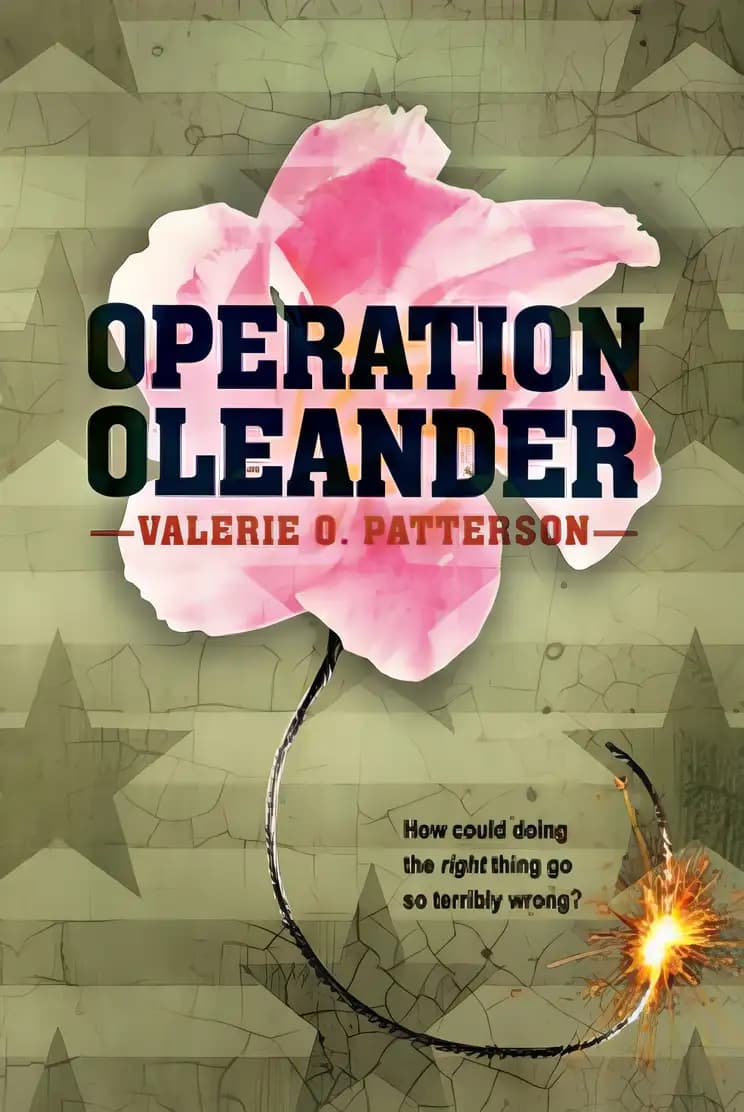
Operation Oleander
on Goodreads (166)
What’s inside...
Ninth grader Jess Westmark starts Operation Oleander to raise money for a girls' orphanage in Kabul, inspired by the flower that grows both in her Florida hometown and Afghanistan, where her father is deployed. However, when her father is gravely injured in a car bomb explosion during a supply delivery to the orphanage, and her best friend's mother and some children are killed, Jess is left wondering if it's all her fault.
Age
10-12
Length
192 pages
Text complexity
Character compass
Jess Westmark
Meredith
Vanessa
Discussion points
What are some ways Jess tries to make a difference in the world? How does her approach change throughout the story?
How do the different settings in the book, from the U.S. to Afghanistan, affect the characters' perspectives and actions?
What role does friendship play in 'Operation Oleander'? How do Jess and her friends support or challenge each other?
Discuss the consequences of Jess’s actions. What lessons does she learn about helping others?
How does the author use the symbols, like the oleander flower, to enhance the story? What do these symbols mean to you?
Tip: Role play these questions
Encourage your child to relate personal experiences when discussing Jess's efforts to help others. It can deepen understanding and empathy.
Explore the cultural differences highlighted in the book. This can be a great stepping stone to teach respect and appreciation for diverse lifestyles.
Focus on the friendships in the story. Ask your child about their own friendships and how they can support or challenge their friends positively.
Discuss the outcomes of actions with your child, emphasizing that even good intentions can have complicated consequences.
Use the symbols in the book as a starting point to discuss the deeper meanings of everyday objects and beliefs in your child's world.
Key lessons
Example Lesson: Empathy and understanding
Explanation: In 'Operation Oleander,' the protagonist Jessamy learns to understand and empathize with the challenges faced by people living in a war-torn country.
Real-World Application: Children can apply this lesson by learning to appreciate and connect with people from diverse backgrounds and understanding the struggles they face.
Example Lesson: Consequences of actions
Explanation: The story illustrates how Jessamy's well-intentioned actions of sending gifts to an orphanage in Afghanistan lead to unforeseen consequences, teaching the importance of considering the impact of one's actions.
Real-World Application: This encourages children to think critically about the potential effects of their decisions and actions on others around them.
Example Lesson: Resilience in adversity
Explanation: Jessamy faces numerous challenges and setbacks throughout the book, and her journey teaches resilience and the ability to overcome difficulties.
Real-World Application: Children learn that perseverance and resilience are essential qualities to navigate life's challenges effectively.
Example Lesson: Importance of community support
Explanation: The book highlights how the community comes together to support the orphanage and each other, underscoring the value of collective effort and community support.
Real-World Application: This can inspire children to participate in community activities and understand the power of helping and being supported by others.
Example Lesson: Personal growth through mistakes
Explanation: Jessamy's experiences in 'Operation Oleander' show that making mistakes is a part of life and an opportunity for personal growth and learning.
Real-World Application: This teaches children to view mistakes as learning opportunities rather than setbacks, promoting a growth mindset.