
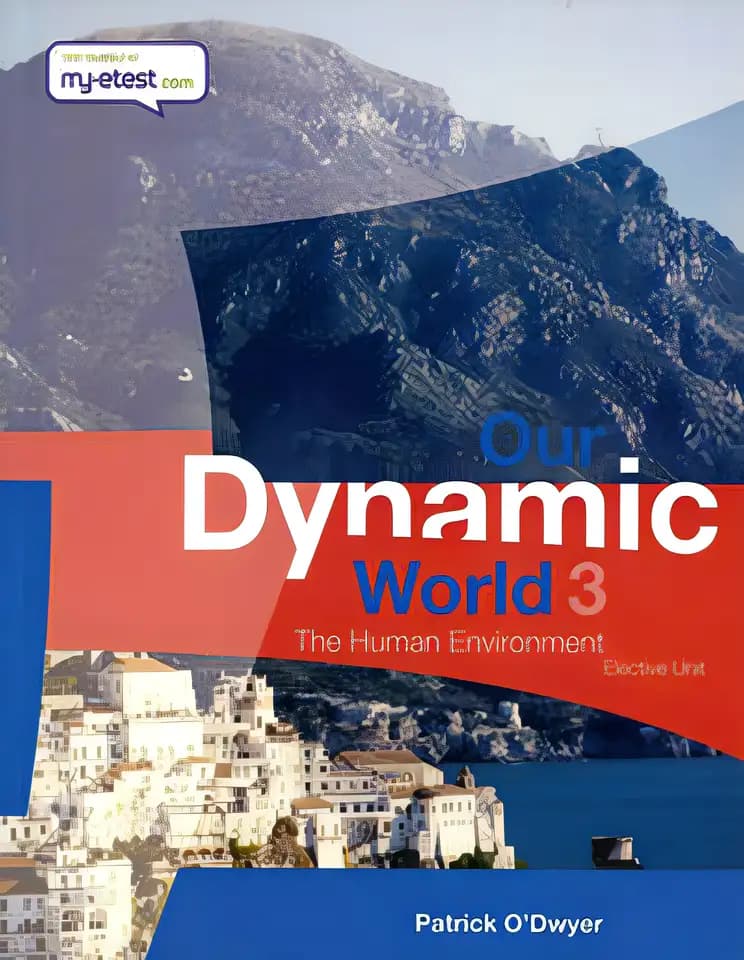
Our Dynamic World: Human Environment (Elective Unit) Bk. 3
What’s inside...
Our Dynamic World 3: The Human Environment covers such topics as: - The dynamics of population - Levels of human development - Population movements - Settlement. Our Dynamic World 3: The Human Environment is written with both Higher and Ordinary level students in mind. It draws on concepts and examples already introduced in Our Dynamic World 1: Core Book in order to reinforce the student' s grasp of key issues.
Packed with full-colour diagrams, maps and photographs. Contains plenty of activities which test the student's ability to handle a variety of examination-type questions.
New syllabus checklist is included for ease of reference.
Why read this book
- Explores human-environment interactions vividly.
- Enhances geographical knowledge and awareness.
- Encourages critical thinking about sustainability.
- Ideal for group discussions and projects.
Age
14-18
Length
168 pages
Text complexity
Discussion points
What are some ways humans impact the environment, and how does the environment influence human activities?
Can you think of a local example where human activity has altered the environment? What were the consequences?
How do you feel about the relationship between humans and the environment after reading this book?
What are some steps we can take to improve our environment based on what you've learned?
If you could advocate for one environmental change in our community, what would it be and why?
Tip: Role play these questions
Encourage your child to relate the book's themes to their everyday observations or experiences. This will help personalize the information and make it more memorable.
Ask your child to imagine they are environmental scientists or policymakers. Engage them in a role-play to discuss the book’s themes and what decisions they would make.
Use diagrams or maps while discussing to visually connect the concepts presented in the book, making the interaction both informative and engaging.
Prompt your child to ask their own questions about the environment, fostering a deeper curiosity and understanding of the topic.
Celebrate your child's insights and encourage them to think about practical applications of what they've learned to enhance their critical thinking skills.
Key lessons
Example Lesson: Interdependence of humans and environment
Explanation: This book explores the crucial relationship between humans and their environment, demonstrating how our daily activities impact the world around us.
Real-World Application: Children can apply this lesson by engaging in environmentally friendly practices like recycling, conserving water, and participating in community clean-up events.
Example Lesson: Responsibility towards sustainable living
Explanation: Through various examples, the book teaches about the importance of sustainable living practices to preserve the environment for future generations.
Real-World Application: Kids can learn to make sustainable choices such as using reusable bags, turning off lights when not in use, and learning about renewable energy sources.
Example Lesson: Cultural awareness and respect
Explanation: The narrative highlights diverse human-environment interactions across different cultures, promoting an appreciation for how various communities interact with their surroundings.
Real-World Application: Children can practice this lesson by showing interest in learning about different cultures, their environmental practices, and respecting their ways of living.
Example Lesson: Impact of technology on environment
Explanation: The book delves into the effects of technological advancements on the environment, both positively and negatively.
Real-World Application: This encourages children to think critically about the use of technology and its environmental impact, promoting a discourse on innovation with responsibility.
Example Lesson: Active participation in community initiatives
Explanation: It emphasizes the power of community efforts in environmental conservation and restoration projects.
Real-World Application: Children are encouraged to participate in local environmental clubs, school programs, or any initiatives aimed at community betterment, fostering a sense of responsibility and belonging.