
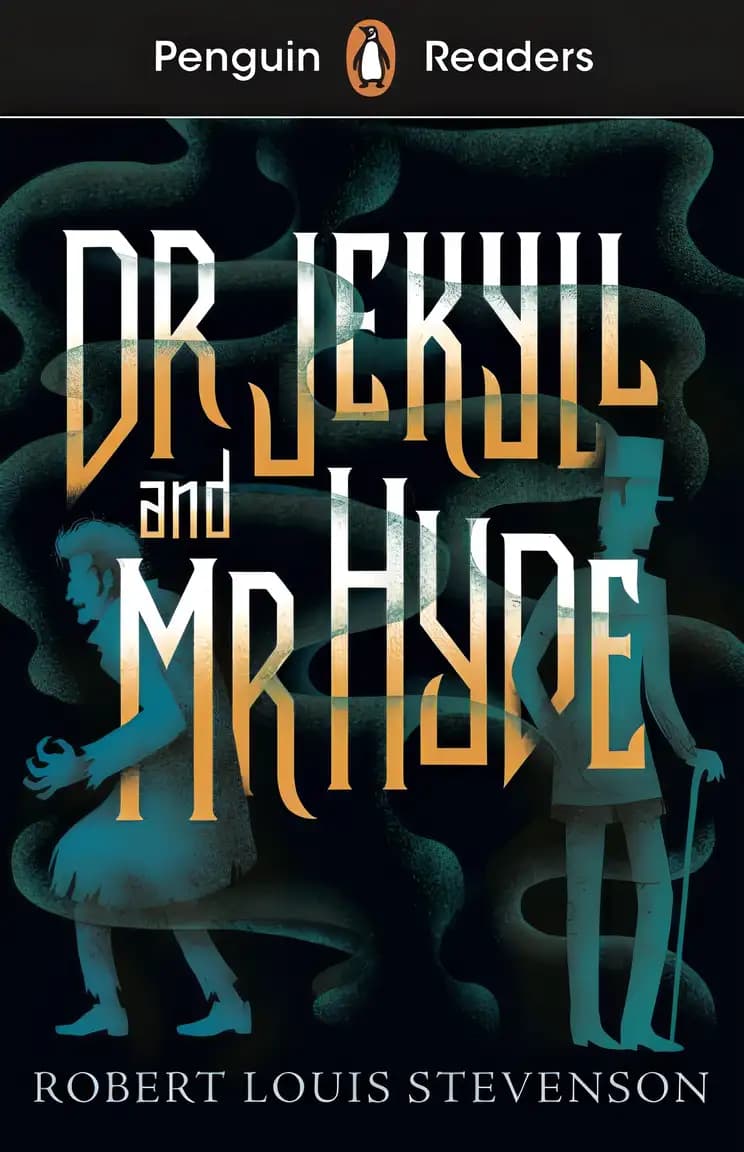
Penguin Readers Level 1: Jekyll and Hyde (ELT Graded Reader)
Penguin Joint Venture Readers S. Series
on Goodreads (6)
What’s inside...
Penguin Readers is an ELT graded reader series designed for learners of English as a foreign language. It features adapted texts, new illustrations, and language exercises across eight levels that correspond to the Common European Framework of Reference for language learning (CEFR). Each Reader includes grammar, vocabulary, and exam skills exercises. Additional online resources like digital books, audio editions, and lesson plans are available with the print edition. The series covers a range of genres and introduces learners to renowned authors and engaging content.
Series reading
Non-Sequential
Age
12-17
Length
64 pages
Text complexity
Character compass
Dr. Henry Jekyll
Poole
Dr. Hastie Lanyon
Mr. Gabriel John Utterson
Mr. Edward Hyde
Discussion points
What do you think Dr. Jekyll and Mr. Hyde represent in the story?
How do the characters in the book react to changes in Dr. Jekyll’s behavior?
Why do you think it's important for Dr. Jekyll to keep Mr. Hyde a secret?
What lessons can we learn about good and bad from Dr. Jekyll’s experiences?
How do you feel about the choices Dr. Jekyll makes throughout the story?
Tip: Role play these questions
Encourage your child to think about the dual nature of human beings, as symbolized by Jekyll and Hyde. Ask them how they see these aspects within themselves or others. Discuss the importance of accepting all parts of oneself and the consequences of hiding one's true nature. Highlight the moral lessons and invite your child to consider what they would do in Jekyll's situation, fostering empathy and ethical thinking.
Key lessons
Example Lesson: The importance of self-control
Explanation: The protagonist, Dr. Jekyll, struggles with his darker side, portraying the battle between his good and evil tendencies. His transformation into Mr. Hyde shows the consequences of losing self-control.
Real-World Application: Children can learn the significance of managing their impulses and emotions to avoid negative outcomes. It teaches them to strive for balance and make wise choices in everyday scenarios.
Example Lesson: Understanding consequences
Explanation: As Jekyll’s experiments progress, the irreversible harm caused by Hyde’s actions showcases how decisions can have lasting effects.
Real-World Application: This narrative helps children understand that their actions have consequences. It encourages them to think before they act and recognize the impact of their decisions on themselves and others.
Example Lesson: The value of responsibility
Explanation: Dr. Jekyll's inability to control his alter ego, Mr. Hyde, demonstrates a lack of responsibility for his own creations and actions.
Real-World Application: This lesson can teach children the importance of taking responsibility for their actions and being accountable for the outcomes, good or bad.
Example Lesson: The conflict between good and evil
Explanation: The dual nature of Jekyll and Hyde illustrates the internal and external conflicts between moral righteousness and wrongdoing.
Real-World Application: Children can learn to identify and choose between right and wrong, understanding that everyone has the capacity for both, but the choices we make define us.