
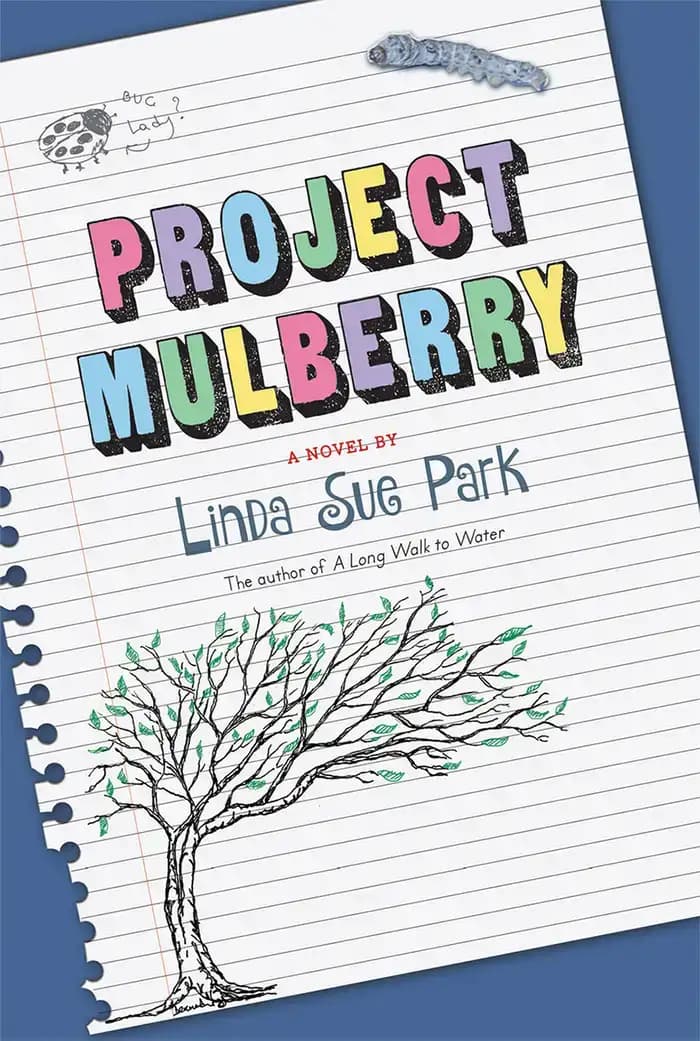
Project Mulberry
on Goodreads (4,036)
What’s inside...
In this contemporary novel, Newbery Medalist Linda Sue Park delivers a funny, lively story that illuminates both the process of writing a novel and the meaning of growing up American. The story follows Julia Song and her friend Patrick as they attempt to win a blue ribbon at the state fair by raising silkworms, a project suggested by Julia's mother based on her childhood in Korea. Despite obstacles such as sourcing mulberry leaves and fitting in with their club's traditional American projects, Julia and Patrick work well as a team. However, the author, Ms. Park, complicates Julia's life, adding depth to the challenges she faces in balancing her heritage with her American upbringing.
Age
8-12
Length
272 pages
Text complexity
Character compass
Julia Song
Patrick
Mr. Dixon
Mrs. Song
Discussion points
What did you learn about friendship and teamwork from Julia and Patrick’s experience with the silkworm project?
How do you think Julia’s feelings towards Mr. Dixon change throughout the story and why?
What are some challenges that Julia faces in the story, and how does she try to overcome them?
How does the setting of the story influence the events and characters?
What did you think of the book’s ending and the decisions the characters made?
Tip: Role play these questions
Encourage your child to reflect on their own experiences with teamwork and how they relate to Julia and Patrick.
Discuss the importance of understanding and respecting different cultures, drawing parallels from Julia’s Korean heritage and how it plays into the story.
Ask your child how they might have handled the challenges Julia faced, fostering a deeper connection to the character’s emotions and decisions.
Explore the impact of the setting by discussing how different or similar your child’s environment is compared to the book’s setting.
After finishing the book, encourage your child to imagine a continuation of the story or an alternative ending, enhancing their creativity and critical thinking.
Key lessons
Example Lesson: Value of hard work and perseverance
Explanation: The protagonist, Julia, undertakes a silkworm project and faces numerous challenges. Her perseverance in managing these hurdles portrays the value of hard work.
Real-World Application: Children can apply this lesson by staying diligent on their tasks at school or at home, understanding that persistence leads to achieving goals.
Example Lesson: Understanding and embracing cultural diversity
Explanation: Julia, who is Korean-American, struggles with her identity and cultural heritage throughout the story. The book explores themes of acceptance and pride in one's background.
Real-World Application: This encourages children to take pride in their own culture and heritage and fosters respect and understanding towards the different backgrounds of their peers.
Example Lesson: Importance of friendships and teamwork
Explanation: Julia and her friend Patrick work together on the silkworm project, learning to collaborate and support each other despite their differences.
Real-World Application: Children learn the importance of cooperating and valuing each other's input and perspective in collaborative tasks, whether in school projects or group sports.
Example Lesson: Dealing with ethical dilemmas
Explanation: The book illustrates Julia grappling with the moral implications of her silkworm project, specifically concerning the exploitation of living creatures for a project.
Real-World Application: This lesson aids children in understanding the complexities of ethical decision-making and encourages them to think critically about the impact of their actions on others and the environment.
Example Lesson: Environmental awareness and responsibility
Explanation: Through the lifecycle of the silkworms, the book introduces concepts of biology and ecology, encouraging a responsibility towards natural processes.
Real-World Application: Children can learn to be more observant and appreciative of nature, understanding their role in the preservation and welfare of the environment.