
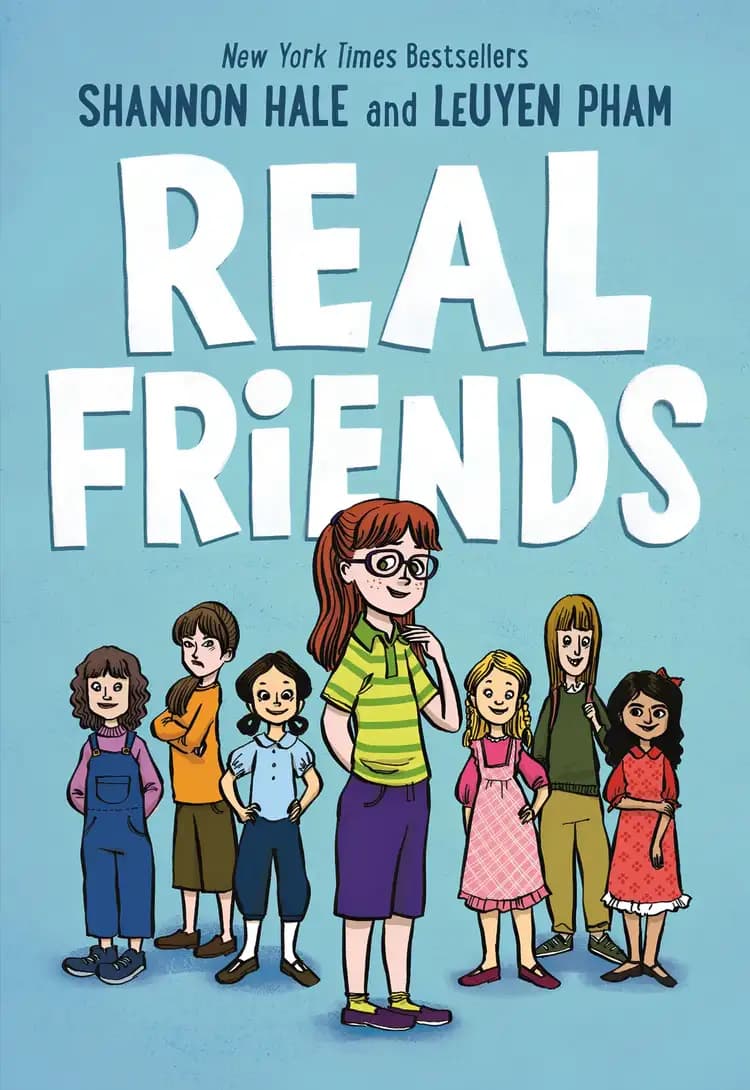
Real Friends
#1 of 4 in Best Friends Series
What’s inside...
When best friends are not forever . . .
Shannon and Adrienne have been best friends ever since they were little. But one day, Adrienne starts hanging out with Jen, the most popular girl in class and the leader of a circle of friends called The Group. Everyone in The Group wants to be Jen's #1, and some girls would do anything to stay on top . . . even if it means bullying others.
Now every day is like a roller coaster for Shannon. Will she and Adrienne stay friends? Can she stand up for herself? And is she in The Group—or out?
Newbery Honor author Shannon Hale and New York Times bestselling illustrator LeUyen Pham join forces in this graphic memoir about how hard it is to find your real friends—and why it's worth the journey.
Why read this book
- Explores complexities of friendship in childhood.
- Encourages emotional intelligence and empathy.
- Based on real-life experiences, relatable storytelling.
- Supports social skill development.
Character compass
Shannon Hale
Adrien
Wendy
Jen
Discussion points
How did the characters in 'Real Friends' handle conflicts in their friendships? Can you think of a time when you faced something similar?
What does friendship mean to you, and why do you think it's important?
How did Shannon change throughout the story? What did she learn about herself and her friends?
What would you do if you were in Shannon’s shoes in different scenarios in the book?
What qualities do you think make someone a good friend?
Tip: Role play these questions
While discussing 'Real Friends', show genuine interest in your child’s thoughts and feelings about friendship.
Use examples from the book to illustrate complex emotions and situations. It can make it easier for the child to relate and open up.
Encourage your child to draw parallels between their personal experiences and the ones depicted in the book, fostering deeper understanding of interpersonal relationships.
Acknowledge and validate their feelings, even if their perspective differs from the actions of the characters in the book.
Promote empathetic thinking by asking them how they would feel if they were in the same situation as the characters.
Key lessons
Example Lesson: Understanding Friendship Dynamics
Explanation: Through Shannon’s narrative, children see the complexities of friendships and how they can change over time, teaching resilience and adaptability.
Real-World Application: Children can use this lesson to navigate their own friendships at school and beyond, understanding that friendships might evolve as they grow.
Example Lesson: Importance of Self-Expression
Explanation: Shannon Hale highlights the significance of being true to oneself even when it’s challenging, illustrated through the protagonist's struggle to fit in.
Real-World Application: Kids are encouraged to embrace their unique qualities and express themselves authentically in various social settings.
Example Lesson: Handling Peer Pressure
Explanation: The story demonstrates the impact of peer pressure on Shannon and how she learns to handle it, promoting self-awareness and critical thinking.
Real-World Application: This teaches children to make decisions based on their values rather than succumbing to peer influence.
Example Lesson: Developing Empathy
Explanation: As readers see the world from Shannon’s perspective, they learn to understand and share the feelings of others.
Real-World Application: Children can apply empathy in real life, improving their interactions and relationships with peers.
Example Lesson: Resolving Conflicts
Explanation: The book showcases various methods Shannon and her friends use to resolve conflicts, underscoring the importance of communication and forgiveness.
Real-World Application: Children learn practical ways to resolve disagreements with friends and family through open communication and understanding.