
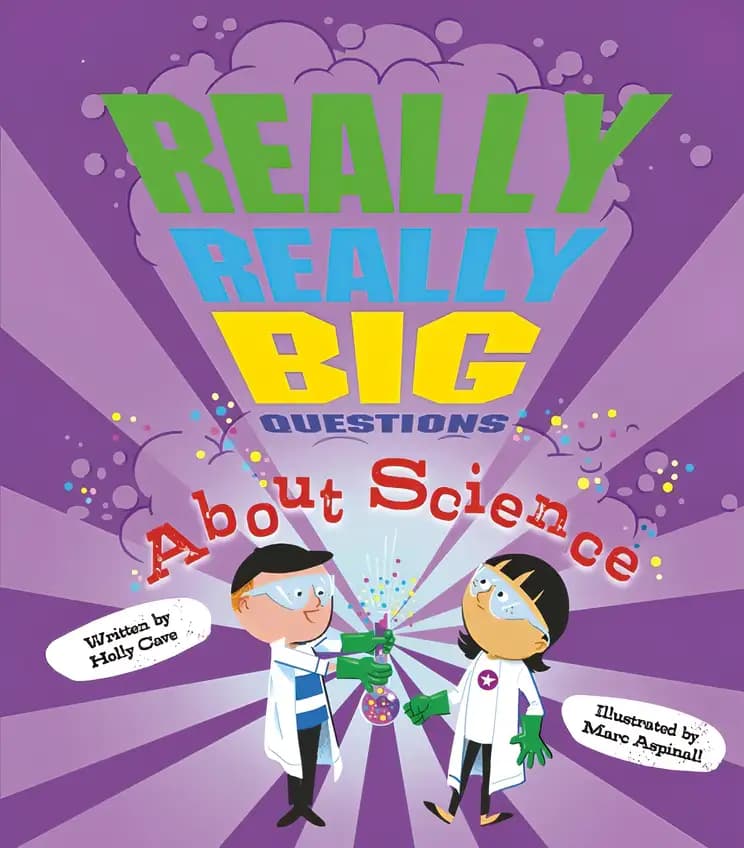
Really, Really Big Questions About Science
I Really, Really Need a Wee Series
on Goodreads (7)
What’s inside...
Really Really Big Questions About Science is an engaging introduction to science and philosophy, exploring intriguing and often unanswered questions such as the best invention, what makes something funny, and the ethics of animal testing in medicine. The book features witty, thought-provoking text and humorous, retro-cool illustrations, making it an unforgettable journey. It is part of a highly acclaimed philosophy series and has been praised as a life-enhancing book that every home should have. The fifth installment, illustrated by Marc Aspinall and written by Holly Cave, includes cool illustrations, brainteasers, and quirky quotations in a simple and fun question-and-answer format, delving into questions like what's in empty space, can elephants cry, and what came first: the chicken or the egg.
Series reading
Non-Sequential
Age
9-12
Length
64 pages
Text complexity
Discussion points
What would happen if gravity stopped working for a day?
How do you think plants drink water?
Can you imagine inventing something new? What would it be?
Why do you think the sky is blue?
Tip: Role play these questions
Encourage your child to think critically by asking them to explain their thoughts after each question. Complement their ideas and guide them to explore further by suggesting simple experiments or observations related to their answers. Share your own thoughts and curiosity to model engagement and enthusiasm.
Key lessons
Example Lesson: Curiosity and inquisitive thinking
Explanation: The book presents complex scientific concepts in a simple, question-and-answer format that encourages young readers to ponder and inquire about the world around them.
Real-World Application: Children can apply this lesson by asking questions about everyday phenomena, fostering a lifelong love for learning and exploration.
Example Lesson: Critical thinking
Explanation: Through its exploration of big scientific questions, the book challenges children to think critically and evaluate information.
Real-World Application: This skill helps children in problem-solving and making informed decisions in their daily activities, from choosing the best materials for a school project to understanding how different elements interact in nature.
Example Lesson: Understanding the scientific method
Explanation: The book indirectly teaches the scientific method by encouraging hypothesis, experimentation, and observation.
Real-World Application: Children learn to apply these principles in real life, conducting simple experiments at home or school which promote a systematic approach to inquiry and knowledge.