
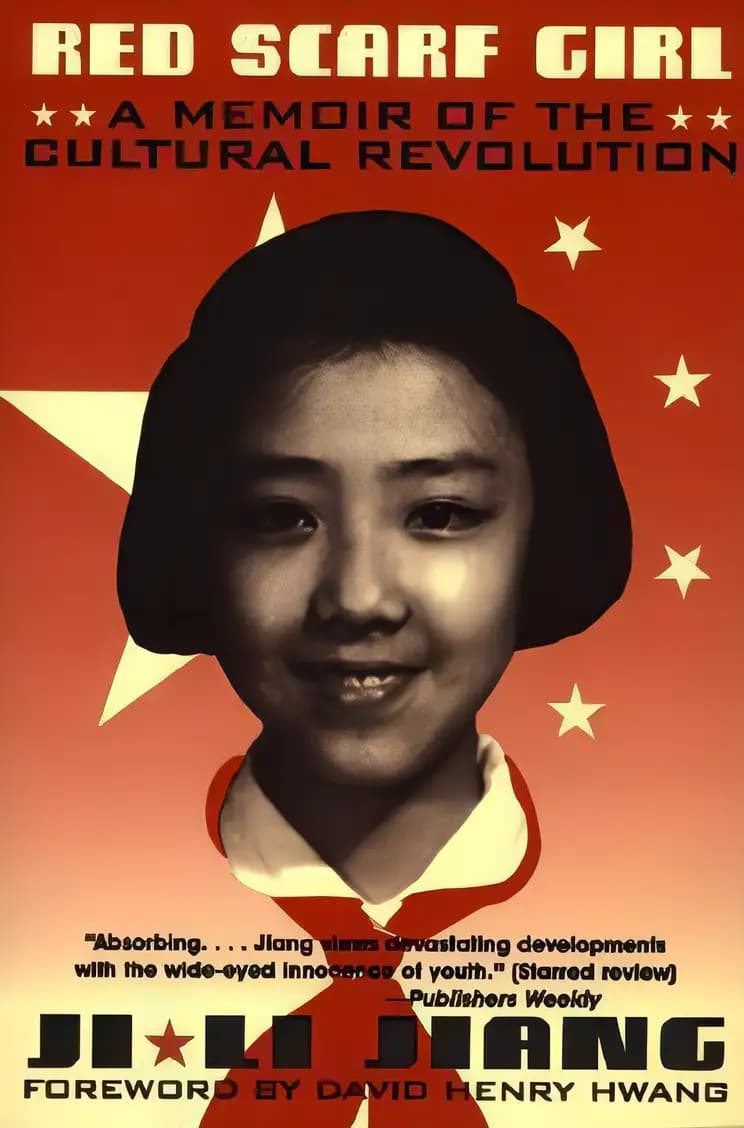
Red Scarf Girl: A Memoir of the Cultural Revolution
on Goodreads (16,643)
What’s inside...
In 1966, Ji–li Jiang turned twelve and was thriving as an outstanding student and leader in China's Communist Party. However, the Cultural Revolution launched by Mao Ze–dong changed everything. Ji–li and her family faced humiliation and terror, ultimately leading to her father's detention and Ji–li's difficult choices. This true story, told with simplicity and grace, highlights the courage and determination of one family during a frightening era in the twentieth century.
Age
11-12
Length
301 pages
Text complexity
Character compass
Ji-Li Jiang
Chang Hong
Song Po-Po
An Yi
Ji-Yun
Ji-Yong
Grandma
Ji-Li's Mother
Ji-Li's Father
Yin Lan-Lan
Du Hai
Discussion points
How did Ji-Li Jiang's experiences during the Cultural Revolution shape her understanding of family and loyalty?
Why do you think education and knowledge were treated the way they were during this period in the book?
What emotions did you feel when reading about Ji-Li's choices and challenges?
How does Ji-Li's story help us appreciate the freedoms and opportunities we have today?
In what ways did Ji-Li show resilience and strength throughout her journey?
Tip: Role play these questions
Set a comfortable and open environment where your child feels safe to express their thoughts and emotions about the story.
Encourage your child to relate the historical context of the Cultural Revolution to current events or their own life to deepen their understanding and empathy.
Highlight the aspects of bravery and moral dilemmas faced by Ji-Li to facilitate discussions on ethics and personal values.
Ask your child to pick a favorite quote or passage and explain why it stood out to them, fostering critical thinking.
Discuss the importance of history and learning from it to avoid repeating the mistakes of the past.
Key lessons
Example Lesson: Resilience in the face of adversity
Explanation: The protagonist, Ji-Li Jiang, faces immense challenges and choices during the Cultural Revolution, which tests her strength and determination.
Real-World Application: Children can learn to persist through difficulties, whether dealing with academic challenges or personal setbacks, and understand the value of staying strong in tough situations.
Example Lesson: The importance of critical thinking
Explanation: Ji-Li is confronted with propaganda and has to learn to question the rhetoric and think for herself, rather than blindly following the masses.
Real-World Application: This teaches children to analyze information critically, question inconsistencies, and form their own educated opinions rather than accepting information at face value.
Example Lesson: Value of family
Explanation: Throughout the hardships, Ji-Li realizes the importance of her family’s support and the sacrifices they make for one another.
Real-World Application: Children can learn to appreciate their family's role in their lives, understand the significance of familial bonds, and foster a supportive home environment.
Example Lesson: Courage to stand up for what is right
Explanation: Ji-Li is often placed in situations where she must make tough decisions between her ideals and safety.
Real-World Application: Encourages children to uphold their values and ethics, even when faced with peer pressure or challenging circumstances, promoting integrity.
Example Lesson: Learning from history
Explanation: The book offers a personal perspective on the Cultural Revolution, allowing readers to learn about historical events through personal narratives.
Real-World Application: Helps children understand historical contexts and encourages them to learn from past events to shape a better future.