
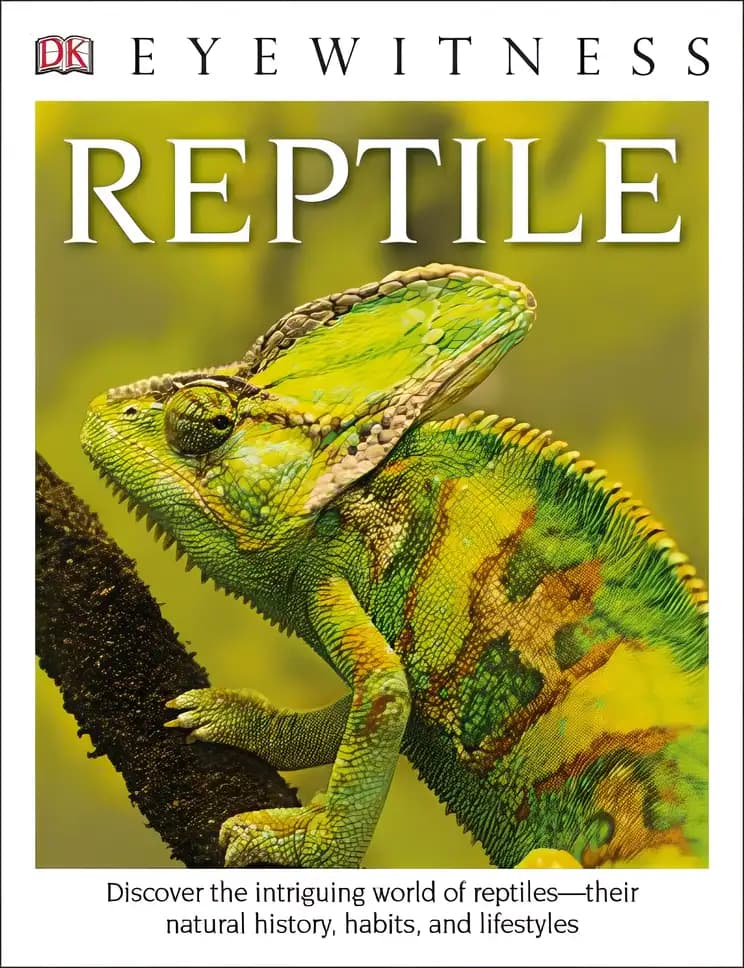
Reptile
#30 in Eyewitness Science Series
What’s inside...
Explore the intriguing characteristics and behaviors of reptiles with DK Eyewitness Reptiles. Discover how crocodiles care for their young, lizards store fat, and chameleons swivel their eyes. Learn about snake charming, gecko's upside-down walking, and why crocodiles swallow stones. The book includes a giant fold-out wall chart full of facts, stunning close-up photographs, and insights into the behaviors of snakes, crocodiles, lizards, and turtles. Part of the trusted DK Eyewitness series, this book offers a unique view into the world of reptiles, making learning engaging and fun.
Discussion points
What was your favorite reptile in the book and why did you like it?
How do you think reptiles feel about their environment?
Can you imagine a day in the life of a reptile? What would you do if you were one?
What have you learned about how reptiles survive in the wild?
How are reptiles different from other animals we've read about?
Tip: Role play these questions
Before reading, ask your child what they already know about reptiles to activate prior knowledge.
While reading, point out the illustrations and ask your child to describe what they see. This can help them connect visuals with text.
After reading, encourage your child to draw their favorite reptile from the book and explain why they chose it. This helps reinforce memory and personal connection.
Compare the traits of reptiles to pets or humans, discussing their unique characteristics and what makes all living creatures special.
Introduce a fun fact research activity where your child picks one reptile from the book and looks up more facts about it online or in other books.
Key lessons
Example Lesson: Respect for nature
Explanation: The story illustrates the importance of preserving natural habitats and treating all creatures with kindness, focusing on the relationship between the characters and their environment.
Real-World Application: Children can be encouraged to participate in recycling, conserving water, and joining nature clean-up activities to apply these principles in real life.
Example Lesson: Teamwork and cooperation
Explanation: Throughout the book, characters work together to solve problems encountered in their adventures, showcasing the power of collective effort.
Real-World Application: Kids can practice teamwork during group activities in school or while playing sports, learning to value each member's contribution.
Example Lesson: Courage and overcoming fears
Explanation: The protagonist faces and overcomes various challenges, teaching children that bravery is not the absence of fear, but the triumph over it.
Real-World Application: This can translate to children facing their own fears, whether it be trying out for a new activity or standing up for what is right in challenging situations.
Example Lesson: Importance of curiosity and learning
Explanation: Characters display a thirst for knowledge about the world around them, promoting a positive attitude towards learning and discovery.
Real-World Application: Children are encouraged to ask questions and seek answers, fostering a lifelong love for learning and exploration.