
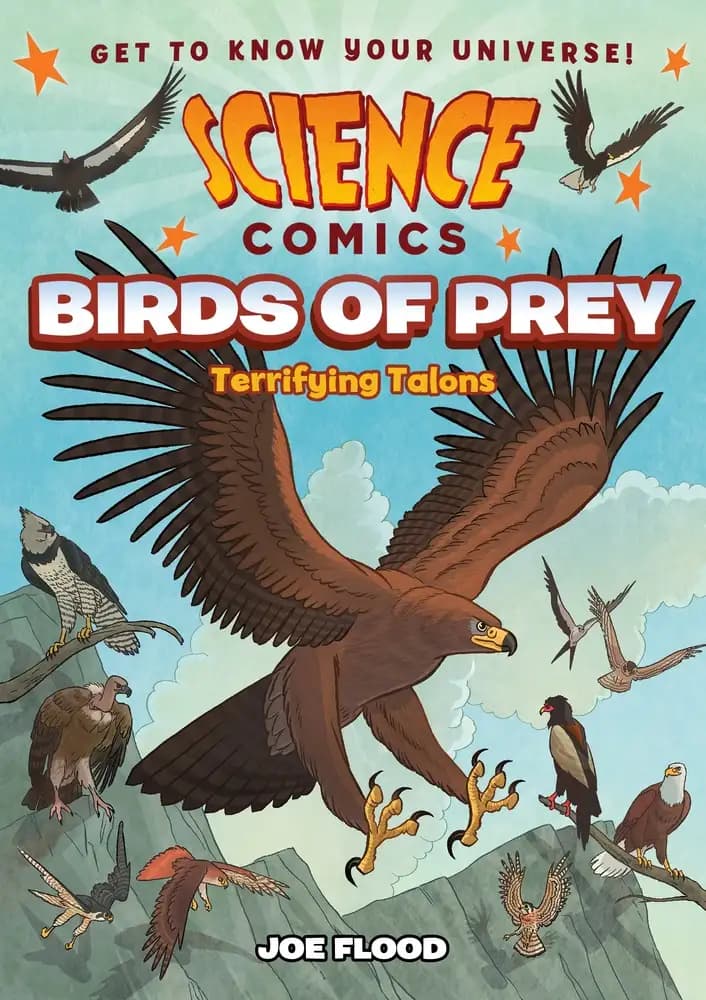
Science Comics: Birds of Prey
Science Comics Series
on Goodreads (148)
What’s inside...
Spread your wings with Science Comics: Birds of Prey, a new and exciting volume of First Second's nonfiction graphic novel series! Every volume of Science Comics offers a complete introduction to a particular topic—dinosaurs, the solar system, volcanoes, bats, robots, and more. Whether you're a fourth grader doing a natural science unit at school or a thirty-year-old with a secret passion for airplanes, these graphic novels are for you! In this volume, you'll get up-close and personal with some of the world’s most skilled hunters, from the majestic eagle to the oft-maligned scavenger vulture! Armed with razor-sharp claws, keen eyesight, powerful wings, and killer instincts, these stealthy predators can make a meal of rodents, fish, snakes, lizards, monkeys, and even kangaroos! Discover how these amazing birds who are often at the top of the food chain, play an integral role in many different ecosystems around the world.
Series reading
Non-Sequential
Age
9-13
Length
128 pages
Text complexity
Discussion points
What characteristics make birds of prey different from other birds?
Can you explain how the food chain works with birds of prey at the top?
Why is it important to protect the habitats of these birds?
How do birds of prey adapt to their environments?
What did you learn about the survival skills of birds of prey?
Tip: Role play these questions
Start by sharing your own interest in the subject to spark curiosity. Use the illustrations in the book to point out different types of birds of prey and their features. Relate the content to local wildlife, perhaps identifying birds of prey in your area. Encourage your child to think about the ecological impact of birds of prey and discuss conservation efforts. Lastly, ask your child to imagine what life would be like as a bird of prey, which can lead to creative thinking and deeper understanding.
Key lessons
Example Lesson: The importance of biodiversity
Explanation: The book showcases various birds of prey, emphasizing their roles in maintaining ecological balance.
Real-World Application: Children learn to appreciate and understand the necessity of preserving different species and their habitats in nature.
Example Lesson: Adaptation and survival skills
Explanation: Through detailed illustrations and narratives, the book explains how birds of prey have adapted to their environments to survive.
Real-World Application: Kids can apply the concept of adaptation to their own lives by learning how to adjust to new situations or environments effectively.
Example Lesson: Food chain and ecosystem interdependence
Explanation: ‘Science Comics: Birds of Prey’ delves into the diet of these birds and their role at the top of the food chain, illustrating the interdependence within ecosystems.
Real-World Application: This encourages children to understand their impact on the environment and the importance of making sustainable choices.
Example Lesson: Respect for wildlife
Explanation: The book portrays the birds with respect and admiration, focusing on their strengths and the challenges they face.
Real-World Application: This can foster a sense of respect and responsibility towards wildlife and the natural world among young readers.
Example Lesson: Scientific inquiry and exploration
Explanation: Joe Flood encourages curiosity through detailed scientific facts and engaging storytelling about different species.
Real-World Application: Children are inspired to observe, question, and explore the natural world around them, enhancing their analytical skills.