
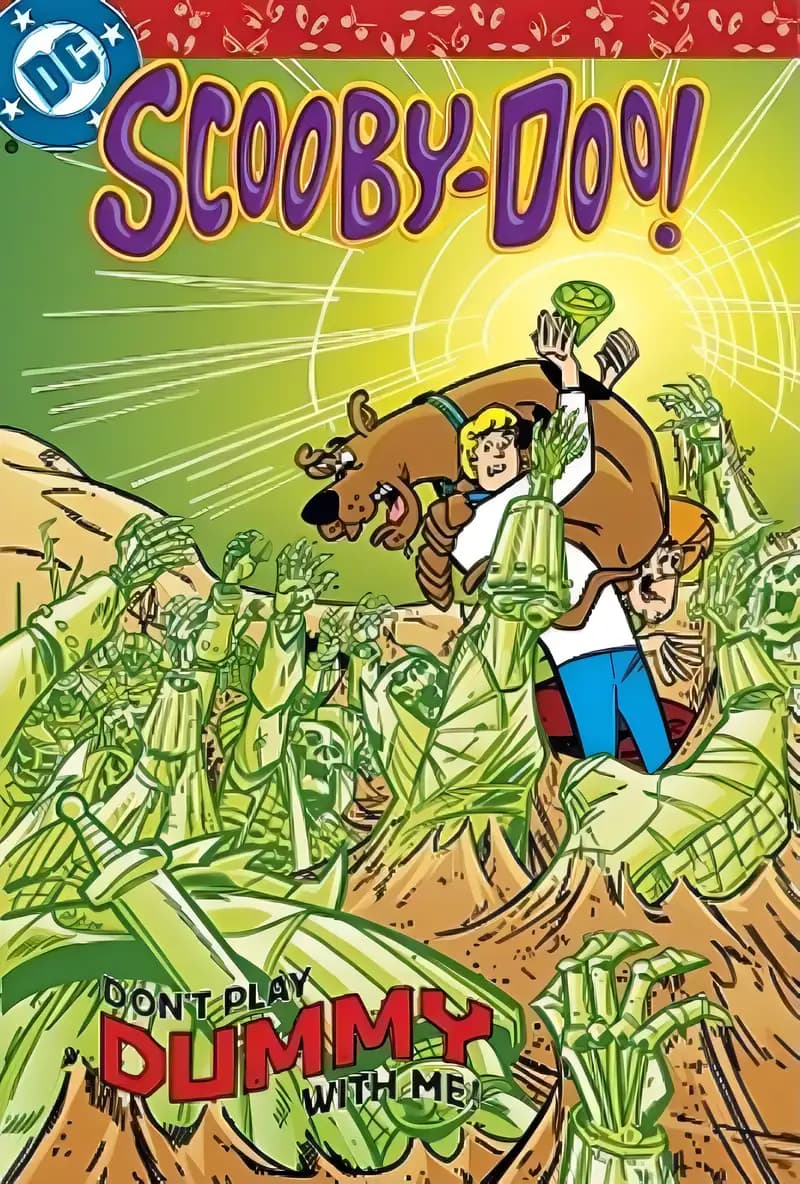
Scooby-Doo in Don't Play Dummy With Me! (Scooby-Doo Graphic Novels)
Scooby-Doo! Team-Up Series
illustrations by
on Goodreads (19)
What’s inside...
In a typical Scooby-Doo adventure, Scooby-Doo and the Mystery Inc. gang—Fred, Daphane, Velma, and Shaggy—stumble upon a spooky mystery involving a ghost, monster, or other supernatural creature that is terrorizing a local community. As they investigate, they encounter various clues, red herrings, and suspects. With Scooby and Shaggy's comedic antics and the team's detective work, they eventually uncover the truth. The supernatural occurrences are usually revealed to be elaborate hoaxes perpetrated by someone with a motive such as revenge, greed, or to cover up a crime. After a chase and a series of mishaps, the gang captures the villain, who is then unmasked and taken into custody. The story concludes with the gang driving off in their van, the Mystery Machine, ready for their next adventure. At the 'haunted fortress' of Kwaidoon, China, the gang faces off against a master thief who's determined to use the Dragon's Eye gem to conquer the world! Plus, a carnival's star attraction disappears, so Scooby joins the circus to save the day! Spotlight editions are printed on high-quality paper and with reinforced library bindings specifically printed for the library market. Grades 2-6.
Series reading
Non-Sequential
Age
7-11
Length
24 pages
Text complexity
Character compass
Scooby-Doo
Daphne Blake
Velma Dinkley
Fred Jones
Norville "Shaggy" Rogers
Discussion points
How did Scooby-Doo and the gang work together to solve the mystery?
What do you think are the most important qualities in a friend, as shown in the story?
Why is it important not to jump to conclusions about 'hauntings' before finding the truth?
How did the characters overcome their fears in the story?
If you were part of Scooby-Doo's team, how would you help solve mysteries?
Tip: Role play these questions
Encourage your child to relate personal experiences to the story, fostering deeper connections and understanding. Discuss the moral lessons in the story and ask your child how they might apply these lessons in their own life. Use expressions and voices for different characters to make the storytelling more engaging and lively. After reading, propose a fun activity like creating a simple ‘mystery game’ based on the plot, enhancing comprehension and creativity.
Key lessons
Example Lesson: Teamwork and Cooperation
Explanation: In the story, Scooby-Doo and his friends work together to solve the mystery. They share tasks, communicate effectively, and support each other which leads to their success.
Real-World Application: Children can apply this lesson by collaborating with their friends or classmates on projects or tasks, understanding the importance of listening to others, and contributing their own ideas effectively.
Example Lesson: Courage and Bravery
Explanation: Throughout the adventure, despite being scared, the characters confront their fears to uncover the truth. This showcases their bravery as they push past their own fears to help others.
Real-World Application: This encourages children to face their own fears, whether it's trying out for a sports team, speaking in front of the class, or standing up against bullying, demonstrating that courage can lead to positive outcomes.
Example Lesson: Problem-Solving Skills
Explanation: The characters in the book use clues and logical reasoning to solve the mystery. This critical thinking process is essential in piecing together the puzzle.
Real-World Application: Children learn to observe details, think critically, and deduce answers from clues, which can help in academic situations such as understanding a math problem or forming hypotheses in science projects.
Example Lesson: Importance of Humor
Explanation: Humor plays a significant role in the book, with Scooby-Doo often providing comic relief. This shows how laughter can ease tension and create bonds between characters.
Real-World Application: Kids learn that humor can be a way to connect with others, diffuse stressful situations, and see the light-hearted side of challenges they encounter.
Example Lesson: Responsibility
Explanation: The characters take on the responsibility of solving the mystery, demonstrating commitment and dedication to completing tasks they've started.
Real-World Application: This teaches children the value of taking responsibility for their actions and duties, whether it's completing homework, performing chores, or fulfilling promises to friends.