
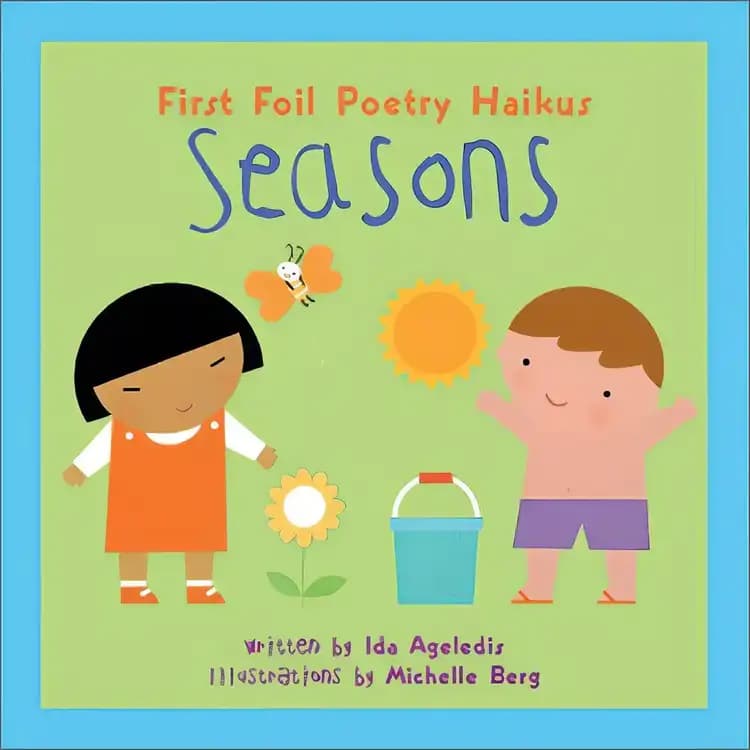
Seasons: First Foil Poetry Haikus
First foil poetry haikus Series
What’s inside...
Introduces children to the four changing seasons--summer, fall, winter, and spring--through fun, clear, and easy-to-understand haikus as well as lively pastel illustrations, lift-the-flaps, and accented foil decorations.
Series reading
Non-Sequential
Age
2-4
Length
10 pages
Text complexity
Discussion points
What feelings did the haiku about spring evoke in you? Can you think of words to describe the season?
How do the illustrations of summer compare to what we see outside during that season? What differences or similarities do you notice?
Which season’s haiku did you enjoy the most and why?
Can you think of your own haiku for your favorite season? What would you include in it?
How do the changing seasons affect the animals and plants in the haikus? Can you give examples?
Tip: Role play these questions
Encourage your child to express their thoughts and feelings about each season depicted in the haikus. Use descriptive language to help them articulate their perceptions. Foster creativity by inviting them to write their own season-themed haiku, emphasizing the sensory details like sights, sounds, and smells. Discuss the natural changes and cycles, relating them to the haikus to enhance their environmental awareness. Most importantly, listen actively to your child’s responses to understand their perspective and make the reading experience enriching.
Key lessons
Example Lesson: Appreciating Nature's Beauty
Explanation: Through succinct and vivid haikus, this book paints a picture of the changing seasons, encouraging children to notice and cherish the natural world.
Real-World Application: Children can be encouraged to observe their own environment, perhaps starting a nature journal or taking seasonal walks to discuss changes they see.
Example Lesson: Understanding Seasonal Changes
Explanation: Ida Ageledis uses the foil poetry format to describe characteristics specific to each season, effectively teaching kids about the cyclic patterns in nature.
Real-World Application: Kids can relate this understanding to their science subjects in school or use it to predict and prepare for upcoming seasonal changes.
Example Lesson: Expressing Thoughts Concisely
Explanation: The haiku format in the book challenges children to understand how impactful brief, structured expressions can be.
Real-World Application: This can help improve their communication skills, making them better at expressing themselves clearly and effectively in school or in social situations.
Example Lesson: Observational Skills
Explanation: Each poem encourages keen observation of small details in the environment, a skill conveyed through the focused imagery of haikus.
Real-World Application: This can enhance a child's attention to detail, which is beneficial in academic settings and in developing mindfulness and presence.
Example Lesson: Creativity and Artistic Expression
Explanation: By encountering poetry from a young age, children learn to appreciate different forms of artistic expression, fostering creativity.
Real-World Application: This exposure can inspire children to explore their own artistic talents, be it through writing their own poems, drawing, or engaging in other creative activities.