
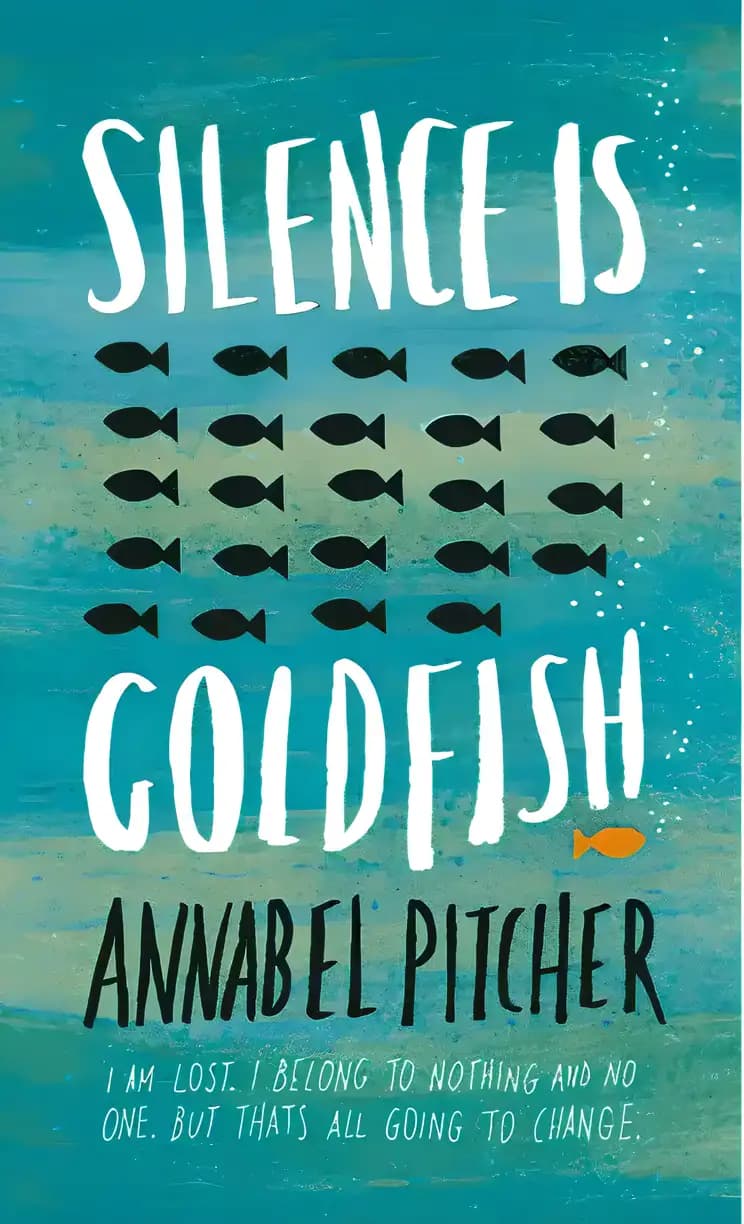
Silence is Goldfish
on Goodreads (3,162)
What’s inside...
'I have a voice but it isn't mine. It used to say things so I'd fit in - to please my parents, to please my teachers. It used to tell the universe I was something I wasn't. It lied.' Fifteen-year-old Tess doesn't mean to become mute. At first, she's just too shocked to speak. And who wouldn't be? Discovering your whole life has been a lie because your dad isn't your real father is a pretty big deal. Tess sets out to find the truth of her identity, and uncovers a secret that could ruin multiple lives. But can she ask for help when she's forgotten how to use her voice?
Age
11-12
Length
365 pages
Text complexity
Character compass
Tess Turner
Toby
Meg
Discussion points
How do you think Tess felt when she decided not to speak? What would you do if you were in her shoes?
What importance does the goldfish flashlight hold for Tess throughout the story? Have you ever had an object that made you feel safe?
Why do you think Tess chooses silence as her form of communication? How do other characters react to her silence?
Can you think of a time when it was hard to express how you felt? What did you do?
What did you learn about friendship and trust from Tess's experiences?
Tip: Role play these questions
Start by sharing your own thoughts on the book to create an open, communicative environment.
Ask your child to draw a scene from the book they found memorable, then discuss why they chose it.
Encourage your child to think about silence and communication by discussing different ways people can express themselves without words.
Relate the book's themes to real-life situations your child might encounter, helping them connect with Tess's story on a personal level.
Praise your child for thoughtful responses and encourage them to ask their own questions about the story.
Key lessons
Example Lesson: The power of self-expression
Explanation: In 'Silence is Goldfish,' the protagonist chooses silence as a form of protest and self-preservation, which highlights the importance of self-expression and finding one's voice.
Real-World Application: Children can learn to express their thoughts and feelings in constructive ways, understanding that their voice matters in their relationships and communities.
Example Lesson: Impact of family secrets
Explanation: The story unfolds the emotional turmoil caused by family secrets, emphasizing how openness and honesty are crucial in family relationships.
Real-World Application: Children can appreciate the value of honesty and trust in the family, helping them foster open communication at home.
Example Lesson: Resilience in adversity
Explanation: As the protagonist faces personal challenges, her journey demonstrates resilience, showing that one can find strength even in difficult times.
Real-World Application: This lesson encourages children to develop resilience and understand that they can overcome obstacles and grow from their experiences.
Example Lesson: Developing empathy
Explanation: The book portrays complex characters with diverse emotions and situations, encouraging readers to develop empathy towards others' experiences and feelings.
Real-World Application: Children can apply this by learning to understand and share the feelings of peers and family, thereby enhancing their emotional intelligence and relationships.
Example Lesson: The importance of friendship
Explanation: Through various interactions and relationships in the book, the value of true friendship is highlighted as a source of support and understanding.
Real-World Application: This promotes the idea of building and maintaining meaningful friendships, helping children to choose and nurture positive relationships in their lives.