
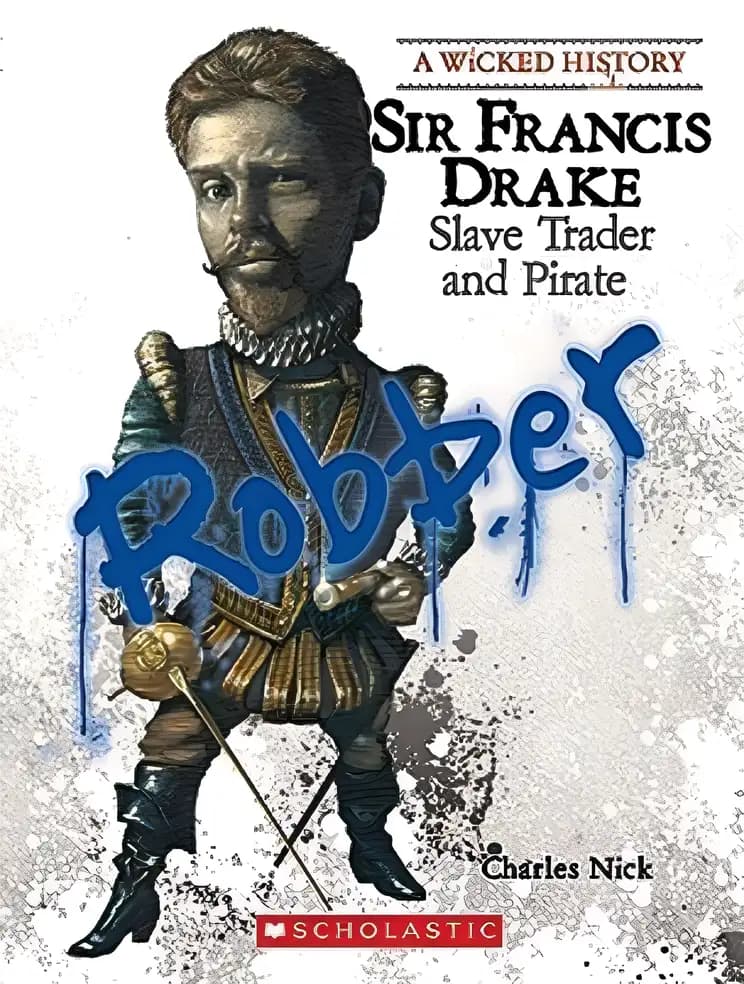
Sir Francis Drake: Slave Trader And Pirate (Wicked History (Paperback)) (A Wicked History)
A Wicked History Series
What’s inside...
In 'Sir Francis Drake: Slave Trader And Pirate (Wicked History (Paperback)) (A Wicked History),' author Charles Nick delves into the darker side of the renowned Elizabethan mariner. The book explores Drake's involvement in the early slave trade, his privateering exploits that bordered on piracy, and the moral complexities of his actions during a time of imperial expansion and conflict. Nick provides a nuanced portrait of Drake, examining his significant achievements as a navigator and hero to the English, while not shying away from the more controversial aspects of his career. Through detailed research, the author aims to shed light on the less celebrated facets of Drake's life, offering readers a more comprehensive understanding of this historical figure.
Series reading
Non-Sequential
Age
11-17
Length
128 pages
Text complexity
Character compass
Sir Francis Drake
John Hawkins
Francis Drake
Discussion points
What actions did Sir Francis Drake take that made him both celebrated and controversial?
How do you think the decisions of historical figures like Drake influence our understanding of right and wrong today?
In what ways did the era Sir Francis Drake lived in differ from our current world, especially in terms of moral and ethical beliefs?
Can someone be considered a hero and a villain at the same time? Why or why not?
How do you think Sir Francis Drake's actions and role as a slave trader affect how we should view his accomplishments?
Tip: Role play these questions
Start the conversation by sharing your own thoughts on Sir Francis Drake’s dual roles to encourage open dialogue.
Encourage your child to think critically by asking them how they would feel if they lived during Drake's time and had to make similar decisions.
Link the discussion to current events, helping them draw parallels between past and present ethical dilemmas.
Prompt your child to consider the perspectives of various characters in the book, including those who may not have agreed with Drake’s actions.
Reinforce that it’s okay to have mixed feelings about historical figures, and that analyzing their actions helps us understand complex human behaviors.
Key lessons
Example Lesson: Understanding historical complexities
Explanation: The book portrays Sir Francis Drake not only as a celebrated explorer but also delves into his involvement in darker activities like slave trading and piracy. This dual depiction helps children understand that historical figures can have complex legacies.
Real-World Application: This lesson can help children grasp that people are not just 'good' or 'bad,' and encourage them to think critically about the nuances in human behavior and historical narratives.
Example Lesson: The impact of moral choices
Explanation: Sir Francis Drake's decisions, such as engaging in piracy and the slave trade, are discussed in terms of their moral implications and the consequences they had during his time.
Real-World Application: Children can learn the importance of making ethical decisions and consider how their own choices could affect others as well as themselves.
Example Lesson: The importance of perspective in history
Explanation: The book presents various viewpoints on Sir Francis Drake’s actions and how he was viewed differently by the English compared to the Spanish or the enslaved people.
Real-World Application: This lesson can teach children that history can be viewed differently from various perspectives, emphasizing the importance of understanding and respecting diverse viewpoints.
Example Lesson: Learning from the past
Explanation: Through learning about Sir Francis Drake's actions and the outcomes they produced, the book encourages reflection on what lessons can be drawn from history.
Real-World Application: This teaches children to think about how we can learn from past events to make better decisions in the future.