
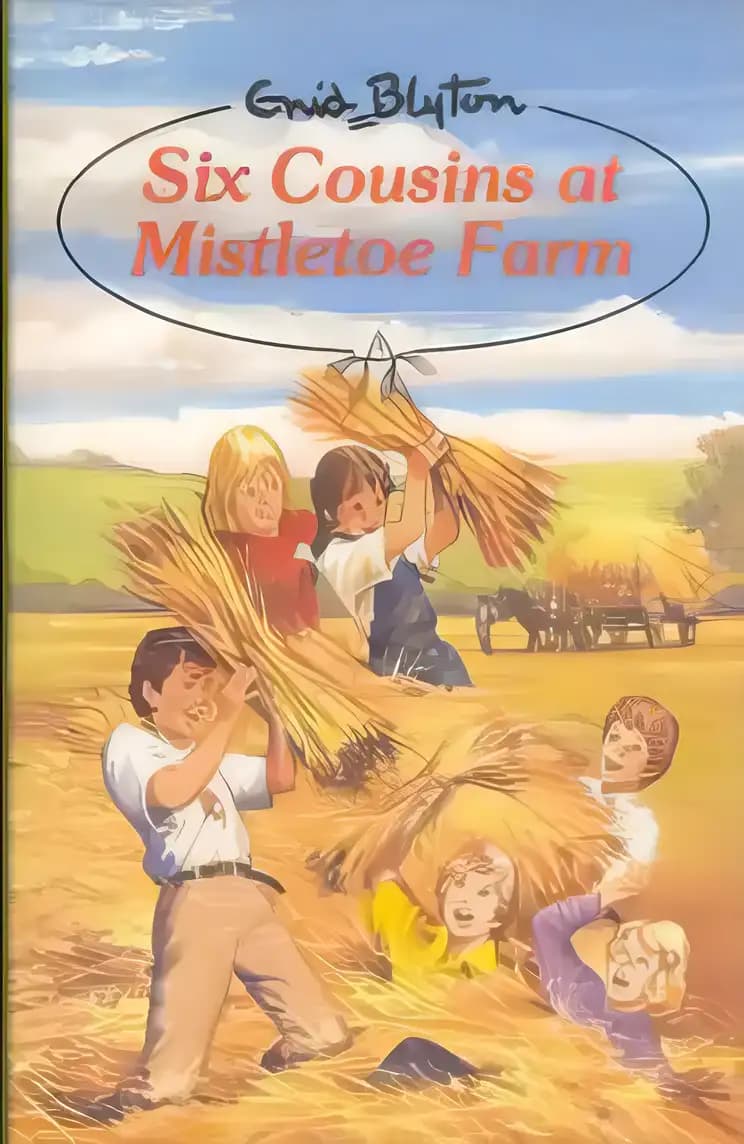
Six Cousins at Mistletoe Farm (Enid Blyton's Six Cousins Series)
#1 in The Six Cousins Series
on Goodreads (715)
What’s inside...
In 'Six Cousins at Mistletoe Farm', part of Enid Blyton's Six Cousins Series, the story revolves around the Longfield family, who live a comfortable life at Mistletoe Farm. Their peaceful existence is disrupted when their cousins, the sophisticated and city-bred Melisande, Cyril, and Roderick, come to stay after their parents are involved in a plane crash. Initially, the cousins struggle to get along due to their different upbringings and personalities. The farm cousins, Jack, Jane, and Susan, are used to a hardworking and simple life, while their city cousins are accustomed to luxury and have a more entitled attitude. Throughout the book, the six children learn to understand and appreciate each other's differences. They embark on various adventures and face challenges that bring them closer together. By the end of the story, they have forged a strong bond and have learned the value of family, cooperation, and hard work.
Character compass
Jane
Roderick
Cyril
Jack
Melisande
Susan
Rose
Harry
Linnie
David
Discussion points
How do you think the cousins felt when they first met at Mistletoe Farm?
What can you learn from the way the cousins learned to work together?
Which cousin do you relate to the most and why?
What does the story teach us about the importance of family and cooperation?
How might the story have ended differently if the cousins hadn't learned to get along?
Tip: Role play these questions
Use expressions and voices for different characters to make the reading experience more engaging.
After reading a chapter, ask your child to predict what might happen next and why they think that.
Discuss the differences and similarities your child feels with the characters to enhance connectivity with the story.
Encourage your child to draw a favorite scene from the book, then describe why they chose it.
Link discussions from the book to real-life family experiences to enhance understanding and relatability.
Key lessons
Example Lesson: The importance of family and cooperation
Explanation: Throughout the book, the cousins learn to work together and support each other despite their differences, demonstrating the power of family bonds.
Real-World Application: Children can apply this lesson by learning to collaborate and build strong relationships with their siblings and relatives, understanding that despite conflicts, family support is invaluable.
Example Lesson: Adaptability and resilience
Explanation: As the cousins adjust to a new lifestyle at the farm, they show resilience in the face of change and challenges, adapting to unfamiliar situations with positivity.
Real-World Application: This teaches children the importance of being flexible and resilient when faced with new environments or changes in life, such as moving to a new school or city.
Example Lesson: Value of hard work and responsibility
Explanation: The story emphasizes the significance of taking responsibility and contributing to community chores on the farm, highlighting the rewards of hard work.
Real-World Application: Children can learn to take on responsibilities, big or small, within their own communities, understanding that their contributions are important and valued.
Example Lesson: Empathy and understanding
Explanation: Through various interactions between the cousins, the book showcases the importance of empathy by understanding and caring for each other's feelings and perspectives.
Real-World Application: This lesson can help children develop stronger social skills, enabling them to connect with peers and adults more effectively by considering and respecting others' emotions.
Example Lesson: Problem-solving skills
Explanation: The cousins encounter and solve various problems together, which fosters teamwork and critical thinking.
Real-World Application: By learning to approach challenges with analytical thinking and cooperation, children can enhance their problem-solving capabilities in day-to-day tasks and school projects.