
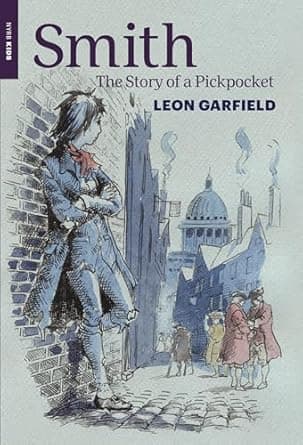
Smith: The Story of a Pickpocket (New York Review Children's Collection)
The New York Review children's collection Series
on Goodreads (972)
What’s inside...
Set in the teeming streets of 18th-century London, Leon Garfield’s Carnegie-Medal–winning novel follows twelve-year-old Smith, a swift-fingered pickpocket whose life changes the moment he steals a document from a well-dressed gentleman—seconds before the man is murdered. Unable to read, Smith must uncover why ruthless villains will kill for the paper while protecting his two sisters and staying one step ahead of the law. His search leads him from the squalor of Seven Dials to the grandeur of St. Paul’s, and finally into the courtroom of a blind barrister who may be friend or foe. Part mystery, part adventure, the tale delivers suspense, humor, and a vivid portrait of Georgian London.
Series reading
Non-Sequential
Age
9-12
Length
216 pages
Text complexity
Character compass
Smith
Hetty (one of Smith’s twin sisters)
Mr. Spiggot
Sir John Fielding
Discussion points
Why does Smith risk everything to decode the document?
How do poverty and privilege shape characters’ choices?
What does Mr. Mansfield teach Smith beyond reading?
Can wrongdoing ever be justified by necessity?
How might life in 18th-century London compare to today?
Tip: Role play these questions
Create a family ‘courtroom’ to debate Smith’s actions.
Use a map to trace Smith’s journey and research the real landmarks.
Key lessons
Example Lesson: Courage means acting despite fear.
Explanation: Smith faces murderers and prison to protect his sisters.
Real-World Application: Standing up to bullies or tackling difficult tasks at school.
Example Lesson: Reading is a gateway to power and safety.
Explanation: Illiteracy endangers Smith; learning to read saves him.
Real-World Application: Valuing education and seeking help when struggling with literacy.
Example Lesson: Justice may require teamwork.
Explanation: Smith and Mansfield combine skills to expose criminals.
Real-World Application: Collaborating with friends or adults to solve problems fairly.
Example Lesson: Appearances can mislead.
Explanation: A beggar boy and a blind man outwit well-dressed villains.
Real-World Application: Withholding judgment and getting to know people’s true abilities.