
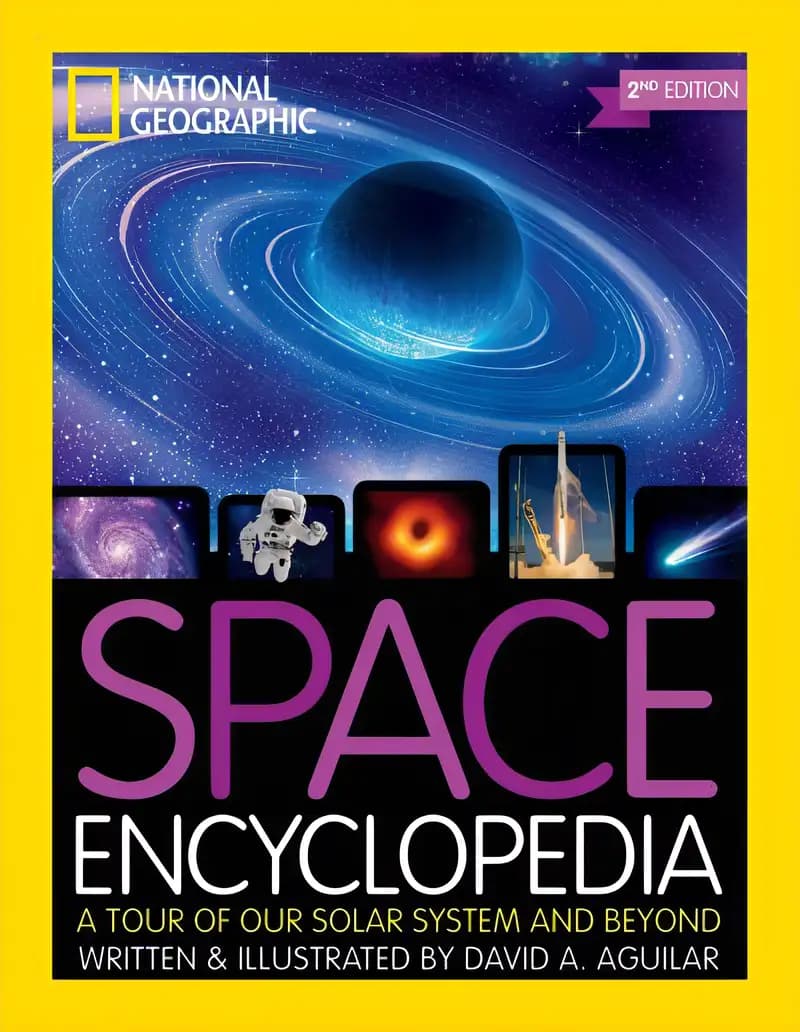
Space Encyclopedia, 2nd Edition: A Tour of Our Solar System and Beyond
#2 of 27 in National Geographic Kids Chapters Series
on Goodreads (232)
What’s inside...
Blast off into space with the experts at National Geographic to discover everything we know about the universe, including exciting, recent discoveries and amazing brand-new NASA space photography. The updated and expanded edition of the hit Space Encyclopedia presents the most up-to-date findings on space exploration and research and breathtaking views of the universe, as captured by the latest and greatest technology, including the recent first ever image of a black hole. This complete reference contains everything kids need to know about our sun and planets including the new dwarf planets, the formation of the universe, space travel, the possibility of life beyond Earth, and more. Authored by David A. Aguilar, an internationally recognized astronomer and former Director of Science Information and Public Outreach at the Harvard-Smithsonian Center for Astrophysics, it is an authoritative and beautifully illustrated must-have for every family, providing both accessible information for school reports and compelling reading on the mysteries beyond our planet.
Discussion points
What do you think it would be like to travel to another planet?
How do you think the solar system was formed?
What is your favorite planet and why?
Can you imagine what life might be like on a different planet?
How does learning about space help us understand Earth better?
Tip: Role play these questions
Start by sharing your own thoughts or excitement about space to spark your child’s interest.
Encourage your child to draw or describe a new planet they might like to explore.
Link the discussion to recent space news or events to make the conversation timely and relevant.
Ask follow-up questions tied to your child's responses to deepen their understanding and engagement.
Relate topics from the book to their daily lives to help them see the relevance of space exploration in their own world.
Key lessons
Example Lesson: Curiosity and Exploration
Explanation: The book takes readers on a journey through our solar system and beyond, encouraging a deep dive into the mysteries of space.
Real-World Application: Children can apply their curiosity and exploration skills by asking questions and seeking answers about the world around them, not just limited to space.
Example Lesson: Scientific Understanding
Explanation: Through detailed information about the planets, stars, and other celestial phenomena, the book fosters a foundational understanding of astronomy.
Real-World Application: This encourages children to appreciate science in everyday life and understand phenomena like the changing positions of stars, moon phases, and the seasons.
Example Lesson: Environmental Awareness
Explanation: The book discusses the conditions on other planets compared to Earth, highlighting the uniqueness and fragility of our planet.
Real-World Application: Children learn the importance of protecting Earth's environment to preserve it for future generations.
Example Lesson: Critical Thinking
Explanation: By presenting complex concepts about space and the universe, the book challenges young readers to think critically and analytically.
Real-World Application: This skill can be extended to evaluating information critically in other subjects such as history or literature.
Example Lesson: Imagination and Creativity
Explanation: The exploration of vast, unknown parts of the universe can inspire children to imagine the unimaginable and think creatively.
Real-World Application: This can be applied in creative writing, art projects, or any field requiring innovative thinking and problem-solving.