
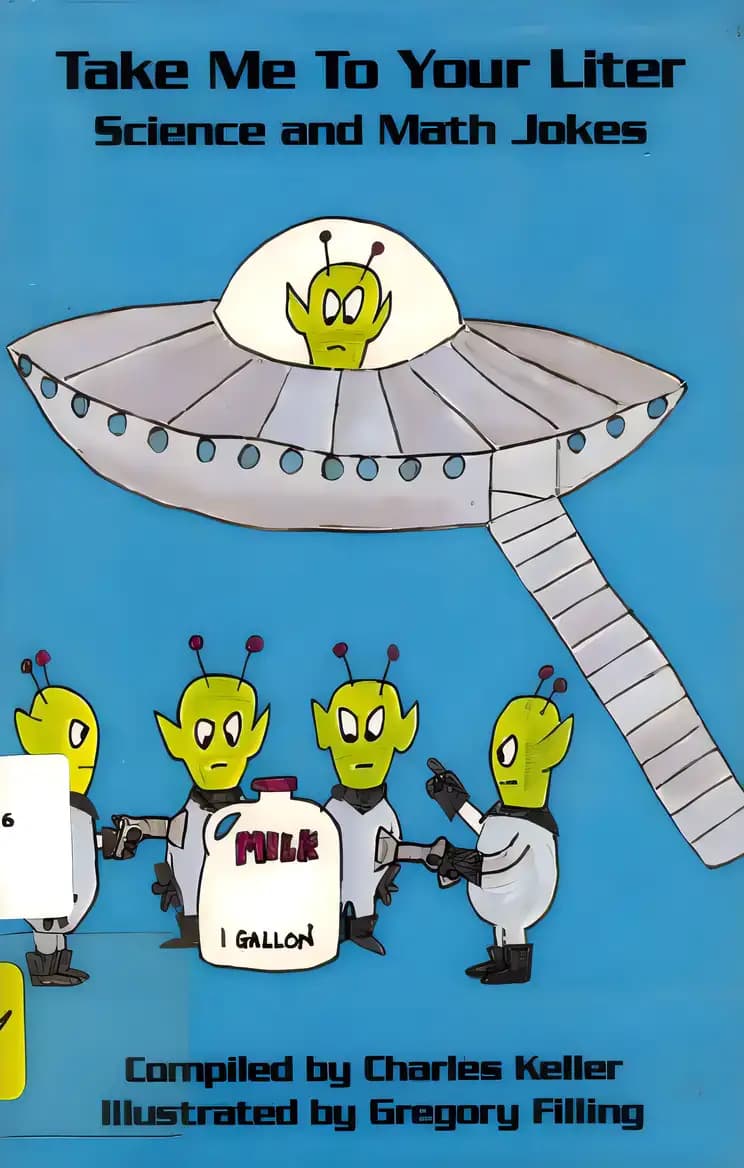
Take Me to Your Liter: Science and Math Jokes
What’s inside...
A collection of jokes and riddles about science and math, including 'What does a hungry math teacher like to eat? A square meal.' and 'What flowers are the laziest? The ones in bed.'
Age
10-13
Length
40 pages
Text complexity
Discussion points
If you could create your own science or math joke, what would it be about?
Which joke in the book was your favorite, and why did it make you laugh?
How do you think using humor helps in learning difficult subjects like science and math?
Can you think of a fun experiment or math problem that relates to one of the jokes from the book?
Tip: Role play these questions
Laugh along with the jokes, showing your child that learning can be fun and enjoyable.
Relate the jokes to real-life scenarios or school lessons to help solidify their understanding of the concepts.
Encourage your child to share their favorite jokes from the book with family and friends, which can boost their confidence and communication skills.
Create a ‘joke journal’ where you and your child can write down new science or math jokes you think of together.
Key lessons
Example Lesson: Appreciation for wordplay and humor
Explanation: This book utilizes science and math jokes to entertain and educate, gearing laughter towards learning.
Real-World Application: Children can enhance their communication skills and creative thinking, making learning fun and engaging both inside and outside the classroom.
Example Lesson: Introduction to basic science and math concepts
Explanation: Each joke in the book revolves around fundamental principles of math and science, helping to pique interest in these subjects.
Real-World Application: Children can integrate these basic concepts during their academic activities, boosting their confidence and understanding in science and math disciplines.
Example Lesson: Enhancement of reading skills
Explanation: Reading through jokes requires attention to word structure and meanings, fostering better reading comprehension.
Real-World Application: Regular reading of such material can help improve children's overall reading proficiency, which is crucial for their academic success.
Example Lesson: Development of social skills
Explanation: Sharing jokes from the book with peers can serve as a great ice breaker and enhance peer interactions.
Real-World Application: Children can use humor to connect with others, improving their social interactions and emotional understanding.