
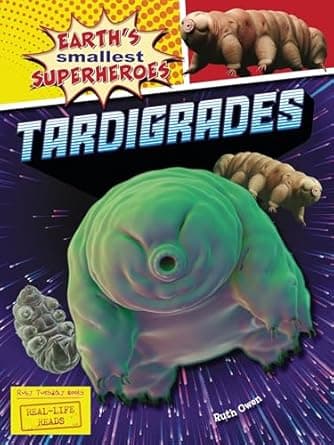
Tardigrades (Earth's Smallest Superheroes (Real-Life Reads))
Earth's Smallest Superheroes (Real-Life Reads) Series
What’s inside...
This photo-rich, non-fiction title introduces children to tardigrades—minute, eight-legged creatures famous for surviving boiling heat, freezing cold, the vacuum of space, and crushing ocean trenches. Using clear language and bite-sized chapters, Ruth Owen explains how scientists first discovered these “water bears,” what they look like under a microscope, how they feed and reproduce, and why their super-tough bodies fascinate biologists and astronauts alike. Sidebars, fast facts, and a closing activity invite young readers to observe moss, keep a science journal, and think like real researchers.
Series reading
Non-Sequential
Age
7-11
Length
32 pages
Text complexity
Character compass
The Tardigrade (Narrator)
Discussion points
Why do scientists study tiny organisms like tardigrades?
How does the tardigrade’s tun state compare to human problem-solving?
What new environments might tardigrades survive in the future?
How can we protect micro-habitats in our own backyards?
Tip: Role play these questions
Use a magnifying glass to examine moss together.
Create a family science journal to record observations.
Compare tardigrade resilience to times your child overcame challenges.
Key lessons
Example Lesson: Size does not limit capability.
Explanation: Tardigrades accomplish amazing feats despite being microscopic.
Real-World Application: Children learn self-confidence regardless of their own size or age.
Example Lesson: Adaptability is a strength.
Explanation: Tardigrades adjust to extreme heat, cold, and space.
Real-World Application: Kids practice flexibility when plans change or challenges arise.
Example Lesson: Curiosity fuels discovery.
Explanation: Scientists found tardigrades because they looked closely at moss.
Real-World Application: Children are motivated to ask questions and explore nature.
Example Lesson: Every organism has ecological value.
Explanation: Tardigrades help control algae and serve as prey in micro-ecosystems.
Real-World Application: Encourages respect for insects, worms, and other small organisms.