
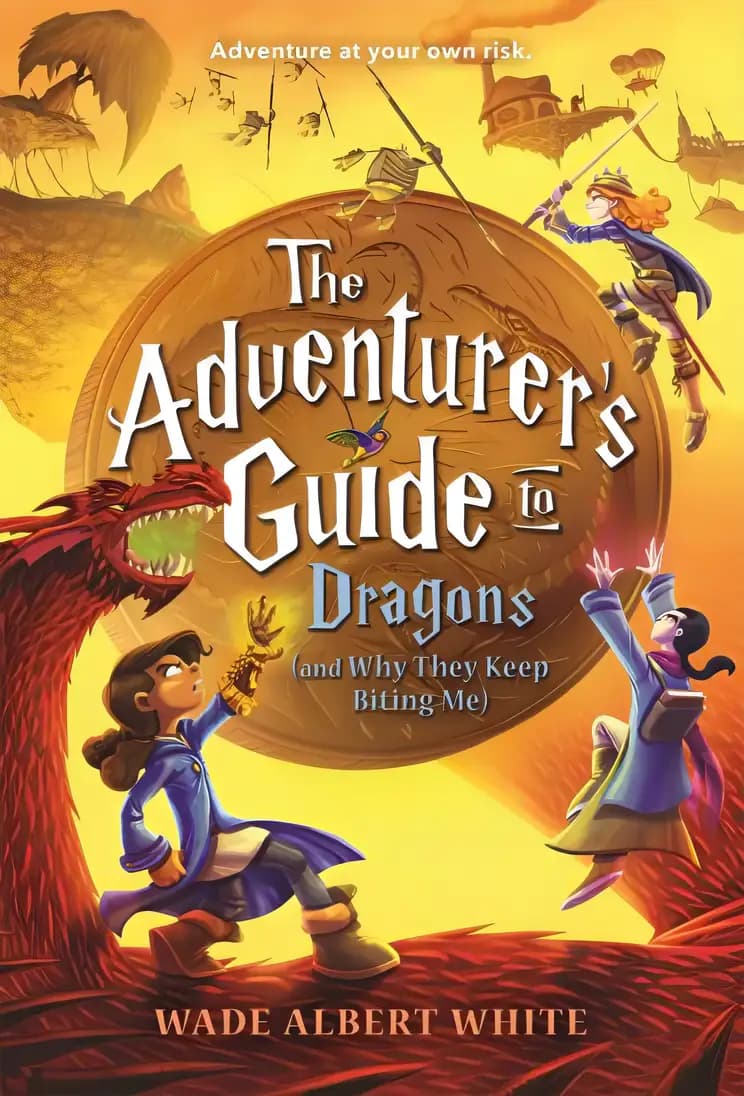
The Adventurer's Guide to Dragons (and Why They Keep Biting Me) (The Adventurer's Guide, 2)
#2 in Saint Lupin's Quest Academy for Consistently Dangerous and Absolutely Terrifying Adventures Series
on Goodreads (338)
What’s inside...
Get ready for dragons, robots, and an even more dangerous quest in the sequel to The Adventurer's Guide to Successful Escapes! Anne, Penelope, and Hiro have returned to Saint Lupin's Quest Academy for Consistently Dangerous and Absolutely Terrifying Adventures, where there's only one way to leave: pass or fail. At the annual Quest Academy awards, they're recognized for their success in their first outing—Best Illegal Quest That Nearly Destroyed the Entire World—but a strange boy steals Anne's gauntlet and activates a new quest that pits them against all of dragonkind. Their charge: kill the dragon queen. The problem is, Anne doesn't want to kill any dragons.
Character compass
Anne
Hiro
Penelope
Tilde
Discussion points
What do you think motivates the dragons in the story to behave the way they do?
If you were part of the adventure, how would you try to befriend a dragon?
Which character do you relate to the most in the book and why?
How do you think the characters change from the beginning to the end of the story?
What would you do if you encountered a challenging situation like the characters in the book?
Tip: Role play these questions
Encourage your child to imagine themselves in the world of the book, asking them how they might feel or react in similar situations.
Discuss the various character traits exhibited and ask your child which traits they admire and why.
Link the challenges faced by the characters to real-life scenarios your child might encounter, guiding them to think about problem-solving in their own life.
After reading, ask your child to draw their favorite scene or character and explain why they made that choice, fostering a deeper connection to the narrative.
Key lessons
Example Lesson: Teamwork
Explanation: Throughout the book, characters must work together to solve puzzles and overcome obstacles, demonstrating the importance of collaboration.
Real-World Application: Children can apply this lesson by engaging in group activities or projects at school and learning how to cooperate with others to achieve common goals.
Example Lesson: Courage
Explanation: The protagonists face their fears when encountering dragons and other challenges, highlighting bravery in difficult situations.
Real-World Application: This lesson can encourage children to confront their own fears and take on new challenges, whether it’s trying out for a sports team, participating in a school play, or standing up for what is right.
Example Lesson: Problem-solving
Explanation: The characters often need to think quickly and creatively to navigate through their adventures, emphasizing the value of critical thinking and ingenuity.
Real-World Application: Kids can use problem-solving skills in their daily life when dealing with academic challenges, resolving conflicts with peers, or planning personal projects.
Example Lesson: Responsibility
Explanation: Throughout their journey, the characters learn to take responsibility for their actions and understand the consequences that follow, instilling a sense of accountability.
Real-World Application: Children learn to become more responsible in their own lives by understanding the effects of their actions on themselves and others, and making more informed choices.
Example Lesson: Adaptability
Explanation: The adventurers often encounter unexpected changes and must adapt their plans accordingly, teaching flexibility in the face of uncertainty.
Real-World Application: This lesson helps children learn to be flexible with changes in their routines or unexpected situations, enhancing their ability to cope with stress and transitions.