
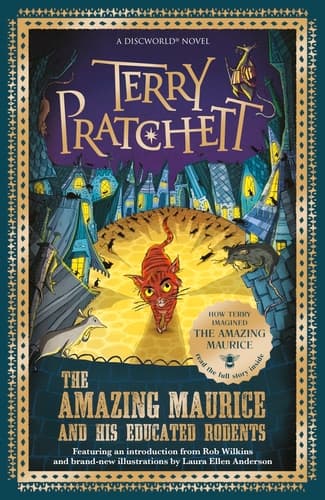
The Amazing Maurice and his Educated Rodents
#28 of 41 in Discworld Series
illustrations by
on Goodreads (50,426)
What’s inside...
Even wizards produce leftovers. But a wizard’s rubbish is laced with magic, and for the rats that forage this rubbish, the magic has changed them – they can speak and read, and have rather grand ambitions for a comfortable retirement. Which is perfect for a con-cat like Maurice. He has his own magical talents, and wants to get rich quick. Together with the rats, and young (rather simple) Keith, the ‘piper’, they work the towns to create their very own plague of rats - then lure them away for cash. But in the run-down town Bad Blintz, this little con goes wrong, and suddenly these educated rodents aren’t playing to the piper’s tune . . .
Character compass
Maurice
Peaches
Keith
Sardines
Hamnpork
Darktan
Dangerous Beans
Malicia Grim
Discussion points
Why do you think Maurice came up with the idea to teach the rats to perform tricks?
How do the rats change throughout the story, and what causes these changes?
What did you learn about teamwork and leadership from Maurice and the rats?
What do you think is the importance of honesty, as shown in the book?
How would you have handled the situations that Maurice and the rats faced?
Tip: Role play these questions
Encourage your child to compare the characters’ journeys with their own experiences, fostering a deeper personal connection to the story.
Discuss the moral dilemmas presented in the book and ask your child how they would react in similar situations, promoting ethical thinking.
Use the unique setting and the characters' adventures to ignite your child's imagination, asking them to envision alternative endings or plot twists.
Highlight passages that demonstrate strong character traits and lead a discussion on how these traits are important in real-life scenarios.
Key lessons
Example Lesson: The importance of teamwork
Explanation: In 'The Amazing Maurice and his Educated Rodents', Maurice, a streetwise cat, collaborates with a group of self-aware rats and a boy to overcome challenges. They learn that working together is more effective than working alone.
Real-World Application: Children can apply this by participating in group activities at school or in sports, learning to cooperate and achieve common goals with others.
Example Lesson: Critical thinking and problem solving
Explanation: Throughout the book, the characters encounter various obstacles that require them to think critically and devise clever solutions. This highlights the power of using intellect to navigate difficult situations.
Real-World Application: Kids can use these skills to handle conflicts with peers, solve academic challenges, and make thoughtful decisions in their daily lives.
Example Lesson: Moral integrity
Explanation: Maurice grapples with moral questions about his past actions and strives to make right choices moving forward. This transformation illustrates the value of personal ethics and integrity.
Real-World Application: This encourages children to reflect on their actions and choose honesty and integrity when faced with moral dilemmas in their own lives.
Example Lesson: The significance of self-awareness
Explanation: The educated rodents gain self-awareness and with it, an understanding of their place in the world. This self-realization is crucial for their growth and decision-making throughout the story.
Real-World Application: Children learn the importance of self-reflection and understanding their own emotions and actions, which is vital for personal development.
Example Lesson: Respect for all creatures
Explanation: The story promotes empathy and respect for creatures, regardless of their size or species, as Maurice and the rats learn to respect each other's abilities and work as a team.
Real-World Application: This teaches children to appreciate and respect diversity among people and to treat all living beings with kindness and compassion.