
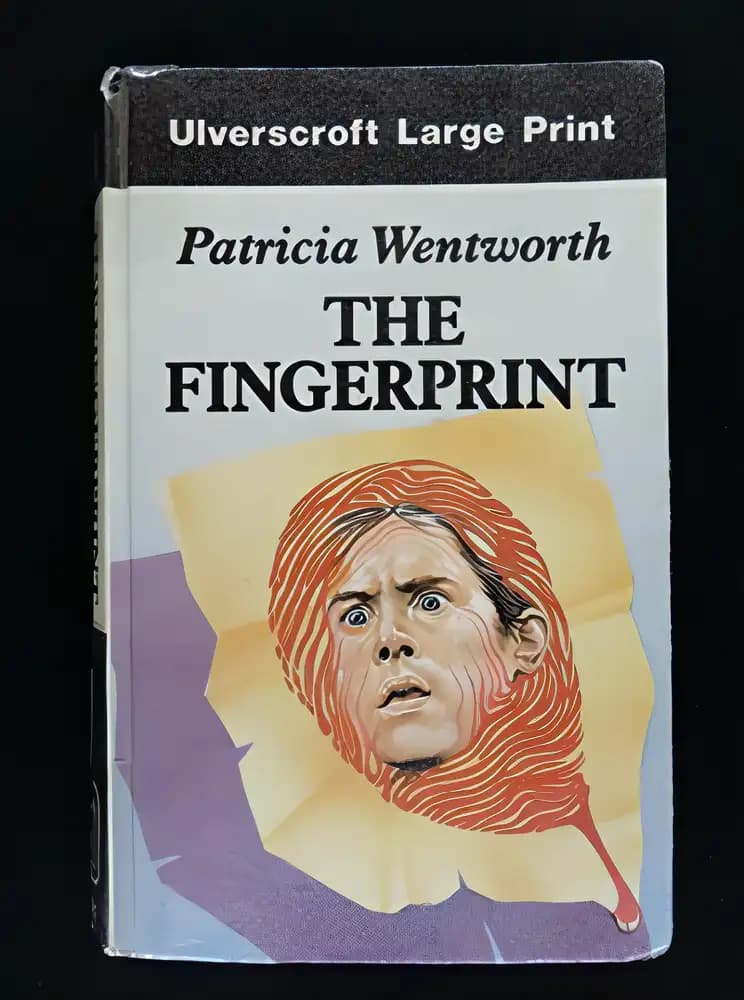
The Fingerprint (U) (Ulverscroft Large Print Series)
#30 of 32 in Miss Silver Series
on Goodreads (1,112)
What’s inside...
Patricia Wentworth was a British crime fiction writer born on November 10, 1878, and died on January 28, 1961. She wrote a total of 32 crime novels primarily featuring Miss Silver, a retired governess turned detective, first introduced in 1928. Miss Silver is often compared to Agatha Christie's Jane Marple and is known for collaborating with Scotland Yard, particularly Inspector Frank Abbott. Wentworth also authored 34 other books in addition to the Miss Silver series. In one of the stories, Georgina becomes the prime suspect of her uncle's murder when she is found with a revolver, shortly after he was found dead. Her uncle had a secret will naming Mirrie Fields as the beneficiary, which complicates the situation further. Additionally, a valuable missing fingerprint from the uncle's collection may hold the key to solving the murder, a mystery that Miss Silver is determined to unravel.
Discussion points
What do you think about how the characters solve problems in the story? Can you think of a time when you solved a problem in a similar way?
How do the characters in the book show trust to each other? Why is trust important in relationships?
What would you do if you were in the main character's situation?
How do you think the story would change if it happened in today's world?
What did you learn from the story that you can apply in your daily life?
Tip: Role play these questions
Encourage your child to relate the events in the book to their own experiences. This helps them connect personally with the story and understand the characters better. Ask open-ended questions that prompt your child to think critically about the themes and morals in the book. Try to relate discussions to real-life scenarios to enhance understanding and empathy. Use examples from the book to highlight the importance of values like trust, problem-solving, and adaptability.
Key lessons
Example Lesson: The importance of honesty
Explanation: The protagonist in 'The Fingerprint' consistently emphasizes truthfulness, which helps solve key elements of the mystery.
Real-World Application: Children learn the value of being truthful in their daily interactions and understand that honesty builds trust.
Example Lesson: Developing problem-solving skills
Explanation: The characters in the book encounter numerous challenges that require critical thinking and clever solutions, showcasing effective problem-solving.
Real-World Application: This teaches children to think critically and creatively when faced with challenges at school or in social settings.
Example Lesson: The significance of perseverance
Explanation: Characters in 'The Fingerprint' face adversities but persist until they achieve their goals, demonstrating determination.
Real-World Application: Kids learn to stay motivated and keep trying even when tasks get difficult, whether it’s completing school projects or learning new skills.
Example Lesson: Understanding consequences
Explanation: The story illustrates how actions lead to outcomes, teaching the characters and readers about responsibility.
Real-World Application: Helps children grasp the concept that their choices have impacts, encouraging them to make thoughtful decisions.
Example Lesson: Empathy and compassion
Explanation: Through the interactions between characters, the book shows the importance of understanding and caring about others' feelings.
Real-World Application: Encourages children to be considerate and supportive in their relationships with family members and peers.