
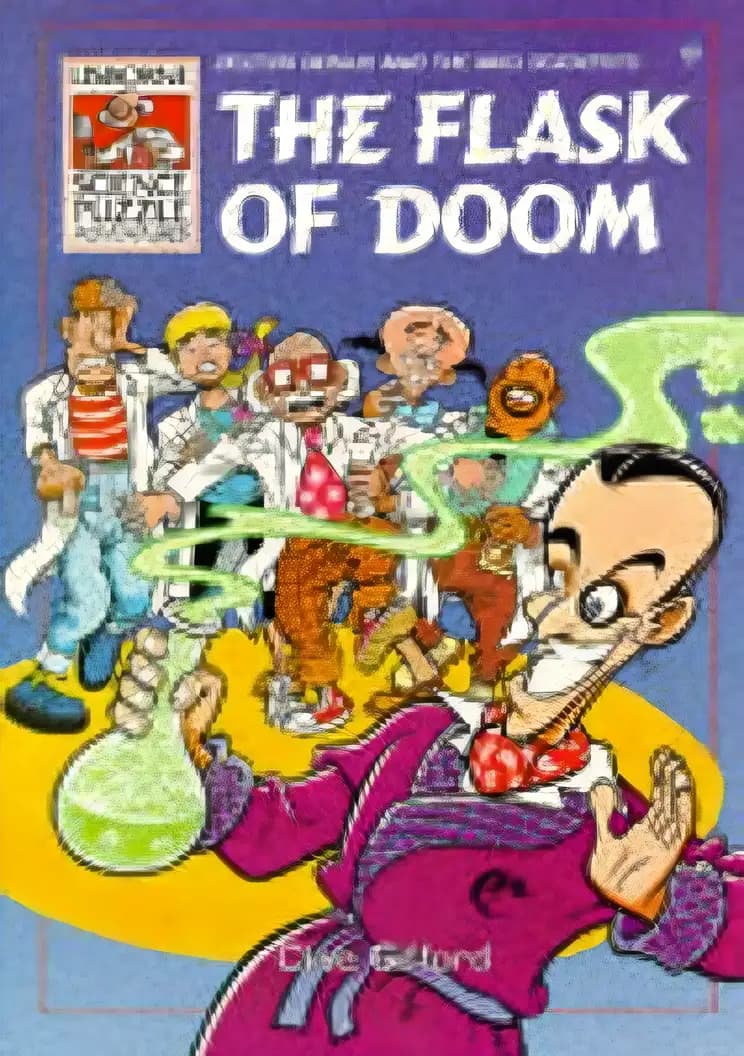
The Flask of Doom: Doctor Genius and the Mad Scientists (Science Puzzle Adventures Series)
Usborne Puzzle Adventures Series
What’s inside...
This is the first book in an exciting new series of adventure stories, peppered with scientific puzzles and problems to solve. Each tale pits the wits of Dr. Genius and his resourceful team against the world's most evil criminal superbrains. In this installment, Max Chaos has made off with a flask of antifriction liquid, and Dr. Genius and the mad scientists must piece together the clues he left behind and try to stop him.
Series reading
Non-Sequential
Age
11-12
Length
48 pages
Text complexity
Discussion points
What would you do if you had an invention like Doctor Genius? How would you use it to help others?
How did the characters show teamwork and creativity to solve the problems in the story?
Can you think of a time when you had to use science or creativity to solve a problem? What did you do?
Which of the mad scientists' inventions was the most interesting to you, and why?
If you could create a science puzzle, what would it be about and how would you challenge your friends or family with it?
Tip: Role play these questions
Start the conversation by expressing excitement about the story's adventures and the cool scientific elements.
Ask your child to describe their favorite part of the book and why it stood out to them, to encourage critical thinking.
Connect the plot to real-world science by discussing how the story's inventions might work or be used today.
Encourage your child to draw or create a simple prototype of an invention they liked from the book, boosting their creative expression.
Praise your child's responses and insights to build their confidence in analyzing and discussing literature.
Key lessons
Example Lesson: Problem-solving skills
Explanation: Throughout 'The Flask of Doom,' characters face various challenges and puzzles that they must solve to advance. Dr. Genius and his team use their knowledge and creativity to navigate through these obstacles.
Real-World Application: Children can apply problem-solving skills in their daily life by tackling challenges at school or during play, learning to think critically and creatively to find solutions.
Example Lesson: Teamwork and collaboration
Explanation: As Dr. Genius collaborates with other scientists, the story shows the importance of working together and combining strengths to overcome difficulties.
Real-World Application: This lesson encourages children to value cooperative group work, enhancing their ability to work in teams at school or in extracurricular activities.
Example Lesson: Importance of science and experimentation
Explanation: The book's focus on mad scientists and intriguing experiments highlights the excitement and relevance of scientific inquiry.
Real-World Application: Children are motivated to engage with scientific subjects in school and participate in experiments, fostering a lifelong interest and understanding of science.
Example Lesson: Critical thinking
Explanation: Characters often need to analyze situations and make quick decisions. The book emphasizes the role of logic and reasoning in solving complex problems.
Real-World Application: Kids learn to approach problems logically and make informed decisions, skills that are essential in academic settings and everyday life.
Example Lesson: Courage and facing fears
Explanation: Dr. Genius and his allies frequently confront dangerous situations bravely. The narrative rewards their courage in the face of fear, showing that bravery can lead to positive outcomes.
Real-World Application: This can inspire children to face their own fears and challenges, whether it's trying out new activities or standing up for themselves or others.