
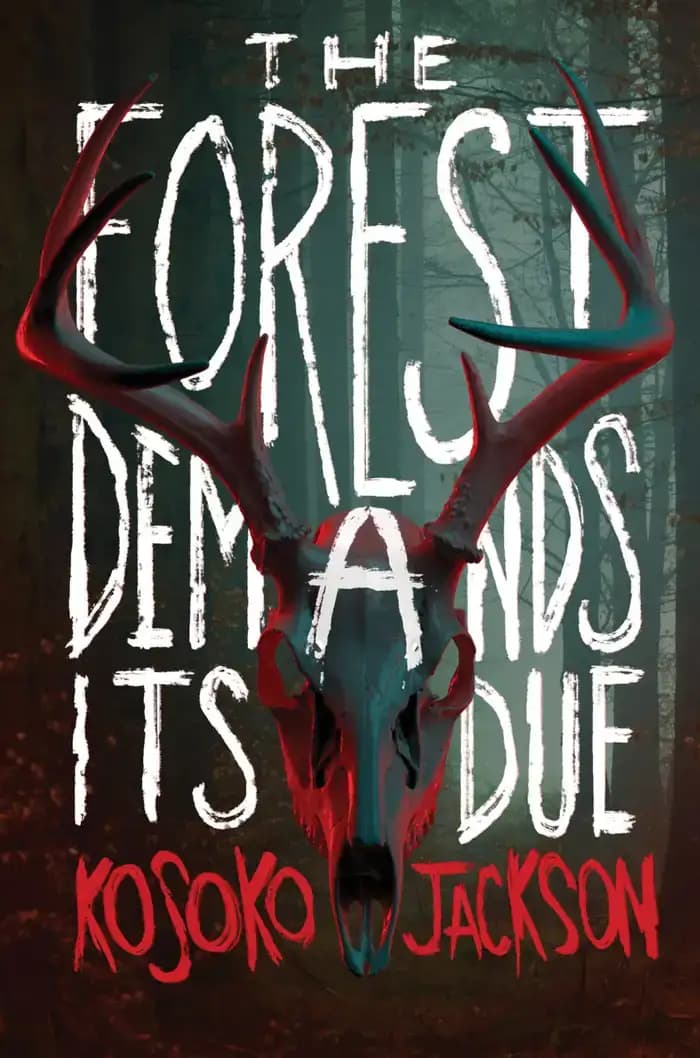
The Forest Demands Its Due
on Goodreads (1,531)
What’s inside...
A Lesson in Vengeance meets The Taking of Jake Livingston in this page-turning YA horror/fantasy set in dark academia about a queer Black teen who discovers the sinister history of his boarding school and the corrupt powers behind it all. Regent Academy has a long and storied history in Winslow, Vermont, as does the forest that surrounds it. The school is known for molding teens into leaders, but its history is far more nefarious. Seventeen-year-old Douglas Jones wants nothing to do with Regent's king-making; he’s just trying to survive. But then a student is murdered and, for some reason, by the next day no one remembers him having ever existed, except for Douglas and the groundskeeper's son, Everett Everley. In his determination to uncover the truth, Douglas awakens a horror hidden within the forest, unearthing secrets that have been buried for centuries. A vengeful creature wants blood as payment for a debt more than 300 years in the making — or it will swallow all of Winslow in darkness. And for the first time in his life, Douglas might have a chance to grasp the one thing he’s always felt was missing: power. But if he’s not careful, he will find out that power has a tendency to corrupt absolutely everything. A high-octane mystery of murder and magic for fans of Ace of Spades, House of Hollow, and Get Out!
Age
14-17
Length
432 pages
Text complexity
Discussion points
Why do you think the forest is important to the characters in the story?
How would you feel if you were asked to give something back to nature? What would you choose to give?
What do you think 'The Forest Demands Its Due' means?
Can you think of a time when you helped nature or the environment? What did you do?
How do the actions of the characters change throughout the story?
Tip: Role play these questions
Start the discussion by sharing your own thoughts on the importance of nature and why it should be respected.
Encourage your child to express their feelings and thoughts about the story by using open-ended questions.
Connect the themes of the book to real-life scenarios your child might encounter, such as recycling, conserving water or planting trees.
Praise your child’s responses to instill confidence and foster a deeper understanding of the book’s messages.
Explore the consequences of the characters’ actions in the book and discuss alternative choices they could have made.
Key lessons
Example Lesson: Responsibility for nature
Explanation: The characters in 'The Forest Demands Its Due' learn that taking care of their natural surroundings is essential. They understand that their actions directly affect the forest and its inhabitants.
Real-World Application: Children can apply this lesson by engaging in activities that promote environmental conservation, such as recycling or participating in local clean-up days.
Example Lesson: Consequences of actions
Explanation: Throughout the book, characters face the outcomes of their decisions, teaching readers that every choice has a consequence.
Real-World Application: This lesson helps children think twice before acting and encourages them to consider the potential results of their actions in everyday situations.
Example Lesson: Courage in facing fears
Explanation: The protagonist shows bravery when dealing with the unknown elements of the forest, illustrating that courage is crucial when facing fears.
Real-World Application: Children can be inspired to face their own fears, whether it's trying out for a school play, standing up to a bully, or sleeping alone in the dark.
Example Lesson: Importance of teamwork
Explanation: The characters learn to work together to solve the mysteries of the forest, demonstrating that collaboration can lead to success.
Real-World Application: This encourages children to cooperate with others, whether in group projects at school or during team sports, to achieve common goals.
Example Lesson: Respect for diversity
Explanation: As characters encounter various creatures and plants in the forest, they learn to respect and appreciate the diversity in nature.
Real-World Application: Children can learn to appreciate and respect differences in people around them, promoting inclusivity and understanding in diverse social settings.