
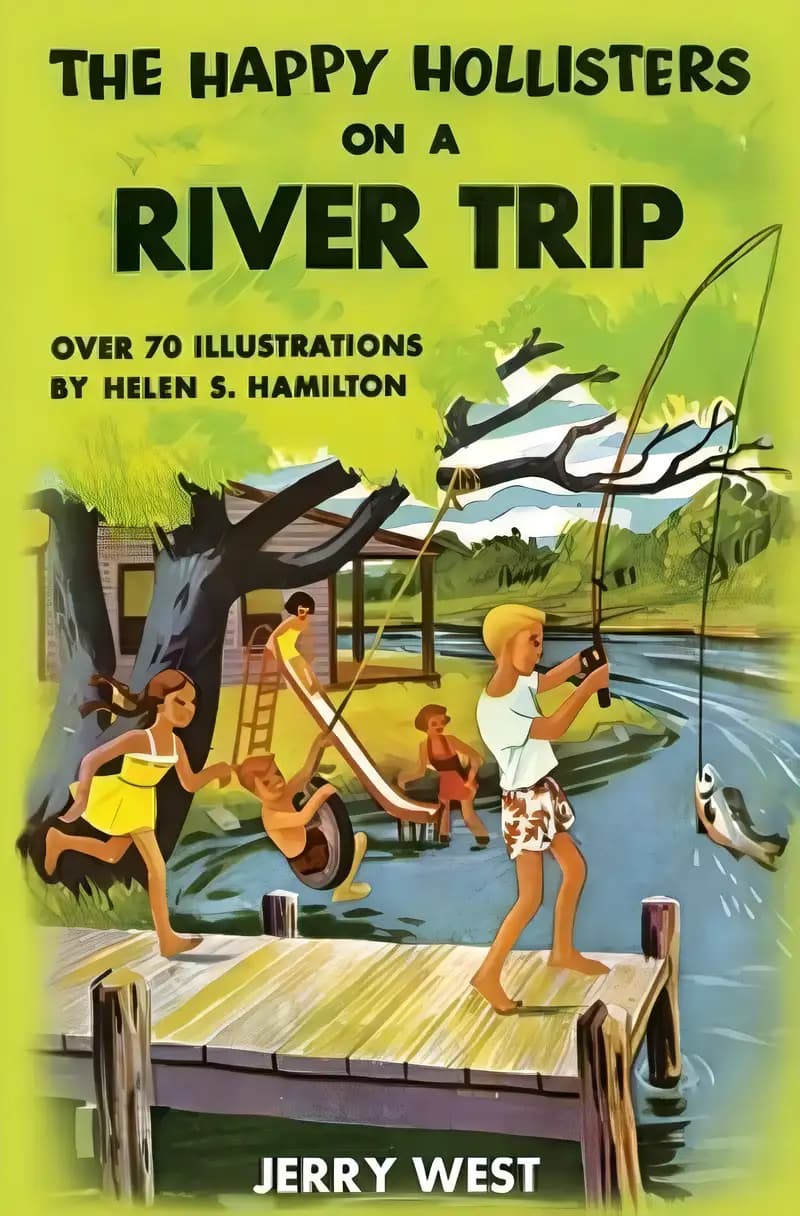
The Happy Hollisters on a River Trip: (Volume 2)
#2 of 33 in The Happy Hollisters Series
What’s inside...
A big fish contest at The Trading Post, the Hollisters' sporting goods store, has everybody in Shoreham excited. After Pete catches a large fish with a tag on its tail, another adventure begins for the eager young detectives. When the children's friend, Bobby Reed, disappears in a leaky old boat, the whole family helps in the search. Uncle Russ lends them his boat, and they set off on a trip down the Muskong River. After helping some hikers on shore, Pete, Pam and Mr. Hollister get lost in the fog on their way back to the boat. A series of surprise discoveries lead the Hollisters on a hunt for Bobby on shore, and other adventures provide good times along the way. But there are false clues and disappointments before the Hollisters find Bobby, solve the mystery of the tagged fish, and bring happiness to an old man, Bobby and his mother. Paperback; 186 pages with over 70 illustrations.
Character compass
Pete Hollister
Pam Hollister
Ricky Hollister
Holly Hollister
Sue Hollister
Mrs. Hollis
Mr. Hollister
Discussion points
What do you think makes the Hollisters a happy family? How do they support each other during their adventures?
How would you solve a mystery like the Hollisters do on their river trip? What clues would you look for?
What was your favorite part of the book and why?
If you could be friends with any of the Hollister children, who would it be and what would you do together?
How do you think the setting of the river impacted the story? Would it be different if it was in another place?
Tip: Role play these questions
Before reading each chapter, ask your child to predict what might happen next and why they think that.
After finishing the book, encourage your child to draw a picture of their favorite scene, explaining why they chose it.
Create a family 'mystery night' inspired by the book, where each family member comes up with a small mystery for others to solve.
Discuss the importance of teamwork as shown in the book, and relate it to everyday situations at home or school.
Use a map to trace the river trip taken by the Hollisters, linking scenes from the book to real geographical places.
Key lessons
Example Lesson: Teamwork and Cooperation
Explanation: Throughout the river trip, the Hollister children work together to navigate challenges and solve mysteries. Their success often hinges on their ability to collaborate effectively.
Real-World Application: Children learn the importance of working with others to achieve common goals, which is a vital skill in school projects and later in professional environments.
Example Lesson: Curiosity and Exploration
Explanation: The story encourages a sense of adventure as the Hollisters explore new environments. Their curiosity leads to discovery and learning.
Real-World Application: Fostering curiosity helps children become lifelong learners and encourages them to engage with the world around them in educational settings and beyond.
Example Lesson: Problem-Solving
Explanation: Faced with mysteries and unexpected obstacles, the Hollisters use critical thinking and reasoning to find solutions.
Real-World Application: This lesson teaches children the importance of thinking critically and creatively when faced with challenges, enhancing their ability to navigate school tasks and daily problems.
Example Lesson: Respect for Nature
Explanation: During their river trip, the Hollisters show great respect for the environment, emphasizing the importance of preserving natural spaces.
Real-World Application: Children learn the value of environmental stewardship and the impact of their actions on the world, promoting eco-friendly behaviors.
Example Lesson: Courage and Bravery
Explanation: The children often face fears and take brave actions throughout their adventures. They learn to overcome their anxieties and grow stronger.
Real-World Application: Instills the value of facing fears and shows children that bravery can lead to positive outcomes, encouraging resilience in personal and academic challenges.