
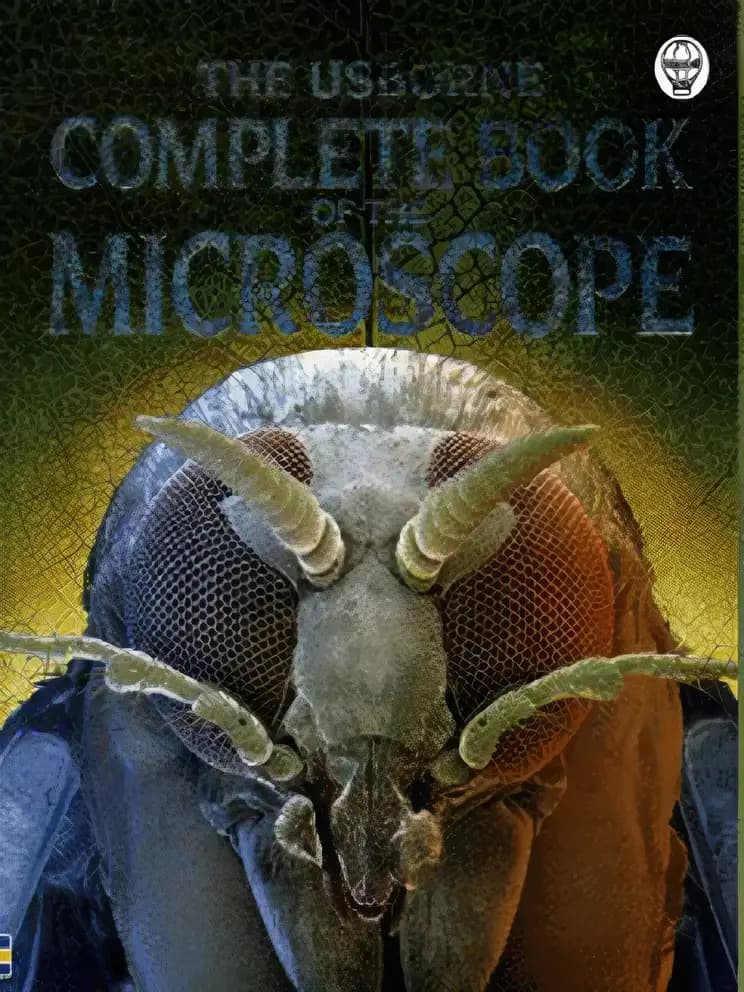
The Internet-Linked Complete Book of the Microscope
Usborne Complete Books Series
on Goodreads (160)
What’s inside...
This is an excellent introduction for budding scientists determined to see what things really look like under a microscope. It gives practical advice on how to use a microscope properly. Winner of the Rhone-Poulenc Junior Science Book Prize, this book is a breathtaking introduction to an extraordinary new dimension. Fantastic photographs, thousands or even millions of times larger than life, reveal the secrets of the micro universe, while step-by-step project ideas and Internet links to recommended websites will help you set off on a micro world tour of your own.
Series reading
Non-Sequential
Age
9-12
Length
96 pages
Text complexity
Discussion points
What did you find most fascinating about how microscopes work?
Can you explain how the size of an object changes the way we see it through a microscope?
How do you think scientists use microscopes to help us understand more about the world?
What would you like to explore using a microscope and why?
How do you think the invention of the microscope has changed the way we look at the world around us?
Tip: Role play these questions
Encourage your child to express their thoughts and make connections by asking them to relate the content of the book to their daily life.
Start a fun project where you and your child can use a simple microscope to explore objects around your home, fostering a practical understanding of the book's content.
After reading, ask your child to draw or write about what they would explore if they had a professional microscope, which helps in reinforcing the information learned.
Highlight the importance of scientific tools like microscopes in discovering new things, thus boosting their interest in science and exploration.
Key lessons
Example Lesson: Curiosity and Discovery
Explanation: This book explores the intricate details of the microscopic world, encouraging children to delve deeper into the subjects they're learning.
Real-World Application: Children are inspired to ask questions and seek answers about their surroundings, promoting a lifelong love of learning.
Example Lesson: Scientific Observation Skills
Explanation: By teaching kids how to use a microscope, the book enhances their ability to observe and analyze tiny details carefully.
Real-World Application: These observation skills can help children in academic settings or even in everyday problem-solving by paying attention to details.
Example Lesson: Appreciating Nature’s Complexity
Explanation: The book displays the complexity of the natural world at a microscopic level, showing that there's more to the world than meets the eye.
Real-World Application: Children learn to appreciate and respect the environment, understanding the importance of its smallest components.
Example Lesson: Understanding Technology
Explanation: The book links the microscopic world with modern technology, explaining how microscopes work.
Real-World Application: This lesson helps children become comfortable with using technological tools, which is essential in a technology-driven world.
Example Lesson: Patience and Focus
Explanation: Mastering the use of a microscope requires patience and focus, as detailed in the book.
Real-World Application: These skills benefit children in their educational journey and personal life by teaching them the value of concentrating on tasks.