
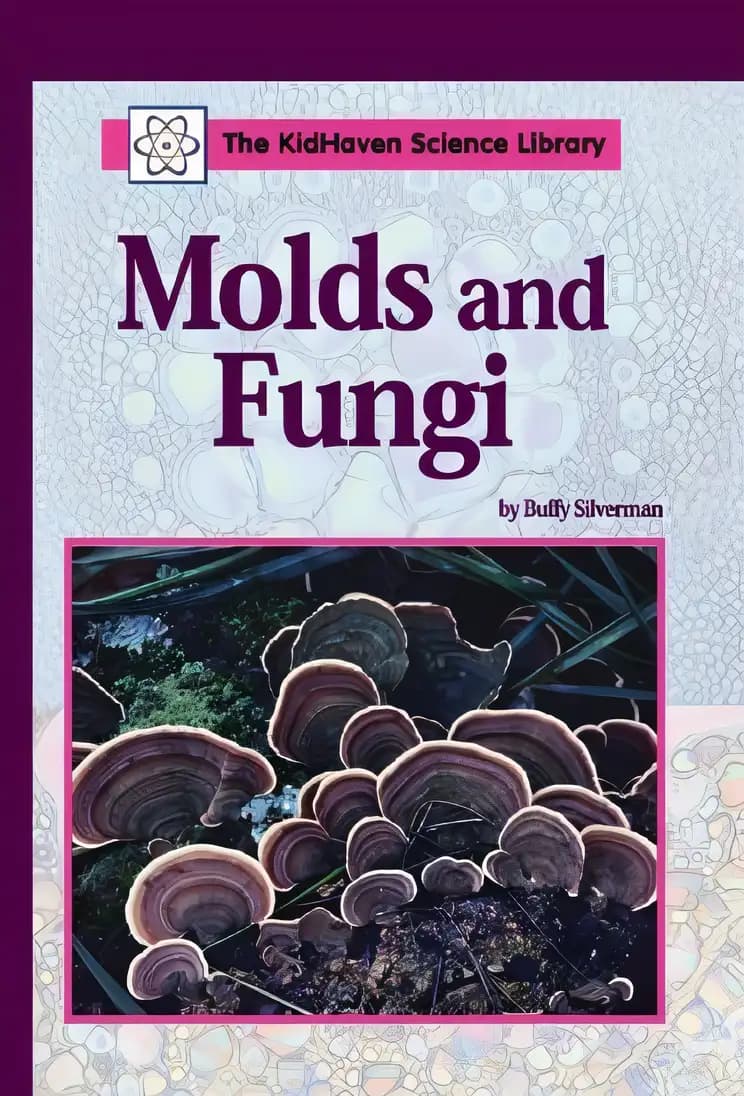
The KidHaven Science Library - Molds and Fungi
#5 in Kidhaven science library Series
on Goodreads (3)
What’s inside...
The KidHaven Science Library - Molds and Fungi by Buffy Silverman is an informative resource aimed at young readers to introduce them to the world of molds and fungi. The book explores the various types of molds and fungi, their roles in the ecosystem, and their importance to both the environment and human life. It delves into the biology of these organisms, explaining how they grow, reproduce, and interact with their surroundings. The book also addresses the beneficial aspects of molds and fungi, such as their use in medicine and food production, as well as the potential hazards they can pose when they grow in unwanted places. Through vivid illustrations and accessible language, Silverman helps children understand the complex science behind these fascinating organisms. The book also fulfills the standards: 'Science as Inquiry,' 'Physical Science,' 'Life Science,' and 'History and Nature of Science' from the National Science Education Standards for Middle and Elementary School.
Discussion points
What are some ways molds and fungi can be helpful or harmful in our environment?
Can you think of any foods that include fungi as an ingredient? Why do you think they are used?
How do molds and fungi grow and what conditions do they need to thrive?
Why is it important for scientists to study molds and fungi?
How can we prevent harmful molds from growing in our homes?
Tip: Role play these questions
Start the conversation by sharing something interesting you learned from the book to pique your child’s curiosity.
Ask your child to draw or describe a type of mold or fungi they remember from the book and discuss its characteristics.
Encourage them to think critically by asking what might happen if certain molds or fungi did not exist.
Relate the topic to everyday life by discussing where molds might be found in your home and the importance of keeping spaces clean.
After reading, consider doing a simple home experiment to grow mold on bread under different conditions, as described in the book, to make the learning experience interactive and tangible.
Key lessons
Example Lesson: Understanding Nature's Role
Explanation: The book educates young readers about the ecological importance of molds and fungi, highlighting how they break down organic material.
Real-World Application: Children learn to appreciate and respect the natural processes happening around them, fostering a sense of environmental responsibility.
Example Lesson: Observation Skills
Explanation: Through detailed descriptions and images of various fungi, children are encouraged to observe differences and identify molds and fungi in their surroundings.
Real-World Application: Enhances children’s attention to detail and observational skills, which can be useful in scientific studies and everyday life observation.
Example Lesson: Scientific Inquiry
Explanation: By discussing how molds grow and reproduce, the book promotes curiosity and basic scientific methods.
Real-World Application: Encourages children to ask questions, conduct simple experiments, and explore science as a way of understanding the world.
Example Lesson: Health Awareness
Explanation: The book covers how some molds can be harmful and cause allergies, teaching about health precautions.
Real-World Application: Arms children with knowledge to make healthier choices, such as understanding spoilage and the importance of food safety.
Example Lesson: Importance of Fungi in Products
Explanation: It explores how certain fungi are used in medicine and food industries, such as penicillin and cheese production.
Real-World Application: Knowledge of biotechnology applications acquaints children with how biology integrates into everyday products and encourages interest in biotechnological careers.