
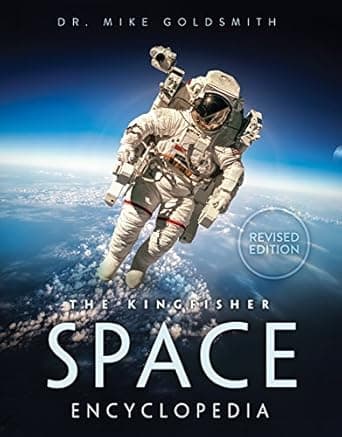
The Kingfisher Space Encyclopedia (Kingfisher Encyclopedias)
#1 in Kingfisher Encyclopedias Series
What’s inside...
Mike Goldsmith’s The Kingfisher Space Encyclopedia offers an up-to-date, visually rich journey through the Universe—from the birth of the cosmos and the formation of galaxies to human space exploration and future missions. Packed with full-color photographs, fact boxes, timelines, and clearly written explanations, it guides 8- to 14-year-olds through complex astronomical concepts while nurturing natural curiosity and a sense of wonder. The book balances scientific accuracy with engaging language, making it an ideal springboard for school projects, independent discovery, or shared family reading.
Discussion points
Why do humans explore space even when it is risky?
Which future mission excites you most and why?
How can space technology help solve problems on Earth?
What challenges might astronauts face on Mars colonies?
How does understanding the universe change our view of ourselves?
Tip: Role play these questions
Plan a backyard stargazing night after reading a star chapter.
Compare family heights to rocket sizes for scale.
Create a homemade model of the Solar System using craft materials.
Key lessons
Example Lesson: Curiosity drives discovery
Explanation: Each chapter shows questions scientists asked before making breakthroughs.
Real-World Application: Students learn to ask questions during class experiments or nature walks.
Example Lesson: Teamwork is essential
Explanation: Space missions combine efforts from many nations and disciplines.
Real-World Application: Children see value in collaborating on group projects.
Example Lesson: Perseverance overcomes obstacles
Explanation: Early missions failed before eventual success, illustrated through timelines.
Real-World Application: Kids can apply persistence when homework feels difficult.
Example Lesson: Protecting Earth matters
Explanation: Sections on climate satellites show how space tech monitors our planet.
Real-World Application: Motivates eco-friendly habits like recycling and conserving energy.
Example Lesson: Critical thinking beats assumptions
Explanation: Explains how new evidence disproved older cosmic models.
Real-World Application: Encourages children to verify facts before sharing information.