
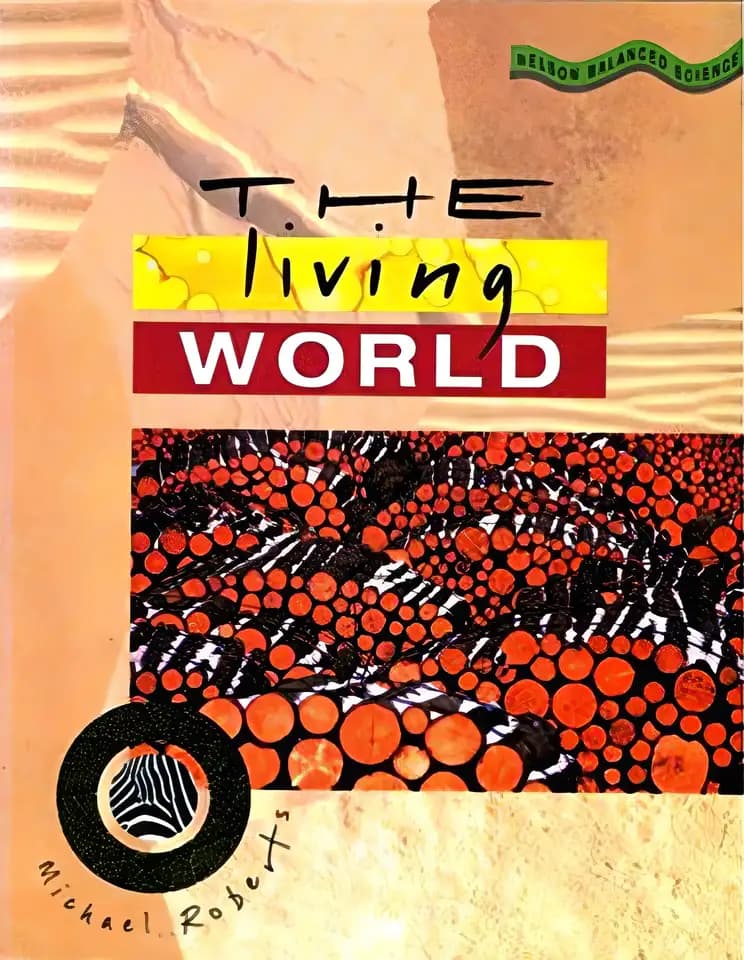
The Living World
on Goodreads (1)
What’s inside...
This is a reference book by M.B.V. Roberts that provides ready answers to questions about the natural world. It covers a wide range of species including animals and plants found on land, sea, and air. The book details how these species feed, breed, and adapt to their environments. It also includes an extensive section on human biology, drawing parallels between human biology and that of other animals. Additionally, the book explores topics such as evolution and prehistoric animals. The design of the book allows for easy access to information through a well-organized index, and it is visually engaging with a mix of artwork, diagrams, and photographs.
Age
18-21
Length
264 pages
Text complexity
Discussion points
What did you find most interesting about the different animals mentioned in 'The Living World'?
If you could be any animal from the book, which one would you be and why?
How do you think the animals in the book depend on each other for survival?
Can you think of ways we can help protect the habitats of these animals?
Tip: Role play these questions
Encourage your child to connect the facts from the book with the real world by discussing any animals you might see in your environment.
Use the illustrations in 'The Living World' as a starting point to ask your child to describe what they see and think.
While discussing, relate the survival of the animals to teamwork and community, and ask the child to draw parallels with their own experiences.
After reading, involve your child in a creative activity like drawing their favorite scene or animal from the book to reinforce their learning.
Key lessons
Example Lesson: Respect for Nature
Explanation: Through vivid illustrations and engaging narratives, 'The Living World' educates children about different ecosystems and the diversity of life that inhabits them.
Real-World Application: Children learn the importance of conservation and begin to cultivate a sense of responsibility towards the environment in their day-to-day actions, like recycling or saving water.
Example Lesson: Interdependence of Species
Explanation: The book highlights how different species rely on each other for survival, showcasing the balance within ecosystems.
Real-World Application: Kids understand the concept of community and teamwork and can apply this by cooperating and helping others in group activities at school or in sports.
Example Lesson: Adaptation and Evolution
Explanation: Illustrating different habitats and how animals have adapted to thrive in them, the book provides a clear and simple introduction to the concept of evolution.
Real-World Application: This lesson encourages children to be resilient and adaptable, understanding that change is a part of life and learning how to adjust in various situations.
Example Lesson: Scientific Curiosity
Explanation: The book poses questions and provides intriguing facts that pique a child's curiosity about the natural world.
Real-World Application: This can lead to further exploration, questioning, and learning in all subjects, fostering a lifelong love for discovery and knowledge.