
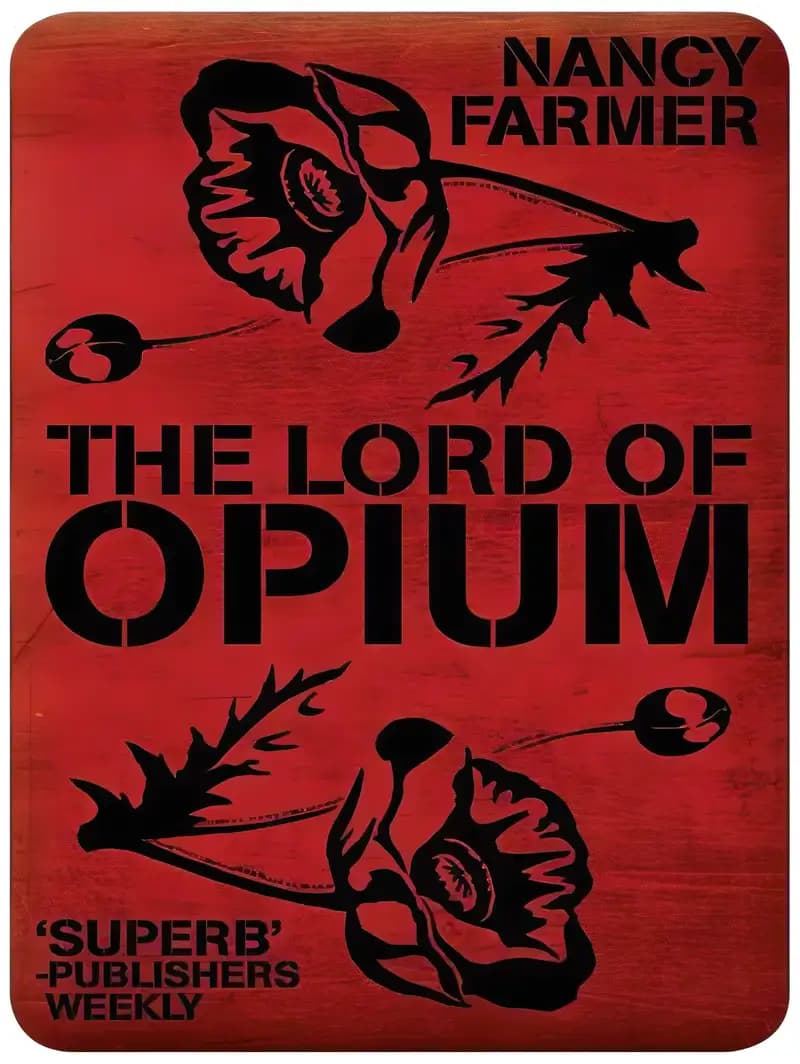
The Lord of Opium (The House of the Scorpion)
#2 of 2 in Matteo Alacran Series
on Goodreads (8,620)
What’s inside...
The Lord of Opium, the sequel to Nancy Farmer's 'The House of the Scorpion,' continues the story of Matteo Alacrán, a young clone of the drug lord El Patrón. After El Patrón's death, Matt inherits control of Opium, a country situated between the United States and what was once Mexico, which is the hub of the drug trade and home to fields of opium poppies. As the new Lord of Opium, Matt must navigate the complexities of his newfound power and the expectations placed upon him. He is determined to use his authority to improve the lives of the people, especially the eejits—humans with computer chips in their brains, rendering them mindless slaves—who work the poppy fields. Matt's journey is fraught with challenges, including political intrigue, the threat of war, and the moral dilemmas of leadership. He also seeks to find a way to free the eejits and to cultivate a relationship with Maria, a girl he cares for. Throughout the novel, Matt grapples with his identity, the legacy of El Patrón, and his desire to create a better world without succumbing to the corruption and violence that characterized his predecessor's rule.
Character compass
Matteo Alacran
Maria Mendoza
Listen
Fidelito
Cienfuegos
Sor Artemesia
Glass Eye Dabengwa
Dr. JesúS Rivas
Discussion points
How do the choices Matt makes throughout the story influence the world around him?
What are the consequences of the drug trade depicted in the story, and how does it affect different characters?
How does Matt's identity as a clone impact his relationships and view of himself?
In what ways do power and responsibility play a role in the story, and how can they be used for positive change?
What does the concept of freedom mean to different characters in the book, and how do they strive to achieve it?
Tip: Role play these questions
Encourage empathy by asking your child how they would feel in Matt’s situation, helping them connect emotionally with his challenges and triumphs.
Discuss the moral dilemmas presented in the book and ask your child what they would do differently, fostering critical thinking.
Highlight the importance of understanding consequences by discussing how each character’s decisions lead to various outcomes in the story.
Explore the theme of identity by discussing what makes each of us unique and how our actions define us, just as Matt discovers his own identity throughout the book.
Tie discussions back to real-world issues like drug abuse, power misuse, and the concept of personal freedom to deepen the contextual understanding of the book's themes.
Key lessons
Example Lesson: Responsibility and Leadership
Explanation: In 'The Lord of Opium,' the protagonist, Matt, inherits a massive empire and must learn to navigate the complexities of leadership at a young age. His struggles and growth in decision-making underscore the importance of responsible leadership.
Real-World Application: Children can learn the importance of taking responsibility for their actions and understanding the impact their decisions have on others, which is crucial in leadership roles at school and in group activities.
Example Lesson: Ethical Decision Making
Explanation: Throughout the book, Matt is faced with numerous moral dilemmas that test his values and ethics. This highlights the need for making choices that are not just beneficial for oneself but also morally sound.
Real-World Application: This lesson helps children to think critically about right and wrong and consider the ethical implications of their choices, be it in their interactions with friends or in following rules at school.
Example Lesson: Environmental Stewardship
Explanation: The story's setting in a futuristic society that exploits genetically engineered plants brings attention to the consequences of environmental negligence and the importance of sustainable practices.
Real-World Application: Children can be encouraged to adopt environmentally friendly practices like recycling and conserving water, gaining an understanding of how their actions impact the planet.
Example Lesson: Compassion and Empathy
Explanation: Matt's relationships with characters like Tam Lin and the eejits, who are dehumanized in the society, illustrate the importance of compassion and seeing beyond societal labels to the humanity in everyone.
Real-World Application: This can help children in developing empathy towards classmates who may seem different and foster an inclusive atmosphere in their own social circles.