
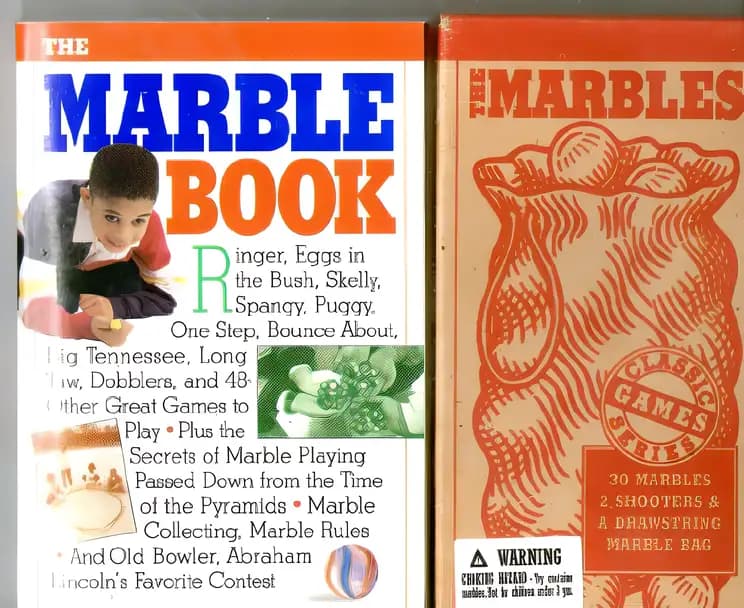
The Marble Book ( Includes Marbles Classic Games)
on Goodreads (8)
What’s inside...
The Marble Book is a comprehensive guide to the game of marbles, complete with 30 marbles and 2 shooters, a drawstring pouch, and extensive information on marble lingo, over 50 games, and collecting. It provides instructions on shooting techniques, game setup, and the best playing surfaces. The book includes popular games like Ringer, Poison, Dobblers, and Old Bowler, preferred by Abraham Lincoln. With 50,000 copies in print and part of the Classic Game series with over 317,000 copies in print, this book is an essential resource for children to learn and enjoy the timeless game of marbles.
Age
5-12
Length
192 pages
Text complexity
Discussion points
What is your favorite marble game mentioned in the book, and why do you like it?
How do you think playing marble games can help you in school or with friends?
Can you invent your own marble game? What rules would it have?
How do the illustrations in the book make you feel about the games?
What have you learned about teamwork or fairness from the marble games?
Tip: Role play these questions
While discussing the book, show genuine interest in the marble games your child finds intriguing. This encourages open communication.
Ask your child to teach you their favorite marble game from the book. Playing together can enhance bonding and better understanding of the game’s appeal.
Encourage your child to use their imagination to create their own game, which helps in boosting creativity and problem-solving skills.
Discuss the importance of following rules and fair play in games, connecting these values to everyday life scenarios.
Use the illustrations in the book as a visual aid to deepen understanding of the text and stimulate a richer conversation about the themes.
Key lessons
Example Lesson: Strategic thinking and planning
Explanation: The Marble Book introduces children to various classic marble games that require planning ahead and thinking several moves in advance to win.
Real-World Application: These skills can be transferred to problem-solving tasks at school, helping children evaluate different solutions and plan their actions accordingly.
Example Lesson: Hand-eye coordination
Explanation: Playing marble games demands precise finger movements and visual alignment, enhancing children's fine motor skills and coordination.
Real-World Application: Improved hand-eye coordination can benefit children in other areas such as writing, sports, and using tools or instruments efficiently.
Example Lesson: Patience and turn-taking
Explanation: The book encourages children to wait for their turn while playing games with others, promoting patience and respect for others’ turns.
Real-World Application: These virtues are important in everyday interactions at school or home, developing a respectful and cooperative attitude.
Example Lesson: Winning and losing gracefully
Explanation: Through engaging in competitive games, children learn how to manage both victory and defeat with grace.
Real-World Application: This helps in building resilience and good sportsmanship, which are crucial when facing various life challenges.
Example Lesson: Historical and cultural awareness
Explanation: The book explores the history of marbles and their significance in different cultures, providing a cultural education.
Real-World Application: Children can connect with history and develop an understanding and respect for different cultural practices and the origins of common games.