
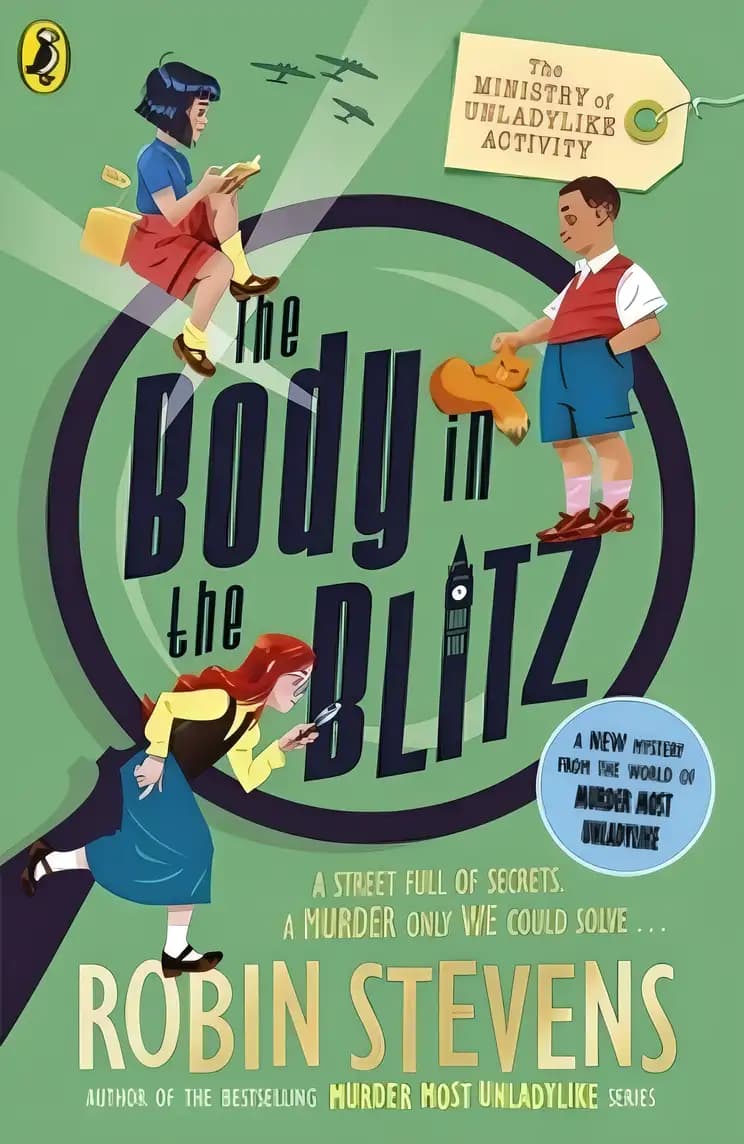
The Ministry of Unladylike Activity 2: The Body in the Blitz
#2 of 2 in The Ministry Of Unladylike Activity Series
on Goodreads (679)
What’s inside...
In March 1941, during wartime Britain, the Ministry of Unladylike Activity trains children as spies, recognizing that adults often underestimate them. Three new recruits, May, Eric, and Nuala, guided by May's sister Hazel, stay on a quiet street close to the Ministry. As they navigate the complexities of war, they discover a mysterious body in the basement of a bombed house. The body could either be a missing Ministry spy that Daisy Wells is searching for in France or possibly a local resident's adversary who has been silenced.
Discussion points
How do you think the characters felt during their adventures and how would you feel in a similar situation?
What are some ways the characters showed bravery and resourcefulness throughout the story?
How does the historical setting of the Blitz impact the story and the characters' actions?
What did you learn about friendship and teamwork from the characters' experiences?
If you could give the main character a piece of advice, what would it be?
Tip: Role play these questions
Start the conversation by sharing your own thoughts about the book, setting a comfortable tone for open discussion.
Encourage your child to think critically about the characters and plot by asking them to predict what might happen next or suggest alternative endings.
Connect the book’s themes to real-life experiences by discussing similar decision-making scenarios that your child might face.
Use historical context provided in the book as a springboard to explore more about the time period with your child, enhancing their understanding and interest.
Praise your child’s responses and insights, fostering a positive and encouraging environment for discussing literature.
Key lessons
Example Lesson: Courage in the face of adversity
Explanation: The characters in 'The Ministry of Unladylike Activity 2: The Body in the Blitz' demonstrate bravery as they solve mysteries during the challenging times of the Blitz. Their relentless pursuit of truth and justice, despite the danger, serves as a powerful example.
Real-World Application: Children can learn to face their fears and stand up for what is right, even in difficult situations. They can apply this lesson by tackling challenges in school or in their personal lives with determination and bravery.
Example Lesson: Teamwork and cooperation
Explanation: Throughout the book, the characters must work together, pooling their unique skills and knowledge, to solve the central mystery. This collaboration is crucial to their success.
Real-World Application: This teaches children the importance of working with others to achieve common goals. In real life, they can practice teamwork in group projects or sports, learning to value each person's contribution.
Example Lesson: Historical awareness
Explanation: Set in the historical context of World War II, the book provides insight into the era's challenges and lifestyles, helping children understand and appreciate history.
Real-World Application: Children can use this knowledge to gain a deeper understanding of history lessons in school and develop a greater appreciation for the events that have shaped the modern world.
Example Lesson: Critical thinking and problem-solving
Explanation: The protagonist's journey is filled with puzzles and mysteries that require careful thought and deduction. This narrative encourages readers to think critically and assess information carefully.
Real-World Application: Children can apply these skills in academic settings when solving math problems or conducting science experiments, as well as in their daily decision-making processes.
Example Lesson: Empathy and understanding
Explanation: As the characters interact with a diverse cast, facing wartime hardships, readers see examples of empathy. This helps children understand the feelings and perspectives of others.
Real-World Application: This lesson can be applied in a child’s interactions with peers and adults, fostering a more inclusive and understanding environment at school and at home.