
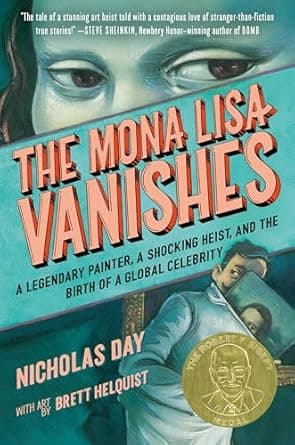
The Mona Lisa Vanishes: A Legendary Painter, a Shocking Heist, and the Birth of a Global Celebrity
What’s inside...
Told in alternating timelines, this fast-paced narrative nonfiction follows two true stories: Leonardo da Vinci’s creation of the Mona Lisa in Renaissance Italy and the astonishing 1911 theft of the masterpiece from the Louvre by housepainter Vincenzo Peruggia. While readers discover how a small portrait of an unknown Florentine woman was painted, forgotten, and finally stolen, they also witness how the manhunt turned the painting into the world’s most famous work of art. Combining snappy humor, primary-source quotes, maps, and Brett Helquist’s lively illustrations, Nicholas Day turns a real art-crime caper into an engaging exploration of history, creativity, and celebrity culture.
Age
10-14
Length
288 pages
Text complexity
Character compass
Vincenzo Peruggia
Lisa Gherardini (Mona Lisa)
Leonardo Da Vinci
Louis Lépine
Discussion points
Why did Peruggia think stealing the painting was patriotic?
How did newspapers create Mona Lisa’s celebrity status?
What qualities made Leonardo a groundbreaking artist?
Tip: Role play these questions
Visit a local museum and compare security then and now.
Have children sketch their own ‘masterpiece’ and craft a protective plan.
Key lessons
Example Lesson: Actions have long-lasting consequences.
Explanation: Peruggia’s theft reshaped art history and his own life.
Real-World Application: Think about ripple effects before making big choices.
Example Lesson: Curiosity fuels discovery.
Explanation: Leonardo’s experiments led to innovative painting techniques.
Real-World Application: Ask questions and test ideas in school projects.
Example Lesson: Media shapes public opinion.
Explanation: Newspapers turned an obscure portrait into a celebrity.
Real-World Application: Evaluate headlines critically and seek multiple sources.